Thanks to everyone who spent their Saturday with us. We loved getting to meet so many of you, and having the opportunity to show all of you this beautiful space we love!
Last week was BUSY here on the farm! We spent the beginning of the week getting the rest of the first two plantings of carrots out of the field and washed. We now have about 7,200 pounds of carrots in our root cellar waiting to be put in your weekly share boxes, and eventually hitting grocery store shelves and restaurant plates.
Now that the first two plantings of carrots are out of the field and washed, we were able to turn our attention to other crops. We spent time pulling all of the onions, and laying them on the plastic mulch to begun the drying process. We leave the onions here for a week or two to let the sun and wind naturally start drying them out. After the onions have begun to dry and form their protective outer shells, we cut off the stem, move them to drying racks in the greenhouse and place them in front of fans to fully dry for winter storage. We usually dry the garlic and have plenty of time to put all the garlic away and clean up the greenhouse before it’s time for the onions to dry. However, if you haven’t caught it yet, this year has been a wild and unpredictable year on the farm. We had to pull the onions a little early this year because some of them had started to bolt. Bolting is when a plant prematurely puts on flowers.

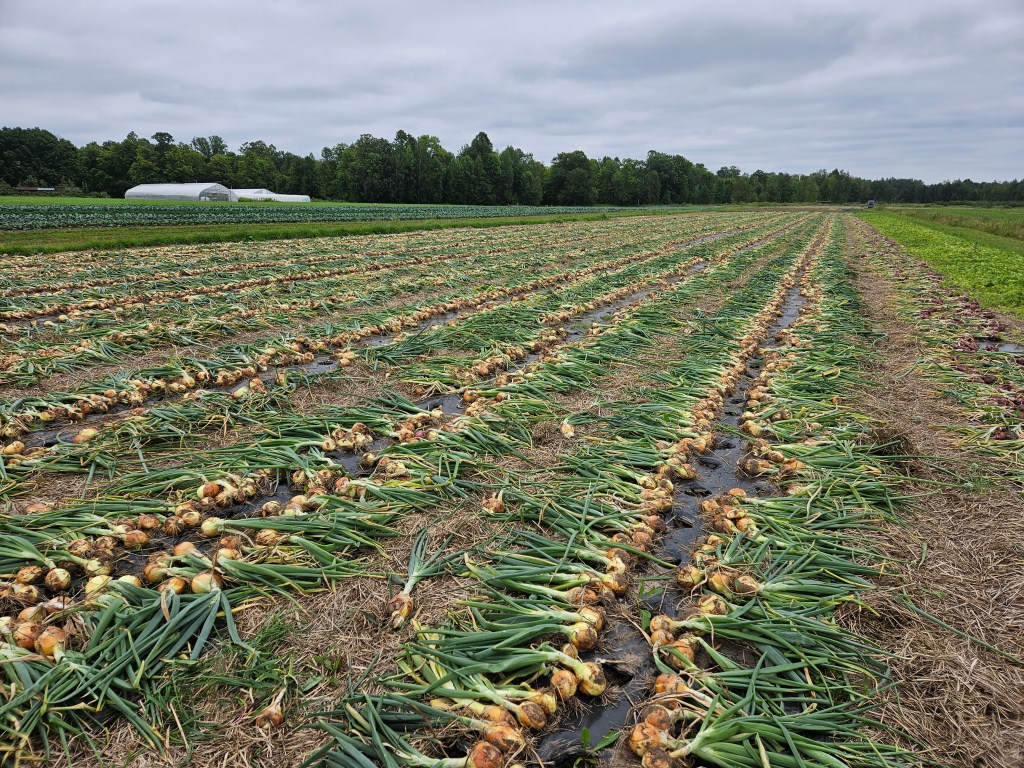
Onions are considered a biennial plant. This means in the first year, we plant the onions from seed and they will create the onion bulbs we all know and love. If we left them in the ground over winter, the next summer the onions would put on a flower and eventually that flower would create seeds (the same ones we plant to create this cycle). Every once in a while, the changes in the environment can confuse the onion into thinking it’s in its second year of growing and needs to put on a flower. Some of these environmental factors are too hot, too cold, too much water, or too little water. My research led me to learn that specifically when temps dip below 45°, the plant thinks it has entered “winter”, then when it warms back up, the plant thinks it has entered summer in year two leading it to put on flowers. Our best guess is that those few overnights in the end of June/early July that got down to low 40s, tricked the onions into believing they were in winter.
When the onions start to bolt, it’s important to get them out of the ground sooner rather than later because the big, thick stems, has the possibility to prevent the onions from properly drying. We rely on the dried onions in the winter for our Winter CSA boxes, and for selling to local restaurants. This means this year we will be drying garlic and onions at the same time. The greenhouse space isn’t big enough to handle both at once (hence why we usually dry one then the other), so we’ve had to get creative clearing out some other spaces to house the onions for a while.
We also picked the first tomatoes from our caterpillar tunnel. We’ve learned a lot from having this new tunnel, but the taste of the tomatoes is the most important part. Beautiful looking plants don’t mean as much to us if the fruit it produces doesn’t taste good. We are doing a taste test of the tomatoes this week. We plan to compare the regular greenhouse tomatoes to the caterpillar tunnel tomatoes to see if one tastes better than the other, or if they are equally delicious. We plan to give you all a thorough update next week on both the tunnel itself and the taste of the tomatoes, so stay tuned!
In your share this week:
Thyme – Onions – Kale – Basil – Green Beans – Carrots – Tomatoes
Zucchini – Cucumber – Cilantro – Green Peppers – Hot Peppers – New Potatoes
Lemon Thyme Shortbread cookies
Ingredients
- 3/4 cup unsalted butter, softened
- 1 1/2 cups powdered sugar, divided
- 2 Tbsp. lemon zest, plus more for garnish
- 1 1/2 tsp. chopped fresh thyme, plus more for garnish
- 1/2 tsp. vanilla bean paste or extract
- 1 1/2 cups all-purpose flour, plus more for work surface and cutters
- 1/2 tsp. kosher salt
- 2 Tbsp. fresh lemon juice (from 1 lemon)
Directions
- Beat butter and 1/2 cup of the powdered sugar in a stand mixer fitted with a paddle attachment on medium speed until smooth, about 1 minute. Beat in lemon zest, thyme, and vanilla until combined, about 30 seconds.
- Whisk together flour and salt in a medium bowl until combined. With mixer on low speed, gradually add flour mixture to butter mixture, beating just until dough comes together, about 1 minute, stopping to scrape down sides of bowl as needed. Shape dough into a 6-inch disk, and wrap in plastic wrap. Let chill until firm, at least 1 hour or up to 24 hours.
- Preheat oven to 350°F. Line a large rimmed baking sheet with parchment paper. Roll out dough on a lightly floured work surface to 1/4-inch thickness. Cut desired shapes using lightly floured 2-inch cookie cutters. Chill, reroll, and cut dough scraps as needed. Transfer shapes to prepared baking sheet, spacing 1 inch apart. Freeze until firm, about 10 minutes.
- Bake in preheated oven until the edges are set, 14 to 16 minutes. Let cool on baking sheet for 5 minutes. Transfer cookies to a wire rack; let cool completely, about 30 minutes.
- In a medium bowl, whisk together lemon juice and remaining 1 cup powdered sugar until smooth. Dip, drizzle, or spread glaze over cooled cookies as desired. Sprinkle additional lemon zest and thyme over cookies. Let stand until glaze is set, about 30 minutes.
African Peanut Soup
- 2 tbsp olive oil
- 1 medium onion, chopped (1 cup)
- 1 tbsp ginger, minced
- 1 jalapeño, seeds and ribs removed, diced
- 4 garlic cloves, minced (1 tbsp)
- 1/2 tsp pepper
- 2 tsp cumin
- 2 tbsp tomato paste
- 14 oz crushed tomatoes
- 4 cups chicken stock
- 1 sweet potato, peeled and diced
- 1 (14 oz) can chickpeas, drained
- 1 cup creamy natural peanut butter
- 4 cups kale, roughly chopped
- 1.5 lbs skinless, boneless chicken breast, cooked, shredded
- 1 tsp salt (to taste)
- peanuts, crushed
- cilantro, chopped (optional) for garnish
- In a large pot heat olive oil over medium heat. Add onions and sauté until softened, about 3-4 minutes.
- Add in ginger, jalapeno and garlic and stir until fragrant about 1 min. Add the pepper, cumin and tomato paste and cook for another 2 minutes, stirring, until paste darkens.
- Add the crushed tomatoes, stock, sweet potatoes, chickpeas and peanut butter. Bring to a boil and stir until fully combined. Turn the heat down to low and simmer for 15 minutes, until sweet potatoes are tender.
- Add in kale and shredded chicken and cook for another 5 minutes. Taste the soup before adding salt. Depending on how salty your stock and/or peanut butter was, it may not need anymore salt. If you use low sodium stock and salt-free peanut butter, it will need a full teaspoon salt, maybe more. Adjust to your own liking.
- Serve warm topped with cilantro and crushed peanuts. Enjoy!
For the farm crew,
Jennifer
 Food Farm