Last week was all about garlic and squash.
The end of September marks garlic sorting time. This is when a few lucky crew members get to sort through each of the garlic bulbs to decide if they will be used as seed garlic, or if they will be sent to shares or sold. Last year we planted over 6,700 cloves of garlic. Every clove that you plant gets turned into a bulb that you harvest. That means over 6,700 bulbs of garlic were sorted one by one. We look at each bulb to see how many cloves it contains, the size of the cloves, and the overall appearance of the bulb. When looking for garlic that will be used as seed for this year, we look for bulbs that have 4,5, or 6 cloves in it. Any more or less and the bulb gets sent directly to the shares/sell pile. Once we’ve counted the cloves, we look at the size of each clove. We want the largest cloves that we can find. This is for 3 main reasons: 1) larger cloves have more energy in them to help the plant gets started. We don’t want the plants struggling and stressed from the very beginning. 2) larger cloves produce a stronger root system early in the growing season. This can improve their ability to access water and nutrients from the very beginning. 3) larger cloves are more resistant to frost. This allows them to better withstand our cold Minnesota winters, and it helps them recover more quickly if they do get a little too cold. For those reasons, anything with small cloves will get put in the shares/sell pile.
As we’re looking at the size of the cloves, it’s also important to make sure that we are choosing bulbs with similarly sized cloves. If they are all different sizes, they have the potential to grow and mature at different rates. Since we are growing such a large amount, making sure everything is growing and maturing at the same rate is very important.
The final inspection is the overall look of the bulb. We look for any signs of disease, internal mold, improper drying, and any other abnormalities. These all get pulled out and set aside for further inspection. planting bulbs with any of these “imperfections” could result in the cloves not germinating, or in them spreading disease to the soil and/or other garlic plants. We always prefer to be cautious and not chance it.
Once we have all our garlic separated into the two piles, we then do the math to figure out how many cloves we will need for planting. We figure out the length of the fields, how many beds we plan to plant, how far apart each clove will get planted, and possible increase or decrease in crop yield. I say we as if all of us are doing this math, but in actuality, Janaki does all of this math for us so only one person has to hurt their brain crunching all the numbers. Thanks to all of your interest in our garlic preserving shares this year, and the fact that we are planning to plant on a longer field than last year, we increased our seed number by 15%. This means at the end of October, the crew will hand plant over 7,700 cloves of garlic. Anything not deemed seed quality, got set aside to be sent as preserving shares or will be saved for winter share deliveries. In past years we’ve also sold a fair amount to restaurants and other local outlets, but this year that’s not possible because we’re saving extra seed.
As the same time garlic sorting was happening, the rest of the crew was out getting all the winter squash from the fields. This meant clipping, throwing, stacking, loading, unloading, counting, and organizing thousands of squash. This is a long process because 1) it’s a lot of squash! 2) the Squash are split into different fields. One is on the main part of the farm, and the other is across the road. We had all the delicata, acorn, and some sunshine squash on the main part of the farm. The delicata made up the majority of this field since it’s the squash we will send with every winter share until we run out. This is also the popular seller to local businesses, and a favorite for most of the farm crew, so we plant quite a bit. Across the road was the rest of the sunshine, the kabocha, and all of the pumpkins.
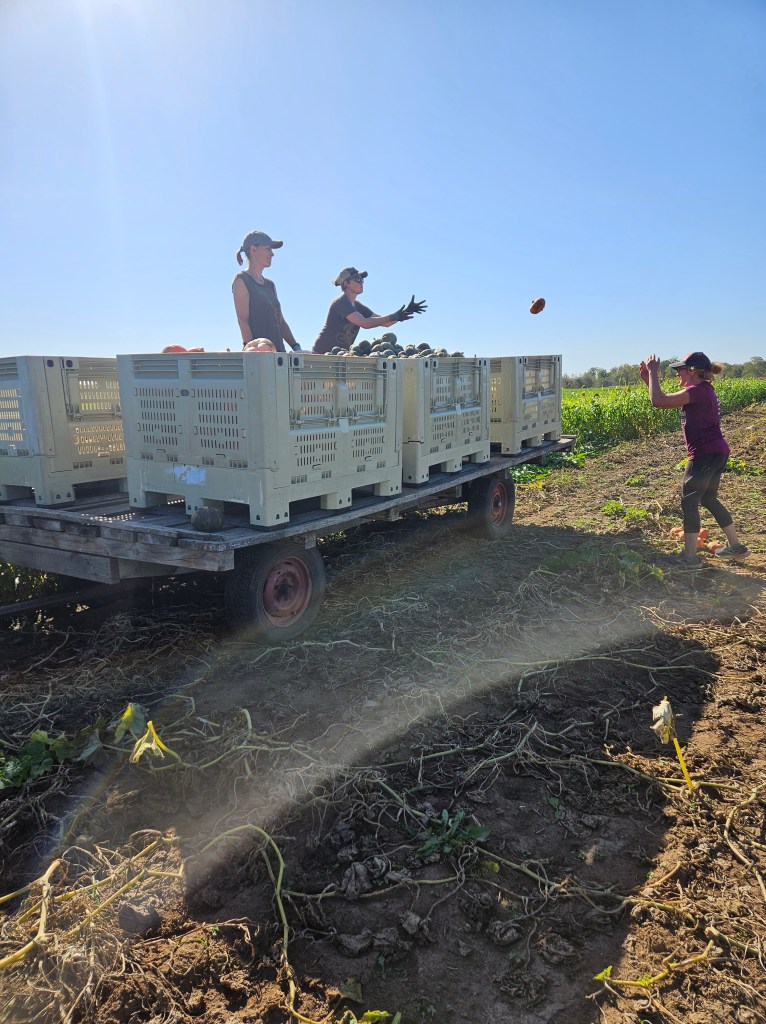
It was a lot of work, but we got all the Squash and pumpkins out of the field by the end of the work day on Friday. Now we begin the curing process for most of the squash so they will stay fresh through the winter months. As for the pumpkins, those get to go home with all of you this week! As you’re carving your pumpkins, feel free to share these fun facts:
-the first vegetable to be carved into a Jack o’lantern was actually a turnip
– Pumpkins need honey bees to pollinate their flowers. The more honey bee visits a flower gets, the more perfect the pumpkin will be
– pumpkins are grown on every continent except Antarctica

In your share this week:
Hot Peppers – Red Peppers – Northeaster Pole Beans – Basil – Carrots – Celery
Onion – Potatoes – Rutabaga – Spinach – Winter Squash – Tomatoes
Salade Nicoise
3-5 medium potatoes
1 cup your favorite vinaigrette (mustard vinaigrette is delicious for this!)
3 cups fresh green beans (cut the Nor’easters on the diagonal)
1 head butter lettuce or spinach
3 ripe tomatoes, quartered
1 cap of canned tuna (optional)
3 hard boiled eggs, halved
1/2 cup Mediterranean style olives
Fresh herbs
Boil potatoes until just tender. Drain and rinse in cold water and slip off the skins. While still warm, cut into 1/8″ slices and gently toss with about 1/3 cup of the dressing. Just before serving, toss greens with vinaigrette and arrange on a platter. Arrange all the other ingredients in clusters around the platter, drizzling on the remaining vinaigrette. Dress the salad with the fresh herbs and serve.
NOTE: you can add any veggie to this salad– carrots, celery, and peppers add depth and color
Rutabaga Hash
- 22 ounces rutabaga, peeled and diced (about 1 large rutabaga)
- 6 ounces green cabbage, chopped (about half a head of green cabbage)
- 1 leek, cut into strips (white parts only, green stems removed)
- 3 tablespoons avocado oil (or any cooking oil or butter)
- 1 teaspoon salt
- ½ teaspoon black pepper
- 1 teaspoon Italian seasoning
- 8 ounces bacon, cut into pieces
- basil for garnish
- Preheat your oven to 425°F. Add avocado oil, followed by rutabaga, cabbage, leeks, and bacon to the cast iron skillet.
- Season with salt, pepper and Italian seasoning. Mix until well combined.
- Roast in the oven for 25 minutes, then take the veggies out, and mix around before returning to oven for another 20-30 minutes, because you want all the vegetables to get a little crisp on them.
- Finally, garnish with basil if you want, then eat!
For the farm crew,
Jennifer
 Food Farm