Summer CSA Week 9

The trees are a dark and sleepy sort of green, the crickets start their conversations before the sun goes down. Annie’s Tiger lilies are blooming out the kitchen window. Lambsquarter and pigweed reach up through the cover-crop in the race to the sun and tiny grasses try to hide behind carrots in their row hoping the crew won’t see them as they crawl along weeding immaculately. On work days, I want a cold meal and hot coffee. It is August on the farm.

This month tends to be a busy month for people. Obligations and summertime desires 20180806_123441come crashing together in a scramble for attention in the last fleeting days. Summer feels like the 1812 Overture by Tchaikovsky: gentle late-May days, storms, sultry evenings, hammocks, carrot weeding and the whirlwind finale. Of course, this isn’t what it was written for – but if the song fits, wear it.

Harvesting the first of the carrots and potatoes from the field is a treat and it also marks a seasonal shift for us here on the farm. The crescendo of harvest doesn’t happen for another several weeks, but the tune of the finale starts now. We’ll finish up the last of the weeding in these next couple of weeks and then move to harvesting all of the time.

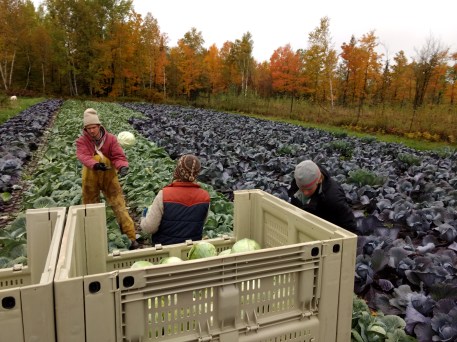
After four seasons on this farm I am still amazed at how much food gets harvested in a short amount of time –and it starts with these first buckets from the field.

For the gearing-up farm crew,

Karin

P.S. Dave would like people to know that the cucumbers you are getting are from our outside plants. Yay! A lot of work goes into getting things like carrots and cucumbers growing in the greenhouses- and it allows us to push the season earlier. But we get excited when things come from the fields this time of year.


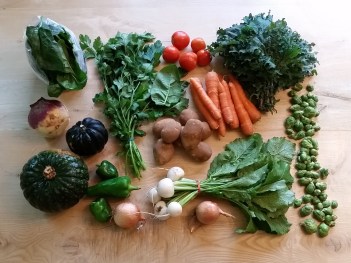
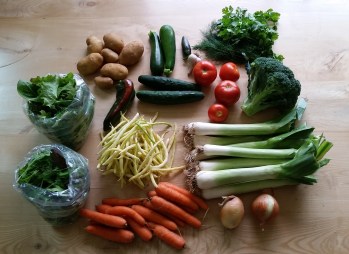
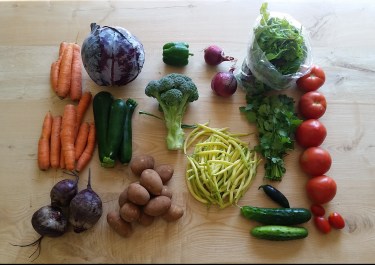
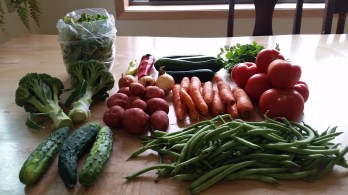
In your share this week:

  • Broccoli
  • Carrots
  • Cilantro
  • Cucumbers
  • Dill
  • Green onions
  • Peas
  • Hot wax peppers
  • New red-gold potatoes
  • Tomatoes
  • Zucchini

Carrot Greens Chimichurri

  • 1 cup finely chopped carrot greens (preferably organic)
  • 2 teaspoons dried oregano
  • ¼ teaspoon cumin
  • 1 teaspoon ground sweet paprika
  • ½ teaspoon crushed red pepper flakes
  • 1 garlic clove, minced
  • 1 teaspoon salt
  • a few grinds of pepper
  • ¼ cup white wine vinegar
  • ¼ cup olive oil (a good fruity one)
  1. Wash and dry your carrot greens well.
  2. Roast carrots in a 450 degree oven for 10-15 minutes (or until tender but not mushy).
  3. Finely chop your carrot greens and mix them with all of the dried spices and minced garlic. Stir in the vinegar and olive oil. Taste and adjust seasonings. (tip: taste it with a carrot or a piece of bread rather than by the spoonful)
  4. Serve with roasted carrots (or other veggies), toasted bread, or over grilled fish or meat.


New Potatoes

20180806_122142

New scale and new potatoes!

I cannot bring myself to put a recipe in for the new potatoes. They are so wonderful when they’re young and fresh. The skins are thin and delicate, and they’re the best kind of potato you’ll eat all year. New potatoes are called new because they’re harvested while the plant is still green. Storage potatoes are harvested once the plants have died, and the potato skins and flesh have hardened a bit.

Since they’re so tasty and so fleeting, I would just steam them (10-12 minutes) and smash them with butter or olive oil and whatever herbs you have sitting around. Keep it simple!

Summer CSA Week 8

These past few days have found me washing raspberry stains off my fridge handle and sand out of my hair. And eating copious amounts of snap peas.

Aspects of high-summer send my mind racing back to childhood like chasing a ball down a hill before it gets to the street. I am struck by whatever memory pops up out of the variety of sensations this time of year. Like raspberries and sand. Or the feeling of walking past a creek: the coolness and the smell of wet rocks and moss inviting one to get closer. Maybe to get in it, if mom says it’s okay.

One of my favorite smells is of rain on warm soil. It’s the country version of my other favorite: rain on sidewalks (which is what I grew up with). The smell is so distinct, and so wonderful. It smells like rejoicing.

Janaki has been spending his free time (ha- that isn’t a thing he has) irrigating the fields

img_20180729_115908619

Freshly Hatched Baby Robins!

these past couple of weeks. Between newly seeded cover crops and full grown broccoli (and everything in between) everyone out in the dirt is thirsty. We’re lucky we have the infrastructure to water everything- but it’s not the same as a good long rain.

Day after day of lovely weather has upsides for sure. It’s weed killing weather, and I have no idea where my good rain jacket is. It is just a matter of time until the rain comes – and though it might rain on a parade or picnic later this week, I hope that when it comes you’ll rejoice like the soil and the farmers.

For the thirsty farm crew,

Karin


  • Basil20180730_133830
  • Beets
  • Chard
  • Cilantro
  • Cucumbers
  • Green Onions
  • Parsley
  • Green Peppers
  • Snap peas
  • Tomatoes
  • Zucchini

Swiss Chard Pancakes

2 cups (475 ml) whole milk
2 1/2 cups (325 grams) all-purpose flour
3 large eggs
1 teaspoon coarse salt
Freshly ground black pepper
1 small onion, coarsely chopped
3 green onions, snipped
1 shallot, coarsely chopped
2 garlic cloves, split, germ removed, and coarsely chopped
Leaves from 10 parsley sprigs
5 large or 10 small Swiss chard leaves, center ribs removed, roughly chopped
About 1/2 cup (120 ml) grapeseed, peanut, vegetable, or olive oil

To serve: Plain, thick yogurt mixed with a little lemon zest, lemon juice and salt, to taste

If you’d like to keep your finished pancakes warm while you cook them: Heat oven to 250 degrees F and line a baking sheet with foil.

Make the batter: Put everything except the Swiss chard and oil in a blender or food processor and whirl until the batter is smooth. Scrape down sides. Add chard leaves and pulse machine until they’re chopped to your desired consistency.

Cook the pancakes: Heat a large skillet over medium-high heat and pour in a good puddle (1/4-inch deep) of oil. Once oil is hot enough that a droplet of batter hisses and sputters, spoon about 3 tablespoons batter in per pancake. It will spread quickly. Cook until browned underneath and (the edges will scallop, adorably), then flip, cooking on the other side until browned again. Transfer to a paper towel-lined plate, and then, if you’d like to keep them warm, to the foil-lined tray in the oven.

Repeat with remaining batter. Serve with lemony yogurt or another sauce of your choice.

Do ahead: Unused batter keeps in fridge for 3 days. Finished pancakes keep in fridge for a couple days, and will freeze much longer. Separate pancakes with pieces of waxed or parchment paper so they don’t glue together.


Summer CSA Week 7

This weekend I made a broccoli salad for a family pot luck. Before I chopped the broccoli into a thousand pieces, I showed my grandma. I told her why I knew (thought) it was ready to pick, and what the variety (Imperial) looks like in the field next to other broccoli. She got a kick out of it –or she humored me. Either way, she wasn’t going to get that kind of information in that morning’s paper. I know she would rather I go back to school, but she’s happy enough to learn about what I’m doing. The broccoli salad was a hit, and I was bragging just a little bit about the fact that I had helped to grow it.

It has taken me time to get there. Years. To brag in the simple, and not let that weird extended-family pressure (to do more, be more, have more) change how I talk about my life or vocation. As a still fairly young person, I clearly remember the stressful feeling of img_20180715_084528095some conversations before graduating high-school, and after, and again after a two year degree. Well-meaning and loving people just wanted to know what I was up to; I know that now. At the time, however, it painted how I talked about what I choose to do with my life. Do you know that feeling? –where you try to make what you’re doing sound as snazzy as it possibly can but really it’s just 90% simple day-in-day-out stuff. Like trying to print double-sided tri-fold programs, counting broccoli, sitting in meetings, or listening to children’s music all afternoon. No one’s job is a fairy tale. And if it is, they work in Disney World and that’s it’s own sort of thing.

Adding anything into one’s life or taking anything out of it that isn’t a part of our culture’s value system takes work. It takes deciding on a new culture and new values. Like choosing to repair things instead of buying the latest and greatest, or to participate in a CSA.

Parts of our society are so bent on the next new thing or some strange sense of the American Dream that we end up allowing the best things to seem like burdens. Like preparing food or growing food. There’s a notion of “why would you do that if you could be doing X?” I’m doing it because it’s not a burden. It’s an honor. I am happy to work on the farm and I’m happy to wash a little dirt off my refrigerator shelves once in a while. And I’m proud to tell my family that I do so.

For the farm crew,

Karin

P.S. Dave wanted to let members know that this will be the last of the head lettuce for a while until cooler temperatures set in. A few cut worms have been found as we have harvested. Wash this lettuce more carefully than you normally would.

P.P.S. Dave also wants people to be aware that the basil is young, fresh and delicious. It won’t keep long, so unless you use it soon, he recommends tossing it with some oil to keep in the fridge for a bit longer.


In your share this week:

  • Basil20180723_132713
  • Cabbage (red or green)
  • Carrots
  • Cucumbers
  • Kale
  • Lettuce
  • Green Onions
  • Snap Peas
  • Peppers
  • Tomatoes

Kale and Cucumber Salad with Ginger Dressing

Dressing

  • 8 ounces fresh ginger
  • 1 green or red Thai chile
  • 1 garlic clove
  • 3 tablespoons fish sauce
  • 3 tablespoons sugar
  • 3 tablespoons vegetable oil

Assembly

  • 1 bunch kale, ribs and stems removed, leaves torn into bite-size pieces
  • 1 English cucumber, very thinly sliced
  • 1 small red onion, thinly sliced (or try green onions)
  • 2 tablespoons fresh lime juice
  • 2 teaspoons sugar
  • Kosher salt
  • 1 bunch cilantro, coarsely chopped
  • ¼ cup store-bought fried onions

PREPARATION

Dressing

  • Heat broiler. Broil ginger in its skin, turning once, until very dark brown and beginning to scorch in places and a paring knife passes through the center with relative ease, 40–50 minutes (if skin is getting too dark before flesh is tender, turn down the heat or move to the oven). Let cool; slice (leave on the skin).

  • Pulse ginger, chile, garlic, fish sauce, sugar, oil, and 2 Tbsp. water in a food processor, adding additional water by tablespoonfuls if needed, until a smooth paste forms.

  • Do Ahead: Dressing can be made 3 days ahead. Cover and chill.

Assembly

  • Toss kale and ¼ cup dressing in a large bowl to coat; massage with your fingers until kale is slightly softened.

  • Toss cucumbers, onion, lime juice, and sugar in a medium bowl to combine; season generously with salt. Let sit 10 minutes to allow cucumbers and onion to soften slightly.

  • Add cucumber mixture to bowl with kale and toss to combine, adding additional dressing if desired. Serve topped with cilantro and fried onions.

Summer CSA Week 6

There is a growing list, never a shrinking one, of things do do on the farm. This time of year it all needs to be done right now. Or last week. This past Friday the crew finished close weeding the second planting of carrots. It is slow detailed work done crawling around on one’s hands and knees. The completion of weeding each carrot field is like a quarter, half, and three quarter chime to an hour when it’s finally done. Two down one to go.

There are a lot of things getting done on the farm and I don’t really know how. It is amazing what gets done. There is even more getting done than I know because half the time I don’t know what Janaki is doing on the tractor and more than half the time, veggies pop out of the ground and I realize Dave snuck seeds in at some point.

This past week on the farm my contribution to crossing things off the list has been 20180716_134923.jpgsuperseded by my adding things to it. Mostly adding broccoli. I’ve been spending a fair bit of time zig-zagging across beds of broccoli with my head down and my brow furrowed wondering if I really should be harvesting of all this. But yes, I really should. The first and second planting of broccoli (out of 8 plantings) both came on strong and at once. Luckily Janaki has a list of people he can call who might be interested in extra broccoli and John is good at sweet talking restaurants and grocery stores into ordering
just a case more.

Having such a bounty to manage is a good thing. Too much broccoli? What a lucky problem for a farm to have.

The harvest is what really matters even if I find myself thinking of other things I could be getting done instead. Like starting to weed the third planting of carrots. But the work  we do is given meaning by the harvest, and by the produce ending up in your home. Otherwise what would this all be about?

For the farm crew,

Karin


Broccoli

Carrots

Cauliflower

Cucumbers

Garlic scapes

Greens mix

Lettuce

Green onions

Snap Peas

Juliet tomatoes


20180716_095554

Cauliflower Slaw

1/2 cup thinly sliced almonds
Juice of half a lemon (about 1 tablespoon), plus more to taste
1 tablespoon white wine vinegar
1/4 teaspoon fine sea salt or table salt, then more to taste
3 tablespoons (30 grams) dried currants
5 tablespoons olive oil, plus more for frying
2 tablespoons (about 25 grams) brined or salt-packed capers
oil for frying
1 head of cauliflower (about 1 1/4 pounds)
Freshly ground black pepper
3 scallions, thinly sliced (use green and white parts)
2 tablespoons chopped flat-leaf parsley (optional, mostly for color)

Heat oven to 350 degrees F. Spread almonds on a tray and toast them until they’re a deep golden color, tossing them once or twice to ensure even cooking. This will take 10 to 14 minutes. Set aside to cool.**

Meanwhile, place lemon juice, vinegar and 1/4 teaspoon salt in a small bowl. Add currants; set aside and let them soak while you prepare the other ingredients.

If using brined capers, drain and spread them on paper towels until most of their moisture has wicked out, about 5 minutes. If using salt-packed capers, soak them in water for 10 minutes to remove the saltiness, then drain, rinse and pat dry on paper towels. Pour a 1/2-inch of olive oil or another oil that you prefer to fry in in a small skillet or saucepan. Heat it over medium-high. When hot enough that a droplet of water added to the oil hisses, carefully add the capers and step back — they’re going to sputter a bit for the first 10 seconds. Once it’s safe to get closer, give them a stir. Depending on how dry they were, it can take 1 to 2 minutes for them to get lightly golden at the edges and then crisp. Remove with a slotted spoon. Drain on paper towels.

Trim cauliflower leaves and cut head into quarters. Cut cauliflower, stem and florets, into 1/4-inch slices. Add to a large bowl.

Scoop currants from vinegar mixture with a slotted spoon and add to bowl with cauliflower, along with almonds, capers, scallions and parsley. Slowly whisk 5 tablespoons olive oil into remaining vinegar mixture in a thin stream. Add several turns of freshly ground black pepper. Pour over cauliflower and other ingredients and turn gently to coat all pieces. Taste and adjust seasonings, adding more lemon juice, salt or pepper to taste. Dig in!

Israeli Salad

2 medium juliet tomatoes, cubed
1 1-pound English cucumber, cubed
1/2 medium red onion, cubed, or 4 scallions, finely sliced
3 tablespoons finely minced fresh, flat-leaf parsley
Juice of half a lemon
2 to 3 tablespoons olive oil
1 1/2 teaspoons sumac powder
Salt and pepper, to taste

You can either toss all of the vegetables in one large bowl, and pour over it the parsley, lemon juice, olive oil and sumac mixture you whisked separately in a small bowl, or if you’re in a hurry just toss everything all at once.

Other additions: 1/2 to 1 cup crumbled or cubed feta, 1 bell pepper, cut into cubes, 1 15-ounce can of chickpeas, rinsed and drained, 1/2 to 1 cup coarsely chopped olives, 1 to 2 tablespoons finely minced mint or dill or pita chips (see below). You could also whisk a couple tablespoons of tahini into the dressing for a thicker, sesame-coated flavor. Serve with pita chips, or just eat it plain!

20180716_134923.jpg

Summer CSA Week 5

We have been having some pretty hot days out at the farm. It makes me thankful for my forays into the root cellar. What a lovely reprieve: to be out of the sun and having one’s arms submerged in the dunk tank. I have to remind myself -the tank is for the vegetables not for the humans. They need it more than I do.

Some days after work, I go for a dip in the lake. The queen of dunk tanks. It is nice to go during a weekday evening when there aren’t so many people around. People tend to keep a respectful Duluth-y sort of distance from one another, which I appreciate. Plus, everyone on the beach looks pretty good from a city block or more away. Not exactly like Bay Watch, but somewhere in the ballpark. Of course, get closer and bodies are just bodies. Cuts and bruises, hard times, bearing children and bearing years – it’s all there to see if you get up close.

My first couple of years farming, a few people would say things like “It’s just, like, so cool how you are all out here doing this, ya know? It’s, like, so peaceful. I’d love to do what you do”. And I would say something positive and polite and half true in response. But in my head I’d think – you wanna come out and do this? That’s great, because I’m tired and I’ve been in the sun for 10 hours and I’d love to go into town and get a burger and see a brainless movie.

Of course, these people were well meaning and I did like what I was doing. It would just hit me how there were gaps in what people from outside the farm thought versus what it was actually like doing it day in day out.

That is how it goes –sometimes from a distance things look just great. Like farming is frolicking through fields with baskets of kale and flowers being followed by lambs and dragonflies. That sounds lovely. Janaki, I want lambs. The following me kind.20180709_130045

When you get closer though, you see the real deal. The cellulite, the endless close-weeding, the age spots, the character flaws, the washing of the same bins again and again. Life is less like a storybook when you get up close to it all.

It is the being up close that really matters though. People are a different kind of beautiful when you are close to them. And farming is tiring, and full of things that don’t involve frolicking. Like walking behind a planter getting coated in dust and trying to finish a greenhouse and wandering around looking for something you just had a minute ago. Even tasks like picking up your CSA share and putting it away week after week, freezing extra garlic scapes and looking for ways to eat more greens looks snazzy when in a photograph in someone else’s (perfect) kitchen. Up close, it is work, and it is worth it.

Thank you for being a part of it all with us –from the more romantic aspects of farming (that do happen in real life, alongside all the other parts) to the dirt in your sink. It remains beautiful to me up close, and I hope it does to you too.

For the farm crew,

Karin

P.S. Dave says that the greens mix would be good if they were braised. It’s not quite as tender as ours usually is, but still good.


Broccoli20180620_155835
Cauliflower
Carrots
Cucumber
Garlic scapes
Green onions
Lettuce
Napa cabbage

Sweet and Sour Roasted Napa Wedges

  • 2 tablespoons olive oil
  • 2 tablespoons cider vinegar
  • 1 tablespoon brown sugar
  • 1 teaspoon whole-grain Dijon mustard
  • 1 teaspoon grated garlic
  • 1/4 teaspoon salt
  • 1/2 teaspoon freshly ground black pepper
  • 1 head napa (Chinese) cabbage, cut lengthwise into quarters
  • Extra oil for brushing

Place a large roasting pan in oven. Preheat oven and pan to 450°.

Combine first 7 ingredients in a small bowl.

Brush cut sides of cabbage with  oil. Place cabbage, cut sides down, on preheated pan; bake 6 minutes. Turn cabbage onto other cut side; bake an additional 6 minutes. Remove pan from oven. Heat broiler to high. Brush cabbage evenly with oil mixture; broil 3 minutes or until browned and caramelized.


Broccoli Farro Salad

  • Salt
  • 1 cup semi-pearled farro
  • 1 pound broccoli (dice stems)
  • 4 tablespoons olive oil
  • 2 cloves garlic, minced (or scapes!)
  • Red pepper flakes, to taste
  • Finely grated zest, then juice, of 1 lemon
  • Freshly ground black pepper
  • 4 ounces  grated pecorino romano or Parmesan

Bring a medium/large pot of salted water to boil. Once boiling, add broccoli and boil for 2 to 2 1/2 minutes, until slightly softened but still crisp overall. Scoop out with slotted spoon or tongs, then drain.Add farro back to same pot (I’m totally okay with some errant leftover broccoli flecks and vitamins here, if you’re not, use another pot of salted water) and cook, simmering, for 25 to 30 minutes, until tender. (Since there are so many varieties of farro, however, if your package suggests otherwise, it’s best to defer to its cooking suggestion.) Drain and tip into a large mixing bowl; cool to lukewarm.

Pat drained broccoli dry on towels, trying to remove as much excess moisture as possible. Chop into small (roughly 1/2-inch) bits. In a large sauté pan, heat olive oil over medium-high heat until hot. Add garlic and pepper flakes, to taste, and cook for 1 minute, until garlic is faintly golden. Add chopped broccoli, lemon zest, and salt (I use a full teaspoon kosher salt here, but adjust the amount to your taste) and cook, stirring, for 3 to 4 more minutes, until broccoli is well-seasoned and slightly more tender.

Add broccoli and every bit of garlic and oil from the pan to the bowl of farro and stir to combine. Add lemon juice, black pepper and more salt to taste (but 1/2 teaspoon of each is what we used) and stir to combine. Stir in cheese.

Serve warm or at room temperature as-in, with an egg on top, burrata, and/or bread crumbs.

Summer CSA Week 4

This past weekend I had a simply wonderful time at a camp up north. It is a yearly event in my life these past 5 years and attending feels like going home. It feels like home to be in and out of the lake all day, to smell like hippy bug dope and to see old and new (some brand new!) friends.

I feel so fortunate to have access to a space like that. I try not to take for granted the work people have put into the space for decades and the clean water to swim in and how safe and open the group is.

Really, I am so fortunate that there are many places that feel like home in some way. Like the farm- though it’s my job and isn’t mine per se. Janaki and Annie let us use their space every day to prepare and share food together. And throughout my years here the fields and their idiosyncrasies feel more and more familiar.

As the new members of the farm crew have been getting settled into the daily goings on it has reminded me of how humbling it is to start any new thing. In our society many of us don’t have a background in doing this kind of physical work hour after hour. In the midst of the change of taking on new tasks, I hope those of us who are practiced at working in this place are welcoming and helpful to the newbies.

The places I feel the most at  home in are the ones I want to keep clean and safe and welcoming to me and others. How precious to have multiple places to feel at home in?

If I add up all the space I feel at home in it probably doesn’t add up to much area. A few acres, a few yards and kitchens all added up. But it’s everything to me. And what of all the places that you feel at home in? Maybe it adds up to a larger area- maybe some of our spaces overlap (Park Point anyone?). When all the spaces we hold in ourselves are laid out, and we love them together there is a lot of power in that. Power to protect and to include.

I hope that your week finds you enjoying this good food and lovely weather in celebration of home.

For the farm crew,

Karin


In your share this week:

20180629_134159

  • Beets
  • Broccoli
  • Carrots
  • Cukes
  • Garlic scapes
  • Head lettuce
  • Green onions
  • Radishes
  • Turnips

A Dressing Recipe

  • 1/4 cup oil (I’ve been using non roasted sesame oil and canola oil)
  • 1 tablespoon roasted sesame oil
  • Splash of kimchi juice (if you have some around)
  • Splash of lemon or lime juice
  • 1/8 cup brown rice vinegar
  • 1 Tablespoon puréed ginger
  • 1 Tablespoon honey
  • dash of mustard (dry or liquid)
  • Salt & pepper to taste

We have been pouring this over a chopped salad of all the veggies and serving it over a bed of lettuce for lunch. Yum!


Roasted Beet Pesto (A Food Farm favorite)

              Ingredients

  • 1 cup red beets chopped and roasted (about 1 medium beet)
  • 1-3 garlic scapes
  • ½ cup walnuts roasted
  • ½ cup parmesan cheesegrated
  • ½ cup olive oil
  • 2 tablespoons lemon juice
  • Salt to taste

Instructions

  1. Preheat the oven to 375 degrees F.
  2. Wash and scrub the beet and pat it dry. Chop it into ½” cubes and place the pieces on a large sheet of foil. Wrap the chopped beet in foil, making a foil packet.
  3. Place the packet on a baking sheet.
  4. Roast in the oven for 40 to 50 minutes, or until beets are soft and juices are seeping out.
  5. Allow beets to cool completely.
  6. Add all ingredients except for the oil to a food processor or blender and pulse several times.
  7. Leaving the food processor (or blender) running, slowly add the olive oil until all ingredients are well combined. If the pesto is too thick for your blender to process, add a small amount of water until desired consistency is reached.


Summer CSA Week 3

***Please remember to return your share box!***


Now summer is officially here! How wonderful. The greens of the world are so deep and lush while still alert and ready for months of photosynthesizing. The fields on my drive out to the farm are highlighted with daisies, hawk weed, clover and seeding grasses –all offering contrast and beauty to my morning and evening commute. Summer clouds roll by the farm on their way to somewhere and fluffy seeds float along below them to somewhere closer. Maybe to get stuck in a row of carrots.  20180621_182715-e1529870362379.jpg

I have been considering lately how lucky I feel to be able to perceive beauty. Not just with my eyes, but with all my senses. Maybe especially visually but also temperature, sound, smell, taste, these are all ways we experience beauty. How wonderful.

I am sure there are people who are out there studying the what and why and what-have-you of humans’ ability or desire to see beauty in the world. I am not one of those people. I can understand why other humans are beautiful. I can understand why strawberries and apples are beautiful. But why clouds? Why rocks? Why flowers? Why the way leaves move in the wind?

Delightfully, their beauty (as far as I know) has nothing to do with humans. Seemingly, they don’t directly affect our survival or well-being. We cannot own or tame the beauty of these things. We probably shouldn’t try to own or tame any beauty really.

I try to take moments during the day to take particular notice of how lovely things are. It is easy to get swept up in to-do lists. Thankfully, all of the things on my farm to-do list are bathed in beauty; I don’t have to try too hard to see or taste it. I’m happy to pass several items from our farm to-do list on to you and your home. Enjoy!

For the beautiful farm crew,

Karin

20180618_0939461


In your share this week:

Carrots

Cucumbers

Radishes

Turnips

Head Lettuce

Green onion

Pac Choi


Turnips with Roasted Garlic Goat Cheese and Sesame

Ingredients

  • 1 head of garlic, halved crosswise
  • 1¼ cups plus 2 tablespoons olive oil, plus more for drizzling
  • 8 ounces goat cheese
  • Kosher salt, freshly ground pepper
  • 1 tablespoon black and/or white sesame seeds
  • 1 teaspoon finely grated lime zest
  • 1 teaspoon chopped fresh oregano
  • 1 teaspoon fresh thyme leaves
  • ¼ teaspoon sumac
  • 12 ounces small turnips (about 16), peeled, half quartered, half thinly sliced into rounds
  • 1 tablespoon Sherry vinegar or red wine vinegar
  • Cilantro leaves with tender stems and mint leaves (for serving)

Directions

  • Heat oven to 350°. Combine garlic and 1 1/4 cups oil in a small baking dish. Cover dish with foil and roast until garlic is golden brown and tender, 45–50 minutes; let cool.

  • Remove garlic from oil; squeeze cloves from skins and finely chop to a paste. Process in a food processor along with goat cheese, 1/4 cup garlic roasting oil, and 2 Tbsp. water until smooth (mixture should be spreadable); season with salt and pepper.

  • Meanwhile, toast sesame seeds in a dry skillet over medium heat until golden brown, about 1 minute. Transfer to a small bowl and let cool. Mix in lime zest, oregano, thyme, and sumac.

  • Toss turnips in a medium bowl with vinegar and 2 Tbsp. oil; season with salt and pepper. Divide goat cheese mixture among plates, top with turnips, sesame mixture, cilantro, and mint, and drizzle with more oil.


Radish Greens Pesto

(this was sent to Janaki by a member [thank you!] and while you might not have 4 cups or radish tops, I’m sure a half batch would work out well or you could probably substitute turnip greens as well)

Ingredients

  • 4 cups radish tops (packed), washed and dried
  • 3 cloves garlic, finely chopped
  • Juice of 1/2 a lemon
  • 1/2 cup sliced or slivered almonds, coarsely chopped macadamia nuts or pistachios
  • 1/2 cup freshly grated Parmesan cheese
  • 1/3 cup extra-virgin olive oil plus more as needed
  • salt and freshly ground black pepper, to taste

Directions

Combine first 6 ingredients in a food processor or blender.  Process until smooth, scraping down the sides as needed.  Add additional olive oil to achieve a thick sauce consistency.  Season to taste with salt and black pepper.

Summer CSA Week 2

Notes from the Farm


In the growing seasons of my life I end up with a lot of bruises on my legs. I tend to throw my body around a bit and have little grace and take little care when legging up onto a wagon or truck bed. Last week I fell off a new transplanter we were using to put in the 5th planting of brassicas. I have a pretty epic bruise on my left calf. It doesn’t keep me up at night, but it does hurt to put on socks, or pants, and I can’t cross my left leg over my right. I am not trying to impress anyone out at the farm, or anywhere really, so I’m still wearing shorts and skirts. Why hide?

Last week I went to see some UMD students perform Much Ado About Nothing on the grounds of Glensheen. It was a lovely evening for it –I get such a kick out of that play. The little song in the middle of the play is cute and has a simple ring of truth that Shakespeare lends to words: “Sigh no more ladies, sigh no more. Men were deceivers ever. One foot in sea and one on shore, to one thing constant never. But sigh not so and let them go and be you blithe and bonny, converting all your songs of woe into hey nonny, nonny!” Take the role of gender with a grain of late 16th century salt.  

And Benedick, having found love after swearing to never marry, has a couple of lines “Serve God love me and mend” and  “live unbruised”. I love those lines. They’re also lines set to music in Mumford and Sons first album. A great song.

So, my leg is bruised.

Other parts of me are bruised in a different way.

And I think parts of our country are bruised. It hurts, and it’s ugly and we can’t pull up our socks or turn on the radio or drive down the street without being reminded of the bruises.

I don’t know what it means to “live unbruised” but I long for that. It is not necessarily that the bruises aren’t there anymore –one just doesn’t have to let them dictate one’s path. I can still love my legs and my brain and my country even if it hurts and is dark and unnaturally yellow somehow.

Whatever bruises you might find yourself noticing or acquiring this week, I hope you live out of that place well and that the good food in your belly sustains you through all of it.

For the farm crew,

Karin


In your share this week:

  • Pac Choi
  • Cucumbers
  • Greens mix
  • Green onions
  • Kale
  • Radishes
  • Spinach

Baked Kale Chips

1 bunch (about 6 ounces) kale
1 tablespoon olive oil
Sea salt, to taste

Preheat oven to 300°F. Rinse and dry the kale, then remove the stems and tough center ribs. Cut into large pieces, toss with olive oil in a bowl then sprinkle with salt. Arrange leaves in a single layer on a large baking sheet (I needed two because mine are tiny; I also lined mine with parchment for easy clean-up but there’s no reason that you must). Bake for 20 minutes, or until crisp. Place baking sheet on a rack to cool.

Kale-Dusted Popcorn If you’re making the chips with the intention to grind them up for popcorn, I’d use less oil — perhaps half — so they grind without the “powder” clumping. I ground a handful of my chips (about half) in a mortar and pestle and sprinkled it over popcorn (1/4 cup popcorn kernels I’d cooked in a covered pot with 1 1/2 tablespoons oil over medium heat, shaking it about with potholders frequently). I seasoned the popcorn with salt. I liked this snack, but I think Parmesan and Kale-Dusted Popcorn would be even more delicious. Next time!

Spinach and Smashed Egg Toast (For one)

1 large egg
1 slice of your favorite hearty bread
2 ounces spinach
1 pat butter
1 tablespoon minced shallot
1 tablespoon heavy cream
Sea salt and freshly ground black pepper
1 teaspoon smooth Dijon mustard
1 tablespoon crumbled cheese, such as goat cheese or feta

Bring small pot of water to boil. Lower egg into it and boil for five (for a runnier egg) to six (for a less-runny but still loose egg) minutes.* Rinse egg briefly under cool water and set aside.

Wash your spinach but no need to dry it. Put a small puddle of water in the bottom of a skillet and heat it over medium-high. Once the water is simmering, add the spinach and cook it until it is just wilted, and not a moment longer. Transfer it to a colander and press as much of the excess water out with the back of a fork as possible. No need to wring it out here; we’re hoping to those lovely wilted leaves intact. Keep that fork; you’ll use it again in a moment.

Put your bread in to toast.

Dry your skillet if it is still wet. Heat a pat of butter in it over medium-low heat. Add shallots and cook them for a few minutes, until translucent and a little sweet. Return spinach to skillet and add cream. Simmer them together for one minute, then season with salt and freshly ground black pepper.

Put your toast on your plate and spread it thinly with Dijon mustard. Heap the spinach-and-shallot mixture on top, then add the crumbled cheese. Peel your egg; doing so under running water can make this easier. Once peeled, place it on your spinach toast, smash it open with the back of that fork you used a minute ago, and sprinkle it with salt and freshly ground black pepper. Eat immediately.

* When you’re eating a soft-boiled egg right away, six minutes is the way to go. But here, since we boil the egg and then prepare the rest of the toast, it continues to cook and firm up a bit in its shell, so I’ve found that a 5 to 5 1/2 minute egg will give you the equivalent in the end.

20180618_093825


It’s Share Renewal Time!

Hi Food Farmers,
Welcome to the Food Farm’s 25th growing season! We’re finally set to go with our new online ordering system. To reserve your shares either follow the link above or click on the CSA Shares tab of this website. The ordering process has changed, but in the long run I think the new system will make things easier for us and for members. You can now signup quicker, get access to more information about your membership, and it should reduce our burden of data entry and the chance for mistakes, and make it easier for us to run reports and get an accurate count for each share type.
Please call or email if you run into any problems!

Overall, things are going well on the farm this winter. A poor carrot harvest last fall means that the winter wholesale orders can be put together quickly by Teri and Karin, and regular farm chores are fairly quick to complete. Truman turned the corner on potty training over Christmas, and Ellis just had his first birthday and is happy and healthy after getting over early winter colds. Annie is working three jobs but hasn’t gone completely insane yet, so we’re considering ourselves fortunate! I just returned from a four day trip at two conferences in New York giving workshops on cover cropping with some researchers at Cornell that I met a few years ago. I’m planning this season’s crop rotation, starting the organic certification paperwork and preparing for a presentation at the organic farming conference in LaCrosse at the end of the month.

Seed orders have all been made and are beginning to arrive. It’s hard to believe that we’ll be opening up the greenhouse in three short weeks to begin planting onions for next season!
We’re looking forward to seeing many of you at the annual Food Farm social hour at Zeitgeist Arts on Wednesday, February 21st from 5-7 pm.

Season Wrap-up 
2017 felt like we were constantly on the edge of disaster. With the exception of early June there was excess wetness pretty much the entire season. However, the year turned out to be pretty darn good. Summer Shares in particular were a high point, and we were really proud of the boxes we sent every week. It’s been nice that we’ve been able to keep adding a little bit of diversity to keep the boxes interesting. We did lose about 20,000 pounds of carrots due to the wetness—there are plenty for the Winter Shares, but our wholesale deliveries for early 2018 are significantly less than usual.

We had a really great crew last year, and they did a great job staying on top of the weeds—a particularly difficult job on a wet year. The new cultivation equipment I put together also really helped reduce some of the hand work that we needed to do. The crew pushed hard all the way to the end of the season even after getting an unexpected 10” of snow on the 27th of October.
See the next blog post back for the nice season review and slideshow that Karin put together a few weeks ago.

Looking Ahead 
The big change for this coming season will be that we are no longer raising meat chickens or turkeys. Egg share folks shouldn’t worry–we are keeping the laying hens. We’ve been considering the change for a couple of years, but decided this year was the time. There were a number of things that figured into the decision, but the most immediate was that our insurance company no longer covers on-farm processing which meant that we’d either need to bring them somewhere else to be processed or else get a much more expensive policy from a different company. The birds have been a big part of our farm, and it’ll be sad not to have them around.

When we moved to this farm 30 years ago, most of the land was badly depleted from years of cutting hay with no added fertility. The way we raise chickens and turkeys on pasture played a vital role in bringing it back into vibrant productivity without a lot of tillage and added soil amendments. The good news is that our friend and neighbor Maggie Schulstrom of Spectrum Farm will increase her production of birds to accommodate our members. We became good friends with the Schulstrom/Vavrosky family during our pipeline fight a few years ago, and we know they do a nice job in caring for their animals. They’re also the family that is taking over strawberry production at our beloved Finke’s Berry Farm as Diane and Doug are retiring. You can contact Maggie by email or phone at (218) 380-258 seven.

That’s the big change for this year, though of course we have a lot of ongoing projects to catch up on. Among them are finishing the new high tunnel greenhouse that we started last fall, completing last fall’s drainage project, putting up new deer fence across the road, and working to rehab some of the older buildings on the farm. We are intent upon making this farm as resilient as possible in the face of increasing climate extremes, and many of these projects are designed to do just that.
We hope members are proud not only of the farm they have helped build, but the networks and support for local agriculture in general that has come out of your support of us. Never forget that eating is a powerful act!

For the farm crew,
Janaki

DSC_0790

2017 Season in Review

The farm is tucked in now with a cover of snow for a winter rest that is going by very quickly. Janaki sent in the order for seed potatoes just last week; even as stacks of this year’s crop abide in the root cellar. So it begins: another investment in the future of food and job security for those of us who weed the rows and harvest the eventual crop. I’m letting myself jump ahead too far for a retrospective post. First, a few photos…

This slideshow requires JavaScript.

The little farm boys are as cute as ever. Truman sings songs about excavators and tractors (and everything really) and can name more implements and parts of tractors than I. Ellis is not yet a year, but has already crossed that threshold of looking an awful lot like a little boy and less and less like a baby. He gets carrots to gnaw on with his adorable teeth.

Our growing season panned out pretty well, considering how wet it was. There were many soaking wet harvest days, many almost-too-wet planting days and a couple of times we were running out of the fields with a black sky approaching from the west. Our crew, Caitlyn, Sara, and Garrett, took the weather and subsequent heavy weed pressure in stride and worked hard through the mud. There were also several volunteers who came out on some notably drenching harvest days. Thanks to all of them!

This year marks Dave’s 25th season with the Food Farm. The farm is lucky to have someone so diligent and caring. I can’t imagine the farm without his attention to things that slip from anyone else’s (at least my) purview. Or without his sense of subtlety about why seedlings should be cared for this way or placed over that way. He is a nurturing presence to the farm and everyone he works with.

There have been several projects accomplished and started this past season. The farm has another set of solar panels and has been producing more than enough electricity for our needs. At the end of the season, before the ground froze (but after our fingers and noses did) we were able to put up the frame of a new greenhouse on the front of the property.  It’s 30’ longer than the biggest greenhouse we currently use. It will be nice to have more space to push our season to the edges and make our greenhouse crop rotation more sustainable. Between finishing building the ends of the new greenhouse, putting plastic on it and replacing plastic on another one, I expect to be a greenhouse pro by next spring.

This late fall a project was started to put drain tile under some of the lowest and wettest areas on the farm. The project will be finished this spring when things thaw out. With the exception of 2015, each of the past 8 years has had some period of extreme wetness that has significantly impacted production. This year alone we lost about 25,000 lb of carrots. After a couple years of thought, Janaki is hoping this infrastructure investment will help mitigate the extreme weather events that are now apparently routine. The drain tile is plastic 4” pipe that gets buried 3’ underneath the surface. Perforations in the pipe allow water to get in and then drain away down to the irrigation pond in the back. If we have another season like last season, the water will have somewhere to go and the fields won’t be soaked to the brim. Keeping the ground from becoming saturated should also decrease the risk of erosion since additional rain can sink in rather than run off. I won’t lie, I’m hoping this next season doesn’t put it to the test.

As always, thanks to all of you who support us with your interest, involvement and with your kitchen table. Knowing how many of you have supported and cared for the farm  (and still do!) over the years reminds me that I’m a part of something great and long lasting through life’s changes. Happy New Year.