Summer CSA Week 9

I was blathering on to my one-year-old over breakfast this morning, trying to describe the taste of the cucumber sticks he was eating. I seem to be driven by this need to cram as many adjectives into his first years as humanly possible. I think perhaps it will backfire someday, but I’m not sure how.

Anyway, the cucumber.
I was informing my son, that though I prefer most fruits (especially) and vegetables (generally) at room temperature, cucumbers are one I love right out of the fridge.
Cool, as they are generally thought of, they taste like the feeling of walking through the woods and noticing that there must be running water near by because of the coolness in the air. Maybe even such a small spring it’d be hard to pin-point, but the feeling in the air is still there.
He also got a short lesson in evaporation over breakfast, and I’m sure he understands it quite well now.

When my sister and I were kids, she was the reader. She always had her nose in a book, and read very, very fast. Like, the sixth Harry Potter book in a day kind of fast. But I’d watch her sometimes skipping whole pages at a time. She said it was “just” description, and she didn’t have the patience for that. I’m sure Tolkien was rolling in his grave.

I hope this week you can find ways to notice how things taste and feel and sound and smell and to be present in the here and now. Plenty of times (and reasonably) the here and now can be stressful, or boring. But even so, there can be a lot that’s worth pausing for and noticing.

We’d be lucky if you thought our veggies this week were some of those things!

For the farm crew,

Karin
img_1031


In your share this week:

Green Beans – Carrots – Cilantro – Cucumbers – Lettuce Mix – Green Onions – Green Peppers – Kale – Jalapeno Pepper – Tomatoes – Zucchini


Zucchini and Ricotta Galette

From The Smitten Kitchen

For the pastry:
1 1/4 cups all-purpose flour, chilled in the freezer for 30 minutes
1/4 teaspoon salt
8 tablespoons (1 stick) cold unsalted butter, cut into pieces and chill again
1/4 cup sour cream
2 teaspoons fresh lemon juice
1/4 cup ice water

Filling:
1 large or 2 small zucchinis, sliced into 1/4 inch thick rounds
1 tablespoon plus 1 teaspoon olive oil
1 medium garlic clove, minced (about 1 teaspoon)
1/2 cup ricotta cheese
1/2 cup (about 1 ounce) grated Parmesan cheese
1/4 cup (1 ounce) shredded mozzarella
1 tablespoon slivered basil leaves

Glaze:
1 egg yolk beaten with 1 teaspoon water

Make dough: Whisk together the flour and salt in a large bowl. Sprinkle bits of butter over dough and using a pastry blender, cut it in until the mixture resembles coarse meal, with the biggest pieces of butter the size of tiny peas. In a small bowl, whisk together the sour cream, lemon juice and water and add this to the butter-flour mixture. With your fingertips or a wooden spoon, mix in the liquid until large lumps form. Pat the lumps into a ball; do not overwork the dough. Cover with plastic wrap and refrigerate for 1 hour.

Make filling: Spread the zucchini out over several layers of paper towels. Sprinkle with 1/2 teaspoon salt and let drain for 30 minutes; gently blot the tops of the zucchini dry with paper towels before using. In a small bowl, whisk the olive oil and the garlic together; set aside. In a separate bowl, mix the ricotta, Parmesan, mozzarella, and 1 teaspoon of the garlicky olive oil together and season with salt and pepper to taste.

Prepare galette: Preheat oven to 400 degrees. On a floured work surface, roll the dough out into a 12-inch round. Transfer to an ungreased baking sheet (though if you line it with parchment paper, it will be easier to transfer it to a plate later). Spread the ricotta mixture evenly over the bottom of the galette dough, leaving a 2-inch border. Shingle the zucchini attractively on top of the ricotta in concentric circles, starting at the outside edge. Drizzle the remaining tablespoon of the garlic and olive oil mixture evenly over the zucchini. Fold the border over the filling, pleating the edge to make it fit. The center will be open. Brush crust with egg yolk glaze.

Bake the galette until the cheese is puffed, the zucchini is slightly wilted and the galette is golden brown, 30 to 40 minutes. Remove from the oven, sprinkle with basil, let stand for 5 minutes, then slide the galette onto a serving plate. Cut into wedges and serve hot, warm or at room temperature.


img_1045


Pico de Gallo

  • 1 cup finely chopped onion (about 1 small onion)
  • 1 medium jalapeño ribs and seeds removed, finely chopped
  • ¼ cup lime juice
  • ¾ teaspoon fine sea salt, more to taste
  • 1 ½ pounds ripe red tomatoes (about 8 small or 4 large), chopped
  • ½ cup finely chopped fresh cilantro (about 1 bunch)
  1. In a medium serving bowl, combine the chopped onion, jalapeño, lime juice and salt. Let it marinate for about 5 minutes while you chop the tomatoes and cilantro.
  2. Add the chopped tomatoes and cilantro to the bowl and stir to combine. Taste, and add more salt if the flavors don’t quite sing.
  3. For the best flavor, let the mixture marinate for 15 minutes or several hours in the refrigerator. Serve as a dip, or with a slotted spoon or large serving fork to avoid transferring too much watery tomato juice with your pico. Pico de gallo keeps well in the refrigerator, covered, for up to 4 days.
Summer CSA Week 4

At the end of every CSA season we send out a survey to you our members to find out what you thought of your share boxes throughout the season. There are some general questions about how we did, how you felt about the season, and then line by line we ask if you thought you got too much, too little, or just the right amount of every item we send all season long. It’s a long list, as you can imagine.

We use all that information to try to see what, if anything we should change about what we send in the share boxes, and thus, what we should plant on the farm every spring. Over the years it seems like the farm has honed in pretty well to what works for many of you.

Every year though, there are always responses that lean more to the “too much!” side than “never enough!” (we sure don’t want anyone to feel like there’s not enough -except the snap peas – we can never grow enough of those!).

I seem to remember a couple of years back, many members feeling like they had received too many green onions. A few snipped on top of a baked potato won’t use up a bunch a week, but it seems like green onions are often thought of as a garnish in recipes as opposed to a component adding a lot of flavor. Throughout my week, I seem to always be chopping an onion up, even before I’ve fully decided what to make for dinner. I know whatever I make, it needs onion. You can do the same thing with green onions. Whatever recipe calls for onion using green onions would offer that same flavor punch so you can either substitute/or add green onions. Plus, if you’re cooking them down like in a stir-fry, soup or curry you can use a lot of them. It maybe doesn’t need to be said (but I’ll say it), that green onions won’t need to be cooked as long, and can’t be caramelized in the same way as onions can.

In other years I’ve recommended sharing food with friends or family as a way to use up a share if you’re struggling to finish it by the next week. Pot-lucks can be a great way to share and use up whatever you have laying around. This year the option of gathering around food is more complicated, and sharing more difficult. In spite of this, or because of this, I hope you are able to find creative ways to use, store and maybe even share the vegetables you get from our farm.

Feel free to reach out if you have pro-tips on using up a share, or if you have questions that you think others might like answered as well!

For the farm crew,

Karin


img_0614


In your share this week:

Broccoli – Cauliflower – Cucumbers – Garlic scapes – Head lettuce – Green onions – Pac choi – Radishes


Roasted Cauliflower Spread

From Food and Wine

-I’ve said it before that I’m not much of a recipe person, and my educated guess is that this recipe would be very flexible. You could add in some of the garlic scapes and green onions, and probably change up the spices and herbs and still end up with a tasty spread as long as your liquid to solid ratio stays about the same.

  • 1 head of cauliflower (2 pounds), halved crosswise and thinly sliced
  • 1/4 cup vegetable oil
  • 1 1/2 tablespoons minced fresh ginger
  • 1 1/2 teaspoons ground coriander
  • Kosher salt
  • 3 tablespoons tahini (sesame) paste
  • 3 tablespoons fresh lemon juice
  • 3 tablespoons chopped cilantro
  • Sesame seeds

Preheat the oven to 450°. In a large bowl, toss the cauliflower with the oil, ginger and coriander and season with salt. Spread the cauliflower on a rimmed baking sheet and roast for about 40 minutes, stirring once or twice, until tender and lightly browned in spots. Let cool slightly.

Transfer the cauliflower to a food processor. Add the tahini and lemon juice and pulse to a chunky puree; season with salt. Add the cilantro and pulse just until incorporated. Transfer the spread to a bowl and sprinkle with sesame seeds. Serve warm with pita bread or chips (or on toast!)


Garlic Scape Pesto

  • 10 Garlic scapes
  • 1/3 C Pine nuts or walnuts 
  • 1/3 C Parmesan, asiago or simply parmesan dice or shredded
  • 1/2 Lemon juiced
  • 1/8 tsp Fine Sea Salt or more to taste
  • A few grinds of Pepper
  • 1/3 C Olive oil

Trim the garlic scapes by cutting just below the bulb. Discard the bulb and set the remaining scape aside.
In a food processor, add the chopped scapes. Add the pine nuts, cheese, juice of the lemon and salt and pepper. Process by pulsing until the mixture begins to break down. Scrape the bowl down.
With the processor running, slowly add all the olive oil. Continue to process until all the ingredients are incorporated and broken down, about one minute. Taste for salt.
Store in a covered container or lidded jar in the fridge and enjoy within a week. Also, you can freeze the pesto in a jar or in an ice-cube tray. Once frozen, in the ice-cube tray, remove and place in a zip top bag in the freezer.
img_0617

Summer 2020 CSA Week 1

It’s the first week of the Food Farm Summer CSA share!

Welcome if you are new to this, and welcome if this is your 20th year! We are glad you’re here. Thank you for being part of our farm by choosing to participate in the farm this season. Using fresh, whole food is extra work, and we are grateful that you’ll do that work. It makes what we do on the farm worth it -indeed it’s the whole point.

The first week of deliveries is a truly exciting time here on the farm, especially this year. We have three crew members who are new to our farm and to vegetable farming in general, and you could just feel the excitement as folks showed up this morning. To those of us who have been around awhile this first box is pretty modest, and the anxiety of the season ahead sits heavy with us. Being able to see the beginning of harvest season through their eyes gives us renewed energy for the sweat and toil that lies ahead.

In that spirit, take this food, bless it in whatever way makes sense to you, and let the energy it gives you propel you into action that makes the world, and whatever you have agency over, more just, fair, and loving.

For the farm crew,

Janaki


img_0362


In your share this week:

Pac choi – Lettuce – Rhubarb – Spinach – Greens mix – Oregano


The secret to eating your veggies, especially greens? Drizzle something amazing over them! From our friends at the Duluth Grill (who know a thing or two about making our veggies taste extra good):

Curry Sauce!

  • 1/4 cup seeded serrano peppers
  • 1 1/2 tsp coriander seeds
  • 1/4 tsp cumin
  • 1/8 tsp black pepper corns
  • 1/2 stalk lemon grass
  • 1 tsp chopped cilantro
  • 1 Tbsp fresh grated ginger
  • 1/2 lime zest (use the other half of the lime to make a quarantini?)
  • 1 tsp lime juice
  • 1 Tbsp chopped garlic
  • 1 Tbsp diced onion
  • 1 1/2 tsp aminos
  • 2 Tbsp sugar
  • 1 1/2 tsp salt
  • 1 1/2 tsp turmeric
  • One 15oz can coconut milk

Toast coriander and pepper corns in a skillet. Trim and chop lemon grass. Combine all ingredients except the coconut milk in a food processor until smooth.

Place puree in medium pot and simmer for 5 minutes.

Add coconut milk, whisk and simmer for another 15 minutes. Serve over greens or roasted veggies, keep sealed in the fridge!


Rhubarb Chutney -from Martha Stewart (she serves it along side thick cut bacon -yum!)

  • 1/3 cup sugar
  • 1/4 cup light corn syrup
  • 3 tablespoons white-wine vinegar
  • 8 ounces rhubarb, cut into a 1/2-inch dice (2 cups)
  • 1 shallot, finely chopped (1/3 cup)
  • 1 tablespoon finely chopped fresh ginger (from a 1 1/2-inch piece)
  • 1/2 habanero or Scotch-bonnet pepper, finely chopped (ribs and seeds removed for less heat, if desired)
  • Kosher salt and freshly ground pepper
  • 1 1/4 pounds extra-thick-cut bacon, halved crosswise
Step 1

Preheat oven to 375°F. Combine sugar, corn syrup, and 1/4 cup water in a medium saucepan. Cover and cook over medium heat until sugar has dissolved, about 5 minutes. Uncover, increase heat to medium-high, and boil until caramel turns medium amber, 3 to 4 minutes. Carefully add vinegar (mixture will spatter and caramel will seize). Continue cooking, stirring, until caramel dissolves again.

Step 2

Stir in rhubarb, shallot, ginger, chile pepper, and 1/4 teaspoon each salt and pepper; return to a boil. Reduce heat to medium-low, cover, and simmer until rhubarb is tender and liquid is syrupy, about 10 minutes. Strain chutney, reserving syrup, and transfer to a serving bowl. Return syrup to saucepan and simmer over medium heat until thickened and reduced to 1/3 cup, about 5 minutes.

November Winter Share

farm to table (1)


Welcome to the first Winter Share of the season! The warm and colorful part of the autumn is very much past, the evenings are dark and it is time to start getting in the wintery culinary mood!

I love this time of year, and I know I’ve said so every winter newsletter for a couple of years now. It’s still true. I love the subdued colors of everything, and cold wind on my face and snow falling in the sunshine. I love planning exactly what I should wear outside, and thinking about how I’m so great at planning outfits for winter activities… until I start shedding extra layers along a trail to retrieve on my way back.

I love eating as many potatoes as I want (job perk!). I love getting into a different “breakfast rut” each winter. Two years ago it was hash browns. Last year it was carrots, parsnips (stay tuned for them in later shares!) and potatoes all cooked in a pan with yogurt or ketchup on top.

This year my favorite part of the season will be coming up in just a couple of months: my infant son’s first bites of food. I am so excited for him to eat with me out of the root cellar at the farm. I haven’t decided which of the veggies will be his first. Probably carrots or squash. Or parsnips. Or potatoes. Or rutabaga. I feel so lucky to start him off with such wholesome, good quality food. What a blessing.

Thinking about my boy, and what and how I want him to eat as he grows has been fun, and also challenging for me. It has required me to look at how I eat and my imperfect relationship to food. I want him to have good food, the best food. Healthy and as much organic as possible. But that’s not really all of it. Not at all. I also want food to be something that he sees is worth spending time planning, preparing, and sitting down for.  I want to show him that there is value in investing time and money in food. I don’t want to treat the preparation of food like an inconvenience that just needs to be got over as quickly as possible. And by the time he’s taking his first bites I want to do less eating above the kitchen sink, and more sitting down. Even if it’s just for a fried egg sandwich in the morning.

I say that now. But I recognize that our meals won’t always be balanced, or include a complete protein, or be organic or mostly local. Maybe sometimes they’ll be mostly take-out pizza. And, I want him to see that too, and not see it as a thing of shame. There should be so much LESS shame and embarrassment around familial and personal food choices. Because it isn’t easy to always make the ideal choices we’d like to imagine ourselves making.

At the end of it all, I want him to learn joy- the joy of food in our lives. Food is work, fun, tasty, beautiful, communal, and sustaining.

So thank you for taking on a counter-cultural approach to food with us this winter season. Thanks for being willing to slow things down a bit and put your money down on something of quality.

Whether this is your first or tenth Winter Share with us, welcome or welcome back! I hope this season of local produce finds you well, and keeps you trying new ways of cooking with old staples.

With joy,

Karin


Potatoes with Shaved Celery Salad

(I think in newsletters of yore, I have mentioned that I don’t tend to be much of a recipe follower. Perhaps some of you are though, and perhaps you also got celeriac instead of celery. Ah! If I were you, I’d still give this recipe a whirl, but I would roast scrubbed and halved celeriac until tender (an hour or so) and chop it after that to toss with the salad. But I am not you, so perhaps you’d like to simply roast it with oil and salt and enjoy as is!)

  • 2 1/2 pounds red potatoes, cubed
  • 2 cups cider vinegar
  • 1 cup low-fat buttermilk
  • 1/2 cup finely chopped green onions
  • 1/2 cup light sour cream
  • 1/4 cup finely chopped fresh dill
  • 1/4 cup canola mayonnaise
  • 1 1/2 tablespoons grated red onion
  • 1 tablespoon grated lemon rind
  • 1 tablespoon Dijon mustard
  • 1/2 teaspoon kosher salt
  • 2 cups thinly diagonally sliced celery
  • 3/4 teaspoon freshly ground black pepper

Bring 12 cups water and potatoes to a boil in a large saucepan. Reduce heat; simmer 20 minutes. Add vinegar; simmer 10 to 15 minutes. Drain. Spread in a single layer on a baking sheet; cool.

Combine buttermilk and next 8 ingredients (through salt) in a large bowl. Stir in potatoes. Stir in celery and pepper. Chill at least 1 hour.


Curried Carrot and Coconut Soup

  • 3 tablespoons butter
  • 1 medium onion, roughly chopped
  • ¾ pound carrots, peeled and cut into 1/2-inch coins
  • 1 teaspoon peeled, grated fresh ginger
  • ½ teaspoon ground cumin, to taste
  • ½ teaspoon ground turmeric, to taste
  • ½ teaspoon ground coriander, to taste
  •  Pinch of cayenne pepper
  • 2 cups chicken or vegetable stock
  • 1 cup unsweetened coconut milk
  •  Juice from ½ lime
  •  Salt and freshly ground pepper
  •  Cilantro, if you have it
  1. Heat the butter until the foam subsides. Add the diced chopped onions, sprinkle with salt, stir to coat with butter. Add the chopped carrots along with the spices. Stir and cook until softened, about 10 minutes.
  2. Add the stock; there should be enough to cover the vegetables. Bring the pot to a boil over high heat. Reduce the heat to medium and continue cooking until the carrots are cooked through, about 10 to 15 minutes.
  3. If you have an immersion blender, purée the soup in the pot. If not, wait until the soup cools slightly, and purée in a food processor. Add enough coconut milk (and a little more stock or water if necessary) to bring the soup to the consistency you want. Adjust the seasoning (depending on the stock you use, you may need more or less salt), and lime juice to taste. Garnish and serve.

Summer CSA, Week 17

Rain rain go away,

Come again another day,

Rain rain go away,

We’d like to harvest our vegetables someday

So after the CSA on Monday I think we are going to start building an ark. Two of every vegetable of course. Two Astro vans, thank goodness. Wouldn’t want those to die off.

After a summer of wishing it would rain Mother Nature has decided now would be a much better time to challenge us. The thing is it’s way more fun to get rained on when it’s 70 or 80 degrees as opposed to 40 or 50 degrees.

Endless showers, impeachment headlines and vegetables that need harvesting. If you can find the joy then that could be a recipe for success.

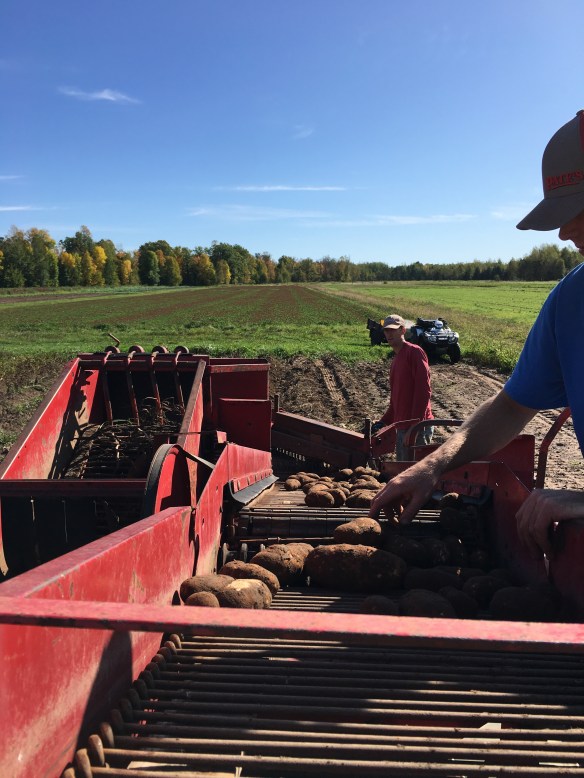
Most of the week was spent harvesting the second planting of carrots. We also picked the last of the outside tomatoes and stacked the squash to store for winter. We took the new potato harvester for a test run. Little tweaks and improvements were made to the design. And it works great!

A ray of baby sunshine came out to the farm on Friday. Bosen and Karin lent a hand and all seemed right with the world again.

From a farm crew out finding the joy,

Tiffany


In Your CSA box:

Northeastern Pole Beans, Beets, Broccoli, Carrots, Cilantro, Cucumber, Lettuce, Yellow Onion, Parsley, Red-ish Sweet Peppers, Hot Peppers, Potatoes, Delicata and Sunshine Squash, Tomatoes, Turnips


Breakfast Huevos Rancheros

Lots of people have very different meanings for huevos rancheros. I like to keep it simple.

  • 2-4 medium potatoes (depending on number of people eating), shredded.
  • Salsa
  • Sour cream
  • Cilantro
  • Shredded cheese
  • Eggs and or meat of choice.

Shred potatoes and squeeze as much water out of them as possible. Heat skillet (cast iron is ideal) to medium high heat with olive oil. Test skillet with sample of potatoes or water to see if it sizzles.

Once skillet is hot place shredded potatoes evenly on skillet about 1-2 inches thick. Salt and pepper top. Drizzle olive oil over top as well.

Leave alone for 5 minutes. Check the bottom often to make sure it isn’t sticking to pan. Flip once golden brown. Salt and pepper other side. Wait another 5 minutes and turn off heat.

Fry eggs to desired consistency. I would recommend over medium-hard. Place shredded cheese on hash browns. Place cooked egg on top of cheese. Apply more cheese. Add a dollop of sour cream and salsa. Garnish with chopped cilantro.

Add ground beef or shredded pork if you are into that for a different flavor.

Autumn Harvest Salad

  • Delicata Squash
  • 1 garlic clove
  • 3 cooked beets
  • 1 raw onion
  • 1 bunch of crunchy kale
  • 1 tbsp maple syrup
  • 1 cup farro- cooked
  • 3/4 tsp chili powder
  • 1/4 tsp paprika
  • Salt and pepper
  • 2 tbsp Apple cider vinegar
  • 4 tbsp olive oil
  • 4 oz goat cheese
  • Parsley for garnish

Set oven to 400 degrees. Cut delicata into slices. Dress with olive oil, salt pepper and chili powder. Roast for 15 minutes.

Cut beets into small cubes. Toss in olive oil place on baking sheet and roast for 30-40 minutes or until tender.

Cook farro by directions and cool. Whisk together ingredients for dressing: apple cider vinegar, maple syrup, olive oil, paprika, chili powder, salt and pepper.

In a large bowl add kale, squash, farro, beets and chopped raw onion. Add dressing and mix well. Top with goat cheese and a garnish of parsley.

Summer CSA, Week 8

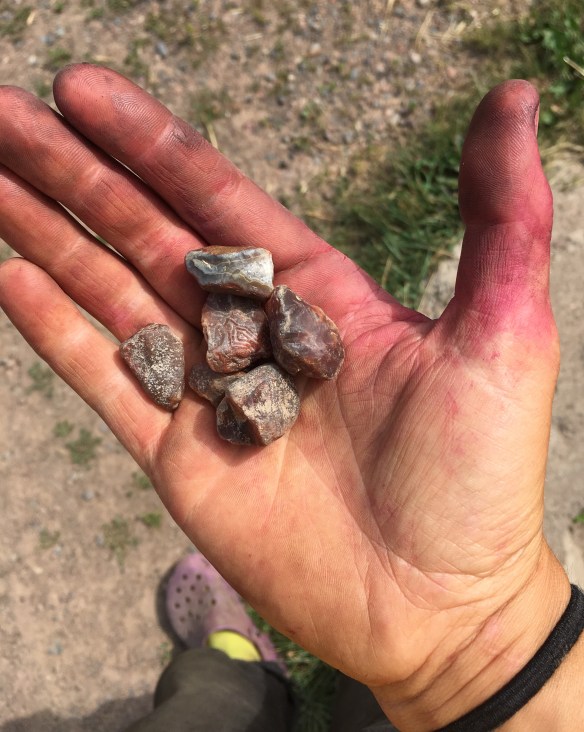
The agate; a treasure to find for north shore residents. We scavenge gravel pits and construction sites looking for those glossy banded rocks. We look with bent necks along the shores of Superior. And each time we come across an agate it’s an exciting surprise.

Some believe agates should go back where they were found, perhaps for the next person to find the joy. Others hoard them in jars around their homes or in the cup holders of their cars.

Our radionics padawan Garret, refers to them as energy boosters. Walking around the farm it’s common to find them piled up waiting to put a smile on someone’s face.

The last two weeks have been a collective effort to weed the 3rd and 4th planting of carrots. With burnt knees and blistered knuckles we damn near completed all 39 beds worth. By the time you read this we might have finished the last seven rows.

Sam and Garrett enjoy tucking agates between carrots. Someone will find it along the way and put it in a row next to them for someone else. Little energy boosters.

Medieval folklore suggests farmers in Europe believed agates could protect their dairy cows.

To prevent milk from spoiling during lightening storms they would hang agates inside barns. This had the added benefit of keeping the witches away from riding their cows at night. A witch will not enter a building protected by an agate.

Agates were also fastened to equipment to ensure a healthy productive crop.

As much as I’d love to see a witch riding a cow, I’d rather have a glass of unspoiled milk.

From a witch weary farm crew,

Tiffany


In your CSA Box: Broccoli – Carrots – Cilantro – Cucumber – Dill – Napa Cabbage – Green Onion – Peas – Green Pepper – Jalapeño Pepper – Tomatoes – Zucchini


Cucumber and Napa Cabbage Coleslaw

  • 1/4 cup Cilantro
  • 2 Cucumbers
  • 1/2 large Napa Cabbage
  • 1/2 cup peanuts-roasted
  • 1/2 tsp garlic powder or some scapes if you have them from last week
  • 1 tsp red pepper flakes
  • 1/4 cup lime juice
  • 1 tsp salt
  • 2 tsp sugar
  • 1/3 cup peanut or canola oil

Chop cucumber and Napa cabbage into thin elongated slices. Dress with cilantro roasted peanuts. Combine peanut oil, lime juice salt sugar and garlic powder to drizzle over slaw.