Summer CSA Week 14

Can you all believe it, we only have 4 more weeks of our Summer CSA season!

The final weeks of the CSA season are busy, busy, busy! Mother Nature threw quite the curve ball for us on Friday night with her far too early, danger of frost. Usually we don’t have to start worrying about the dreaded F word until later in the month. We chose the mentality that if you don’t think about it, it won’t happen (it’s actually the only thing any of us thought about all week, but we had good intentions). Things worked out well for us. It did get really chilly on Friday night, but with the exception of a few melon vines the plants appear to have been mostly unaffected. We then had to pull out our warm-ish layers to get ready for our busy Saturday.

On Saturday, we were at Bayfront for Harvest Fest. It’s always a fun event to meet so many people in the community, chat with other local farmers, and show off some new things. If you stopped by our booth, you may have seen our mini carrots in their packaging. The bags arrived just in time for Harvest Fest, and will be hitting some grocery store shelves later this season, so be on the lookout for them. You’ll be getting this variety in your shares this week, but 2 pounds instead of the little bags for market.

In preparation for the remaining few weeks of the CSA season, Janaki starts taking inventory of all the vegetables we have sent to our members so far this season, and starts planning for when we will send the remaining vegetables.  You all have gotten lots of delicious veggies so far, but there are still quite a few things you haven’t seen in your boxes yet. Spoiler Alert: we still have leeks, rutabaga, parsnips, pole beans, red cabbage, winter squash, and brussels sprouts. This week we have a new addition to the line up with Carmen peppers. These peppers look intimidating because their shape resembles that of a spicy pepper, but they are not spicy at all. They are like a sweet red bell pepper but we love the thick walls and robust flavor of the Carmens.

Along with planning what else will go in the boxes for the remaining weeks, Janaki also starts creating a plan for our big Fall harvest that happens at the end of October. A big part of this is pulling out the carrot and potato harvesters to fix anything that got broken/damaged last fall or over the winter in storage, and to dust off the machines and the crew’s sorting abilities that haven’t been used in a year. We used the carrot harvester on Wednesday to get most of the third planting of carrots out of the field, and we used the potato harvester on Thursday to get russets and red potatoes out of the field to bring to Harvest Fest. This means that for the last 13 weeks, every vegetable you’ve received in your box has been lovingly harvested by hand by our hard working farm crew. 

It’s an exciting time when the veggies are large enough and mature enough to use the full sized harvesters. We weren’t able to use the potato harvester until now because the potatoes weren’t mature enough. Their skin was still too delicate for all of the rolling, shaking, and dropping that the potato harvester puts them through. The first two plantings of carrots were large enough and mature enough that we could have used the harvester. However, due to the disease, the carrots required a lot of sorting. This would have required the harvester to go slower so we would have time to sort more accurately. If we run the carrot harvester too slow, the harvester will skip over some carrots leaving them in the field. We actually enjoy hand-harvesting, but when we’re all geared up to go fast it gets pretty irritating in a hurry when things go wrong. 

Aloo Gobi

Ingredients

2 Tbsp. vegetable oil

1 red chili, diced

2 cloves garlic, minced

1 Tbsp. minced ginger

1 tsp. garam masala

1/2 tsp. dried turmeric

1/4 tsp. cayenne pepper

3 potatoes, peeled and chopped into 1″ pieces

1 medium head cauliflower, cut into florets

1 c. low-sodium vegetable broth

Kosher salt

Freshly ground black pepper

Freshly chopped cilantro, for serving

  • Directions
  • Step 1:In a large skillet over medium-high heat, heat oil. Add chili, garlic, and ginger and cook until fragrant, 1 minute. Add garam masala, turmeric, and cayenne and cook until toasted, 1 minute more. 

  • Step 2:Add potatoes, cauliflower, and vegetable broth and season with salt and pepper. Reduce heat and cook, covered, until potatoes and cauliflower are tender, 15 minutes. Garnish with cilantro to serve.

  • Melon and Cucumber Salad

    Ingredients

    • cantaloupe, seeds removed and cubed
    • 1 large cucumber , thinly sliced
    • 1 large red bell pepper, thinly sliced
    • 1/2 large red onion, thinly sliced
    • 3 – 4 tablespoons apple cider vinegar (white wine vinegar ok too)
    • 1 tablespoon olive oil, optional
    • 1/2 teaspoon fresh cracked pepper, or to taste
    • good pinch of salt
    • fresh basil or mint, to garnish (optional)

    Instructions

    Cantaloupe: Slice your cantaloupe in half (doesn’t matter if you slice it horizontally or vertically). Scoop out the seeds with a large spoon and discard. Slice your cantaloupe halves into 5 or 6 slices. Using a sharp knife, cut from one end of the slice to the other as close as you can to the rind, slowly and carefully cutting the orange flesh away from the peel. Slice into bite size pieces.

    Cucumber: Slice off each end and using a vegetable peeler remove the outer skin (leave skin on for extra nutritional value and fiber). Slice the cucumber into 1/8 – 1/4 inch slices.

    Bell Pepper: Wash and core your bell pepper. Slice into 1/4 – 1/8 inch slices. Cut the slices in half.

    Onion: Slice the onion in half lengthwise. Cut off both ends of one of the halves and remove the outer layer. Place the sliced onion, end cut down and slice into 1/8 – 1/4 inch slices. If onion slices seem too long for you, cut them in half.

    Assemble salad: Place ingredients in a large bowl. Add apple cider vinegar, salt and pepper and mix well to coat. Cover and set in the refrigerator for an hour or so to chill and marinate, mix occasionally if you like

    Summer CSA Week 13

    Last week I promised you all an official update on how the caterpillar tunnel experiment went. I know a few of you were heartbroken to learn that this was not in fact a fun tunnel that we let caterpillars run through all day, but instead it was an effort to save our sad looking tomatoes.

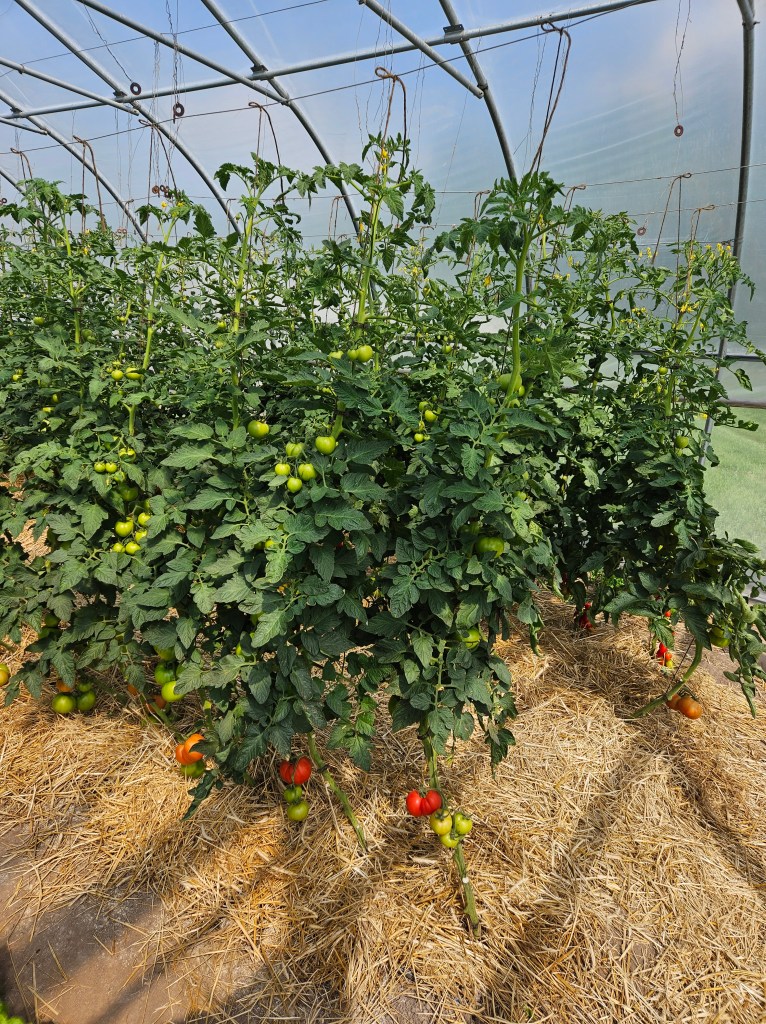
    At the beginning of the season, before we put the caterpillar tunnel up, the field tomatoes looked very stressed. They had gotten their leaves pelted by so much rain and the soil was soaked. As we hustled to get the tunnel up before yet another 2″ rain, we worried that it might be too late for them to recover. I am happy to report that the exact opposite happened. We put the caterpillar tunnel over the tomatoes, and in just a few weeks, they looked like entirely different plants. The leaves went from a dry, shriveled, brown color to a soft, vibrant green color. The plants started producing more leaf sets, growing taller, and eventually putting on flowers and fruit. We think the protection from the elements really saved them because the rest of the field tomatoes developed early blight.

    The fruit has been slow to ripen, but that could be because we pinched off the first one or two sets of flowers in an effort to convince the plant to focus on getting healthy rather than producing fruit. We have been able to harvest a few tomatoes, but most of the fruit on the plants is still green.

    The most important factor in determining if this tunnel was a success came down to the taste. First, for background, we haven’t been satisfied with our greenhouse tomatoes for a few years so this year we tested out new fertility sources. Previously, our nitrogen source was coming from fish fertilizer, and our potassium source was mineral based. Nitrogen is important for the chlorophyll formation in plants. Chlorophyll is what makes plants green which allows them to absorb sunlight through photosynthesis. Without adequate nitrogen, plants won’t be “green” enough to absorb sunlight thus stunting their growth, and possibly preventing them from fully maturing. Potassium is important for plants because it aids in regulating the rate of photosynthesis, and it is associated with the movement of water and nutrients throughout the plant. Without adequate potassium, plants have reduced yield, stunted growth, and poor flavor. 

    Our previous fertilizer mixture worked okay (though applying fish fertilizer through drip tape is a smelly hassle), but we wanted to see if we could do better so we tried an amino acid based nitrogen. This is beneficial to the plants because amino acids are immediately available for the plants to absorb. The fish fertilizer delivered nitrogen in the form of proteins which can take a while to break down so they can be absorbed by the plants. We also switched to using a plant based potassium source instead of a mineral based source. Mineral based sources can often lead to a build up of minerals at the roots of the plant, preventing the plant from being able to absorb other nutrients. We also added calcium and micronutrients to round out the program.  

    Farmer Janaki thought this new fertilizer combination made the greenhouse tomatoes taste significantly better than in previous years. This meant the caterpillar tunnel tomatoes had to be really great in order to earn the top spot for best tomatoes on the farm this year. We had lots of people taste testing, and we all came to the same conclusion: for our Geronimo (large slicing tomatoes) we compared one from our regular greenhouse and one from our caterpillar tunnel, and the greenhouse won. They both had a similar texture, but the greenhouse tomato had more flavor. We also compared an Early Cascade (small canning tomato) from outside and one from the caterpillar tunnel. In this test the caterpillar tunnel won. Again, they had similar textures, but the appearance and flavor of the caterpillar tunnel tomatoes was better. Oddly, the caterpillar tunnel fruit ripened later than both the high tunnel and field tomatoes. We only did a small sample so far, and this is just one year, so we are excited to keep this in mind and see if we feel the same again next year. In farming, there are so many variables that it’s hard to run true experiments that inform results year-to-year, but we keep trying to zero in on better ways of growing healthy food!

    In your share this week:

    Green Beans – Broccoli – Cucumbers – Zucchini – Tomatoes – Sweet Onions – Carrots

    Hot Peppers – Sweet Peppers – Potatoes – Melons – Lavender

    Marcella Hazan’s Tomato Sauce 

    2 cups of tomatoes with juices

    5 tablespoons of butter

    One onion, peeled and cut in half

    Salt

    Combine tomatoes and juices, butter and the onion halves in a sauce pan with one or two pinches of salt.  

    Place over medium heat and bring to a simmer. Cook uncovered for 45 minutes occasionally stirring and breaking up chunks of tomatoes with the back of the spoon.

    Discard the onion before pouring sauce on cooked pasta.  This recipe creates enough sauce for 1 pound of pasta.

    Marinated Vegetable Antipasto

    Vegetable suggestions: Blanched and chilled broccoli, cauliflower, and carrots.  Onion, celery, sweet peppers, zucchini

    Marinade:

    1/2 cup water

    1-1/2 cups wine vinegar

    1 cup olive oil

    2 tbsp sugar

    2 tsp fresh oregano, minced

    1/2 cup pitted olives

    Salt and pepper to taste

    Prepare appx 8 cups vegetables by cutting into bite-size pieces.  Bring marinade ingredients to a boil in a larger saucepan.  Add approximately 2 quarts of cut up vegetables – cover and cook 3 to 4 minutes, stirring once.   Uncover, cool and refrigerate for at least two hours. Drain before serving.

    Summer CSA week 7

    Last week felt like it was all about tomatoes here on the farm. This can only mean one thing, TOMATO SEASON IS HERE! Our crew member Catherine, and our lovely volunteer, Patricia, spend a lot of time in the Spring and Summer keeping the greenhouse tomatoes happy and healthy while the rest of the farm crew tends to all of the outdoor tomatoes. It’s helpful to dedicate specific people to each location since the tomatoes are grown in different ways, which requires different levels of attention. 

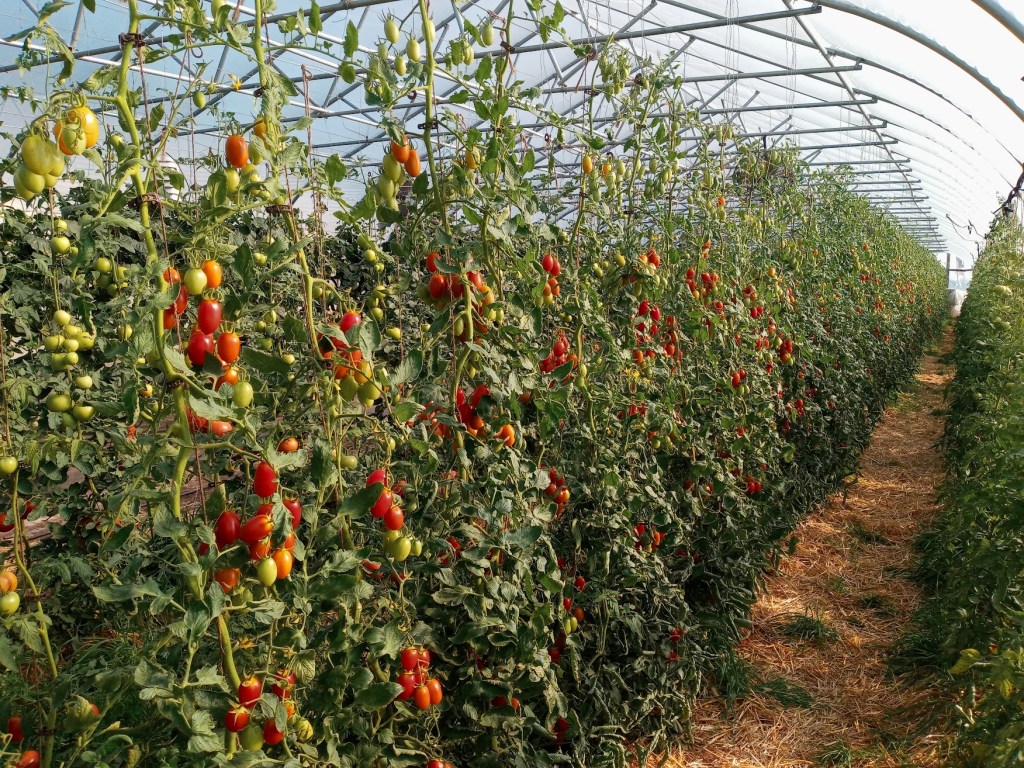
    In the greenhouse, we vertically trellis the tomatoes using the single leader system. In non-farm speak, this essentially means that we force the tomato plants to grow on one single stem, and we use a small circular clip to connect the twine to the tomato stem as a means of supporting the plant as it continues to grow. Tomatoes love to grow what we call suckers, also known as side shoots. These are shoots that sprout out from where the main stem and a leaf meet. If we left the suckers on the plant, they would eventually grow into another top, so the plant forms a bush. This sounds really cool because most people think it means extra tomatoes, but it can actually mean the exact opposite. By leaving the suckers, the plant then has more stems and leaves to distribute nutrients to. As the plants grow taller, this can take a lot longer for the nutrients to get past all the suckers and make its way to the top of the plant. This means more of the plant’s attention is put into vegetation rather than fruit. Too much foliage also reduces air movement which is one of the many ways tomato plants can get and spread disease. In order to achieve this, once a week, Catherine and Patricia spend time pruning off any suckers and adding clips to the plant to keep it supported. This week, Catherine also spent time taking off any of  the leaves that were growing below the first set of fruit. This does two things, it speeds ripening by allowing more light to reach the fruit, and creates better air circulation. With the hot weather we’ve recently been getting, and the plants being grown in an already hot greenhouse, more air flow is very welcomed by the plants. 

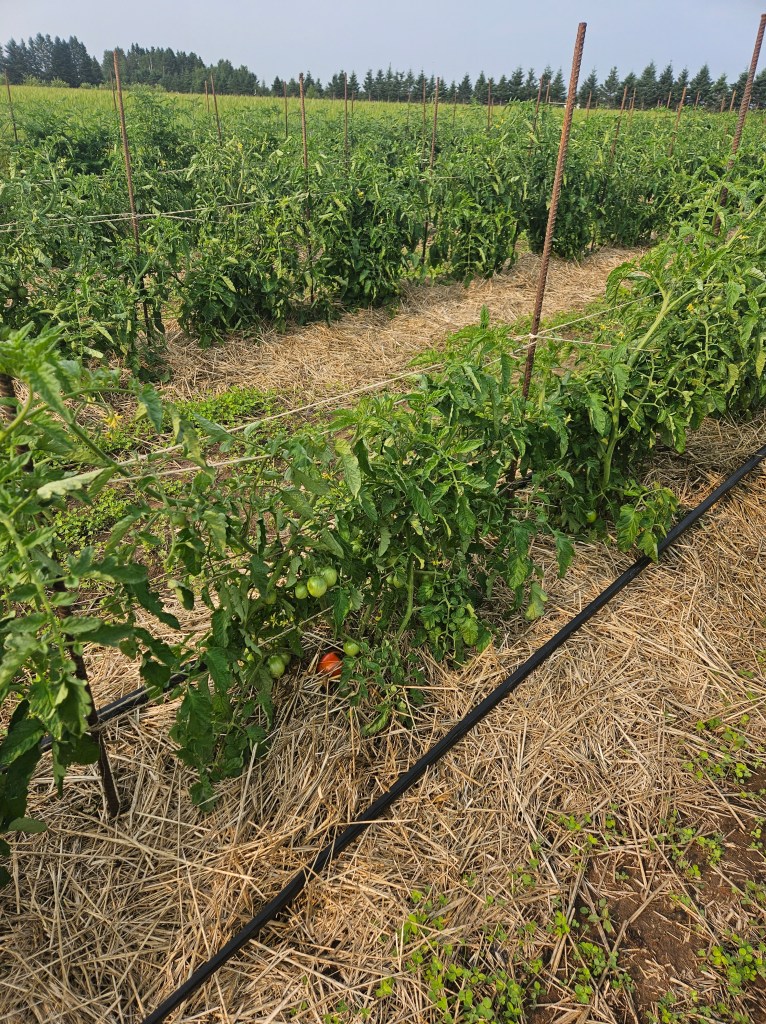
    The outside tomatoes are a whole different story. We don’t do any pruning on those tomatoes. Airflow is better outside, and space isn’t at as much of a premium, so we’re able to plant the tomatoes farther apart without causing disease or shading. Another major difference between the inside and outside tomatoes is how they are trellised. Since there isn’t a pole or wire above the tomatoes, and we aren’t pruning them to follow the single leader system, the easiest way to trellis these crazy tomatoes is to use what is called the “Florida Weave” or “Basket Weave” method. With this method, posts are evenly spaced between the tomato plants, and string or twine is tightly run, horizontally, on either side of the plant. This method works to compress the plant so it stays tight and tidy in its space. It helps to lift the leaves off the ground so they are less likely to pick up diseases from the soil splashing on the leaves when it rains.  Most home growers will use a tomato cage which creates a similar effect. However, with the cages, the plant will eventually grow over the top of the cage and run out of support, and cages are prone to falling over unless they’re large, which can make harvesting tedious. With the Florida Weave method, a new set of twine is added every week or so as the plant grows to continue giving it support. At this point in the season, the outdoor tomatoes have 3 sets of twine holding them up, and we plan to add another 3 or 4 as the season progresses. 

    The cool thing about these trellising methods is that they aren’t exclusive to tomatoes. You can use either method for trellising many other vegetables. On the farm, we use the single leader, vertical trellising for all of our greenhouse cucumbers. In the coming weeks, we will use the Florida Weave method as a form of trellising all of our pepper plants. 

    In your share this week:

    Beets – Broccoli/Cauliflower – Cilantro – Chard – Carrots Green Onions – Snap Peas – Juliet tomatoes (just a couple today, but more to come!) 

    Fried Rice

    3 tablespoons oil

    One medium onion, chopped

    1 clove garlic, minced

    One bell pepper, chopped

    Two carrots, chopped

    Broccoli or cauliflower chopped

    Chard cut into ribbons

    Snap peas, chopped

    Green onions, chopped

    1/4 cup Cilantro, minced

    Tomatoes, optional

    2 eggs, whisked

    3 to 4 cups of cooked rice, cooled

    1/4 c water

    2tbsp soy sauce

    1 tbsp sesame oil

    Salt and pepper to taste

    Put 1 tablespoon of oil into a wok or large skillet.   When it begins to shimmer add the chopped onion, garlic, carrots, pepper, broccoli, and cauliflower.  Sauté a few minutes and then add the peas, chard and tomatoes.  Fry  until partially cooked, but still crisply textured. 

    Remove vegetables. Add remaining oil to pan or wok.  When the oil shimmers, add the rice.  Break up clumps and stirfry. Make a well in the center and pour the eggs into the well.  Scramble the eggs in the middle of the rice and when they’re cooked, add all the vegetables.

    Add water, soy sauce, sesame oil and salt + pepper.   Stir.   Top with cilantro and green onions

    For the farm crew,

    Jennifer

    Summer CSA Week 12, 2023

    It was so nice to see Food Farm folks this Saturday–we enjoyed speaking with so many of you and show off our hard work!

    As some of you may have noticed, the root cellar is gradually filling up with a colorful abundance of carrots, beets, cabbage and potatoes. The farmers have been diligently packing up more and more of these vibrant vegetables, destined for grocery store shelves and eager CSA members.

    Moreover, last week marked the collapse of our onion tops. This may sound slightly catastrophic, but don’t worry – it’s a good thing! The leaves fall over simply because the plant has matured and is no longer developing. It’s also how we know they are ready for harvest. In the photo (see left), you can see Teri & Aaron gently lifting them from the ground before laying them out to dry. Careful handling is essential during harvest to avoid bruising, which makes the bulbs susceptible to storage rot. Following the uprooting, these onions will begin their curing process in the fields for a week or so before having their tops removed and transferred to a well-ventilated indoor storage space.


    In your share this week:

    Basil – Beans – Broccoli – Cauliflower – Carrots – Celery – Cucumber – Melons

    Sweet Onions – Bell Peppers – Potatoes – Tomatoes – Zucchini


    The recipes this week have a lot of room to make them your own. Either one would be good with just about any item in the share (excluding the melons). So feel free to follow them as directed or create your own pizza & curry experiments…


    Zucchini Crust Pizza, from The Cozy Cook

    2 cups shredded zucchini
    1/4 teaspoon salt
    3 large eggs, beaten
    1/2 cup all purpose flour (almond flour, coconut flour, and whole wheat flour may also be used)
    1/3 cup shredded parmesan

    1. Preheat oven to 350°.
    2. Spread the shredded zucchini out on a lightly greased baking sheet and sprinkle lightly with salt. Bake for 15 minutes. Remove and transfer the zucchini to paper towels or a cheesecloth.
    3. Increase oven temperature to 450°.
    4. Squeeze out as much additional moisture from the zucchini as possible. Add the zucchini to a large bowl along with the whisked eggs.
    5. Sprinkle the flour in gradually, stirring to incorporate. Continue to add flour until desired consistency is obtained. (I use the entire ½ cup for all-purpose flour.)
    6. Spread out onto a lightly greased 12-inch pizza pan, leaving 1-inch or so around the edges.
    7. Top with shredded Parmesan cheese and bake for 18 minutes, until it begins to brown slightly. Remove from oven.
    8. Reduce heat to 400°.
    9. If possible, let the crust cool for extra crispy results.
    10. Top with desired pizza toppings. Bake for ~10 minutes, until the cheese is melted and bubbly.

    Summer Vegetable Curry, Inspired by Half Baked Harvest

    Basil Coconut Ginger-Lime Rice:

    1 (14 ounce) can coconut milk
    1 cup jasmine or basmati rice
    1 tablespoon fresh ginger grated
    1 lime juiced + zest

    1. Add the coconut milk to a medium size pot. Bring to a low boil and then add the rice, salt, and ginger. Stir to combine and then place the lid on the pot and turn the heat down to the lowest setting possible. Allow the rice to cook ten minutes on low and then turn the heat off completely and let the rice sit on the stove, covered for another 20 minutes (don’t take any peeks inside!). After 20 minutes remove the lid and add the lime juice + zest.

    Curry:

    4 tablespoons extra virgin olive oil
    1 pound boneless, skinless chicken, diced
    2 bell peppers, chopped
    1 zucchini, chopped
    2 cups green beans, chopped
    1 cup broccoli, diced
    1 cup cauliflower, diced
    1 cup carrots, diced
    1 tablespoon fresh ginger, grated
    2 cloves garlic, grated or minced
    2-3 tablespoon thai red curry paste
    1 (14 ounce) can coconut milk
    1 tablespoon fish sauce
    1/2 cup fresh basil, chopped
    1 mango, diced
    1 jalapeño, seeded + diced
    fresh naan and goat cheese, for serving

    1. Heat a little olive oil in a large skillet over high heat. Add the chicken and cook until browned and cooked through, about 5-10 minutes.
    2. Add another drizzle of olive oil to the skillet. Add the peppers, zucchini, beans, broccoli, cauliflower, carrots, ginger and garlic. Cook the veggies 5 minutes or until they just begin to soften.
    3. Add the coconut milk, curry paste, and fish sauce. Stir to combine, bring the mixture to a boil, cook 5 minutes or until the sauce thickens slightly. Remove from the heat and stir in the basil.
    4. In a small bowl toss together the mango and jalapeño.
    5. Serve the curry over the rice. Add a spoonful of the mangos and a sprinkle of goat cheese. Eat with Naan!

    For the farm crew,

    Charlie

    Summer CSA Week 17, 2022

    It’s pumpkin time!

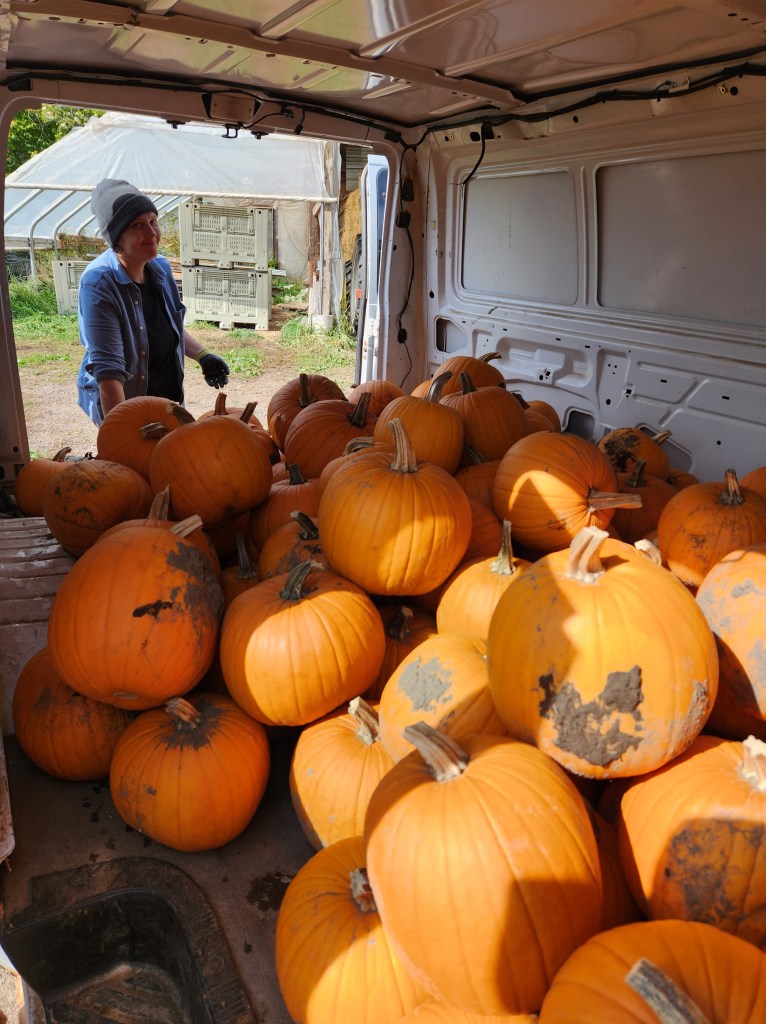
    This is the penultimate CSA week! You will be receiving a carving pumpkin with your share this week. The pumpkins do not fit in the box, so please remember to grab your pumpkin when you pick-up. Enjoy carving jack o’lanterns! Try roasting your pumpkin seeds for a bonus tasty snack.

    Next week will be the 18th and final CSA box for this season. It has been a joy having you as part of the Food Farm family!

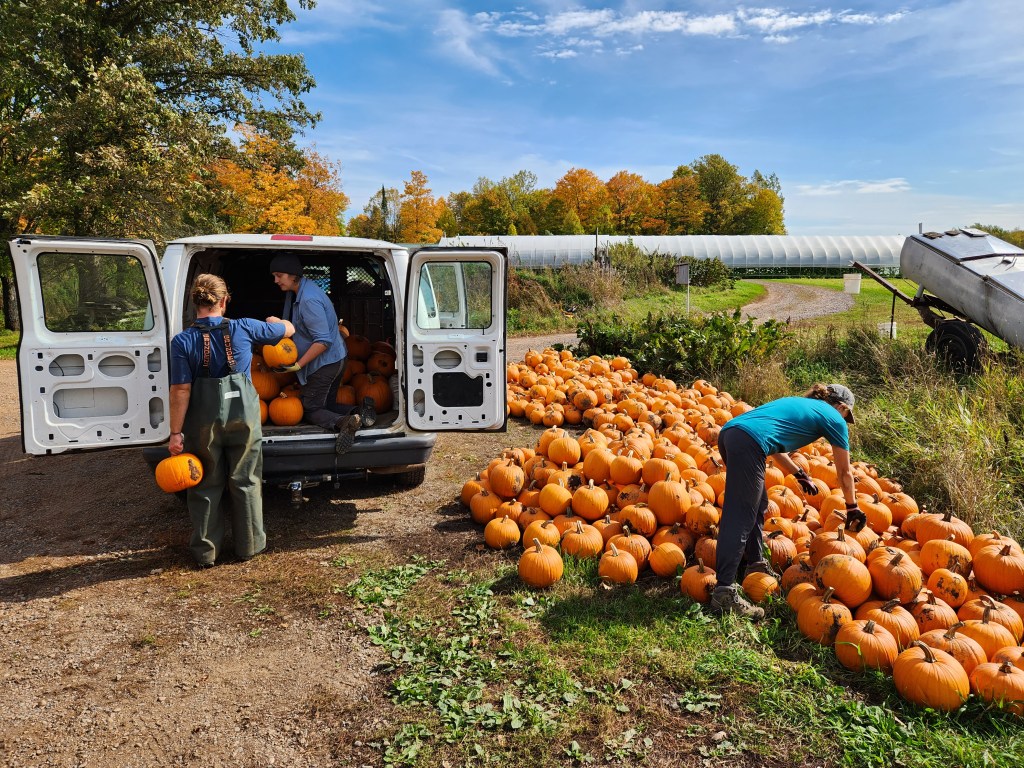
    Loading up pumpkins for Monday deliveries.

    In your share this week:

    Noreaster Beans – Broccoli – Carrots – Garlic – Leeks – Lettuce – Onion – Sweet Red Peppers (not hot) – Jalapeño Pepper (hot) – Yellow Potatoes – Daikon Radish – Delicata and Acorn Squash – Tomatoes – Parsley


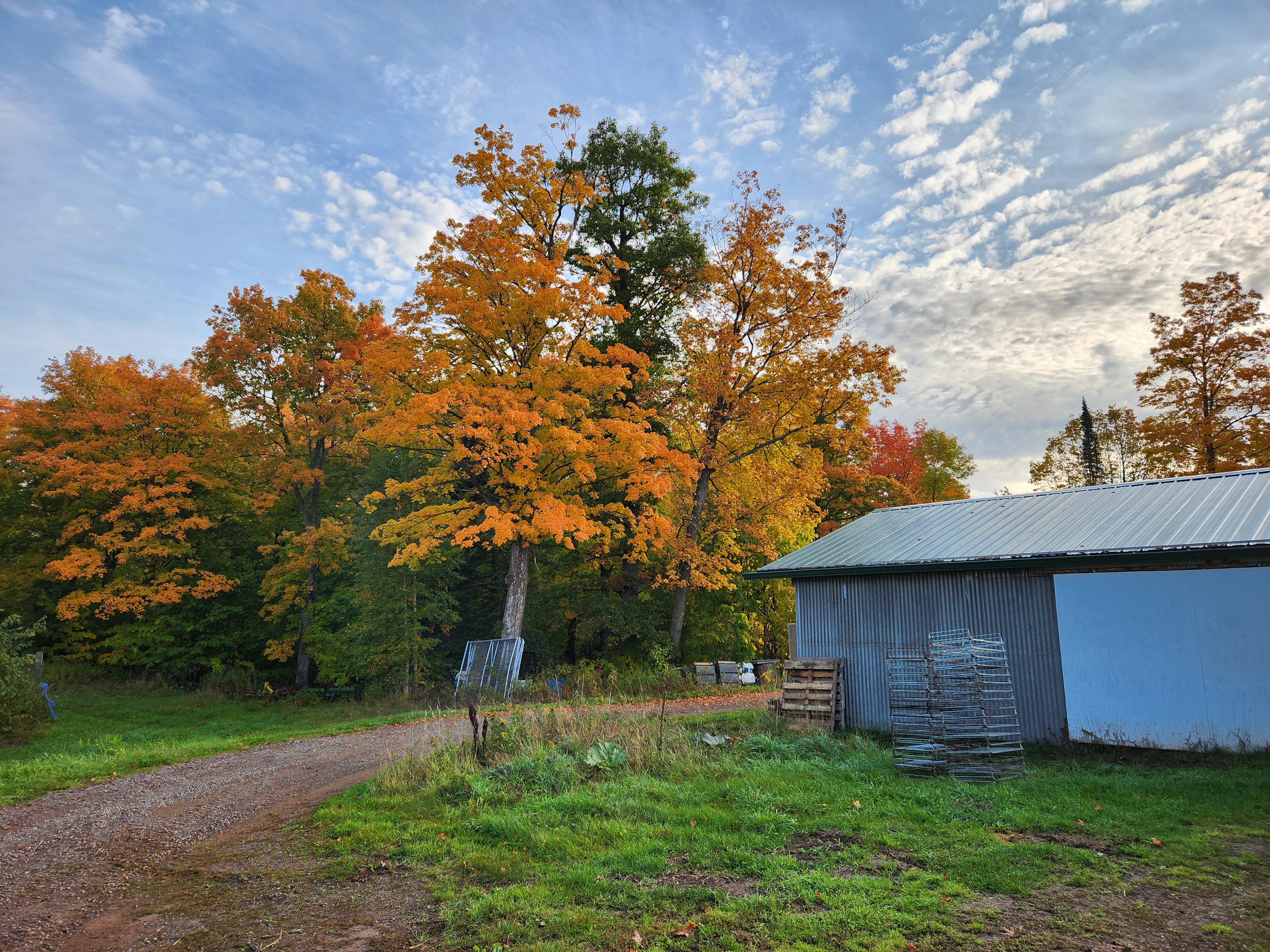
    Leaves changing at the farm


    Universal Cream of Vegetable Soup

    This recipe works for nearly any vegetable the farm grows – from celery to leeks to squash! This is also a great way to use up veggies from last week.

    Ingredients

    • 4 tbsp butter
    • 6-8 cups coarsely chopped veggies (suggested starting point: 1 med onion coarsely chopped, 2 leeks, one clove garlic minced, 2 diced carrots,  2-3 stalks celery coarsely chopped, 2 potatoes diced. Add any other veggie like broccoli, cauliflower, or  squash to total 6 cups veggies.)
    • 1/4 cup flour.  
    • 4 cups broth (chicken, pork or veggie)
    • 1/2 to 1 cup milk or cream
    • Salt and pepper to taste

    Instructions

    1. Sauté veggies in the butter 10-15 minutes (until tender but not brown).
    2. Add flour and cook for a couple of minutes.  
    3. Turn heat to high and add 4 cups of broth (chicken, pork or veggie), while constantly stirring as the soup thickens.  Bring to a boil.  
    4. Reduce heat to simmer the soup.  Cook, partially covered, until the vegetables are very tender (appx 30 minutes).   Using an immersion blender, food processor, or blender process the soup until smooth.  Add a little water or more broth if the soup is too thick and difficult to process.  
    5. Return soup to the pot and add 1/2-1 cups milk or cream.  Salt and pepper to taste.
    6. Can be served with grated cheese.

    Recipe from Deb Rausch


    What to do with Daikon Radish?!

    This week you will find daikon radish in your box. Daikon is a large peppery variety of radish that is common in Asian cuisines. This crunchy vegetable can be eaten raw, pickled (like in traditional kimchi), or cooked.

    Vietnamese Pickled Carrots & Daikon Radish (Đồ Chua)

    Ingredients

    • 1/2 lb daikon radish*
    • 1/2 lb carrots*
    • 1 tbsp salt
    • 1/2 c boiling water
    • 5 tbsp granulated white sugar
    • filtered room temp. water
    • 4 tbsp distilled vinegar

    Instructions

    1. Peel daikon and carrots, then cut with mandolin slicer medium to small matchsticks. Smaller cuts will pickle faster.
    2. In a large bowl, sprinkle with salt evenly and toss to coat. Soak for 15 minutes.
    3. Rinse thoroughly to remove the salt and in small hand-fulls, squeeze to remove as much moister as you can.
    4. Add to jars, filling almost to the top.
    5. Create the vinegar solution (brine) by boiling water then adding sugar. Mix to dissolve. Add vinegar.
    6. Pour this liquid evenly into your jars. If needed, add extra room temp water to barely fully submerge the veggies.
    7. Screw on the lids, store at room temperature until pickled to your taste, checking every 12 or 24 hours. It usually takes 2-5 days depending on the temperature.
    8. Refrigerate when ready, for up to 3 weeks, or until too sour or veggies lose their crunch.

    *You can change the ratio of veggies to your preference and/or scale the recipe up or down depending on how much veg you have to pickle. Just make sure you have enough brine to completely submerge your veggies.

    Based off recipe from Hungry Huy.

    Check out other daikon recipes here.


    For the farm crew,

    Starr

    Summer CSA Week 4

    At the end of every CSA season we send out a survey to you our members to find out what you thought of your share boxes throughout the season. There are some general questions about how we did, how you felt about the season, and then line by line we ask if you thought you got too much, too little, or just the right amount of every item we send all season long. It’s a long list, as you can imagine.

    We use all that information to try to see what, if anything we should change about what we send in the share boxes, and thus, what we should plant on the farm every spring. Over the years it seems like the farm has honed in pretty well to what works for many of you.

    Every year though, there are always responses that lean more to the “too much!” side than “never enough!” (we sure don’t want anyone to feel like there’s not enough -except the snap peas – we can never grow enough of those!).

    I seem to remember a couple of years back, many members feeling like they had received too many green onions. A few snipped on top of a baked potato won’t use up a bunch a week, but it seems like green onions are often thought of as a garnish in recipes as opposed to a component adding a lot of flavor. Throughout my week, I seem to always be chopping an onion up, even before I’ve fully decided what to make for dinner. I know whatever I make, it needs onion. You can do the same thing with green onions. Whatever recipe calls for onion using green onions would offer that same flavor punch so you can either substitute/or add green onions. Plus, if you’re cooking them down like in a stir-fry, soup or curry you can use a lot of them. It maybe doesn’t need to be said (but I’ll say it), that green onions won’t need to be cooked as long, and can’t be caramelized in the same way as onions can.

    In other years I’ve recommended sharing food with friends or family as a way to use up a share if you’re struggling to finish it by the next week. Pot-lucks can be a great way to share and use up whatever you have laying around. This year the option of gathering around food is more complicated, and sharing more difficult. In spite of this, or because of this, I hope you are able to find creative ways to use, store and maybe even share the vegetables you get from our farm.

    Feel free to reach out if you have pro-tips on using up a share, or if you have questions that you think others might like answered as well!

    For the farm crew,

    Karin


    img_0614


    In your share this week:

    Broccoli – Cauliflower – Cucumbers – Garlic scapes – Head lettuce – Green onions – Pac choi – Radishes


    Roasted Cauliflower Spread

    From Food and Wine

    -I’ve said it before that I’m not much of a recipe person, and my educated guess is that this recipe would be very flexible. You could add in some of the garlic scapes and green onions, and probably change up the spices and herbs and still end up with a tasty spread as long as your liquid to solid ratio stays about the same.

    • 1 head of cauliflower (2 pounds), halved crosswise and thinly sliced
    • 1/4 cup vegetable oil
    • 1 1/2 tablespoons minced fresh ginger
    • 1 1/2 teaspoons ground coriander
    • Kosher salt
    • 3 tablespoons tahini (sesame) paste
    • 3 tablespoons fresh lemon juice
    • 3 tablespoons chopped cilantro
    • Sesame seeds

    Preheat the oven to 450°. In a large bowl, toss the cauliflower with the oil, ginger and coriander and season with salt. Spread the cauliflower on a rimmed baking sheet and roast for about 40 minutes, stirring once or twice, until tender and lightly browned in spots. Let cool slightly.

    Transfer the cauliflower to a food processor. Add the tahini and lemon juice and pulse to a chunky puree; season with salt. Add the cilantro and pulse just until incorporated. Transfer the spread to a bowl and sprinkle with sesame seeds. Serve warm with pita bread or chips (or on toast!)


    Garlic Scape Pesto

    • 10 Garlic scapes
    • 1/3 C Pine nuts or walnuts 
    • 1/3 C Parmesan, asiago or simply parmesan dice or shredded
    • 1/2 Lemon juiced
    • 1/8 tsp Fine Sea Salt or more to taste
    • A few grinds of Pepper
    • 1/3 C Olive oil

    Trim the garlic scapes by cutting just below the bulb. Discard the bulb and set the remaining scape aside.
    In a food processor, add the chopped scapes. Add the pine nuts, cheese, juice of the lemon and salt and pepper. Process by pulsing until the mixture begins to break down. Scrape the bowl down.
    With the processor running, slowly add all the olive oil. Continue to process until all the ingredients are incorporated and broken down, about one minute. Taste for salt.
    Store in a covered container or lidded jar in the fridge and enjoy within a week. Also, you can freeze the pesto in a jar or in an ice-cube tray. Once frozen, in the ice-cube tray, remove and place in a zip top bag in the freezer.
    img_0617

    Summer CSA, Week 7

    This week I’ve been thinking about life in miniature.

    What would life be like as a carrot? What does a potato bug think about?

    When a human is thundering towards you, hunched over and wielding a bent steak knife as a carrot, I would be terrified. Standing at a height of no more than 4 inches tall carrots line up in rows. They stand together through wind whipping across a field, giant rain drops, humans with knives, and absent minded deer.

    I imagine those little carrots are scared out of their minds by all the gigantic things that could hurt them in this world. But I also imagine those little carrots working through that fear, talking to each other with their little voices and radiating confidence. The more confident the carrot the tastier it is, obviously.

    However I do not think that same theory applies to a potato bug. Do not eat potato bugs, gross. We spent a lot of time with potato bugs this week. Leaving much opportunity to mull over the possibility of them being some sort of indestructible super bug.

    So what does a potato bug think about? Their whole world is around a couple of potato plants. Until they are adults they can only inch along like slugs. So do they chit chat with their friends while munching and destroying precious potato leaves? Do the adult bugs whisper sweet nothings into each others ears?

    I don’t imagine a potato bug being afraid of much. They seem like simple minded creatures. Worry is low on their list of priorities. The potato bug is more into socializing, gluttony, and hibernation.

    Seeing the world through a miniature perspective is a helpful reminder of how lucky we are to not be so mini. The wind across a field won’t blow us down. I cannot be shaken off a plant and put in a 5 gallon bucket.

    That is pretty cool.

    From a larger than life farm crew,

    Tiffany


    In your CSA box: Basil – Beets – Broccoli – Carrots – Cauliflower – Cucumbers – Garlic Scapes – Lettuce Mix – Green Onions – Zucchini – and a few surprise tomatoes!


    To throw everyone for a loop I went with sweet treat recipes.

    Zucchini Brownies

    • 1/2 cup Canola Oil or Olive Oil
    • 1-1/4 cup sugar
    • 2 tsp vanilla extract
    • 2 cups flour
    • 1/2 cup cocoa powder
    • 1-1/2 tsp baking soda
    • 1 tsp salt
    • 2 cups shredded Zucchini

    Preheat oven to 350 degrees. Combine oil, sugar, vanilla in medium bowl.

    Combine flour, cocoa powder, baking soda and salt in another bowl.

    Combine flour mixture to sugar mixture. The batter is crumbly.

    Stir Zucchini into batter. Batter should now be moist and thick.

    Place batter into 8 x 11 inch baking dish.

    Bake 25-30 minutes. Or until brownies are firm on edges of dish.

    Flourless Orange Cauliflower Cake

    • 1-1/2 cup cooked puréed cauliflower
    • 6 large eggs
    • 1 cup sugar
    • Zest from one orange
    • 2-1/2 cups ground almond meal
    • 1 tbs corn starch
    • 1 tsp almond extract
    • 1 tsp vanilla extract
    • 1/2 tsp salt
    • 1 heaping tsp baking powder

    Preheat oven to 350 degrees. Grease or line a spring foam baking pan. This is a sticky cake you need a spring foam pan.

    Purée cauliflower and combine eggs. Mix until fully combine. Add sugar, zest, almond meal, corn starch, extracts, salt and baking powder.

    Bake in prepared pan for 50-60 minutes or until set. Let cool in pan for 20 minutes before removing from pan.

    Sprinkle cake with powdered sugar and orange zest once completely cooled and serve!