Greetings on this sunny winter day! Karin was off newsletter duty today, so you’re stuck with the last minute ramblings Truman and I came up with. Here are his thoughts:
I would like to wish all the farm kids a very happy, jolly, merry Christmas and that you all get what you’re looking for this holiday. I am looking forward to special food in my stocking, especially candy canes because we only get those at Christmastime. My favorite foods for dinner are mashed potatoes, broccoli, carrots, and beets. I like making and eating gingerbread cookies. I also like being in my pjs all day, especially my footy firetruck pajamas. I call them my matchies because Ellis has the same ones.
Even–or I suppose especially–in a turbulent year like this, I am just so humbled by my position in this world, so thankful to have family and friends nearby, so honored to have hundreds of families trusting this farm for their food supply. The older I get the more I realize how essential it is to have these networks of support in place to allow me the energy to in turn do my part in what I hope is an effort to make the world a little better. Our family is incredibly grateful to this place, the people, and the planet we call home.
For the farm crew,
Janaki
In your share today: Beets, Red Cabbage, Orange and Purple Carrots, Onions, Yellow and Russet Potatoes, Sunshine and Delicata Squash
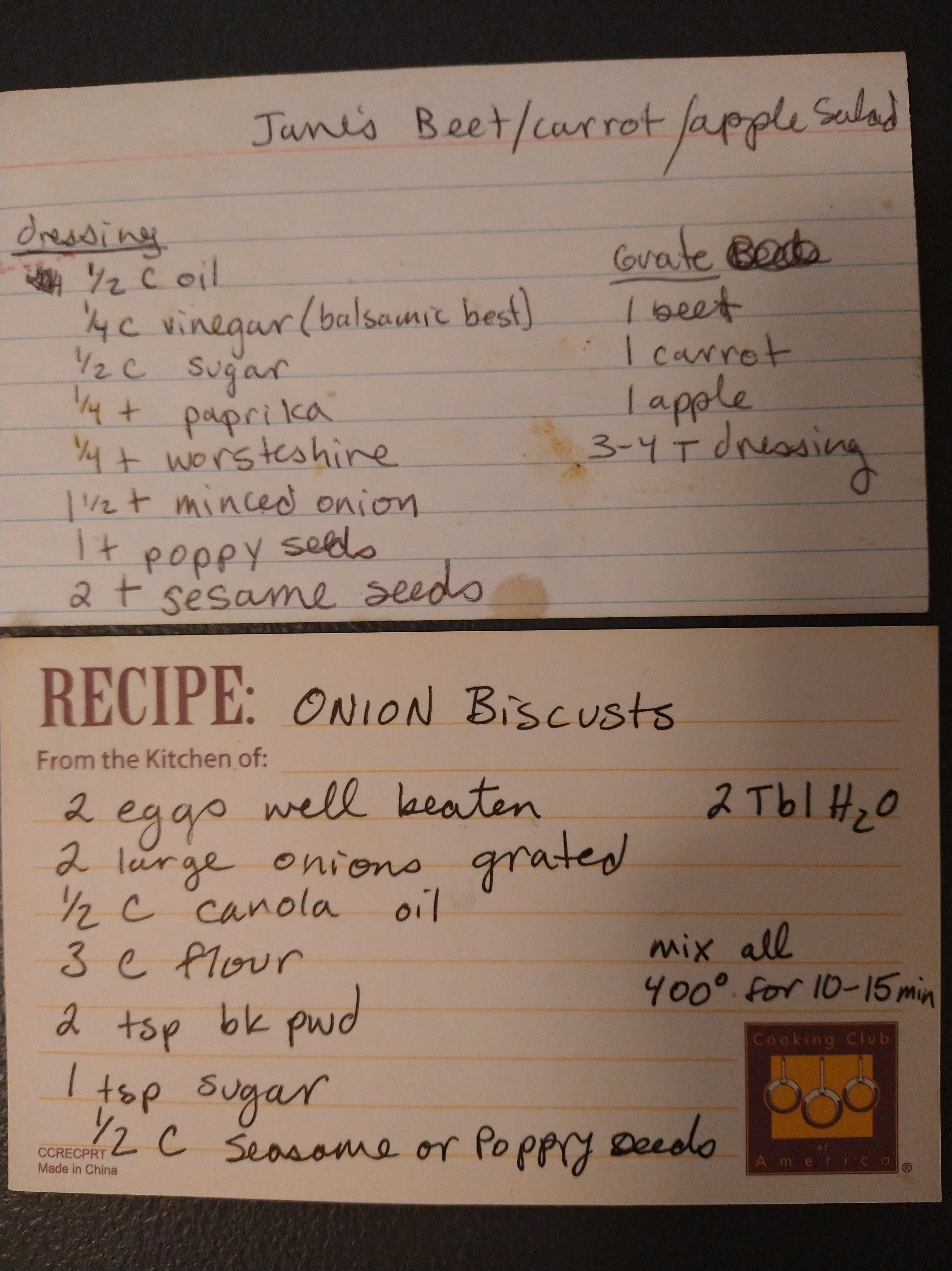
Sorry, I didn’t have time to type in recipes today, so I’m just going to take a picture of two of my favorites–hopefully you can read the handwriting!. I was skeptical of the fresh beet/carrot salad at first, but it has become a staple in our house. And warm biscuits are hard to pass up any time of the year.
As I look back over this farm season, I am reminded of how challenging it has been. There was not enough rain, then too much at once, then hail, then not enough rain again. It hasn’t been an easy year on the vegetables = not an easy year on the farmers.
Obviously, out there in the world there has been a huge amount of difficulty and unpredictability that has affected all of us. So much rubber seems to be meeting the road at once and it stinks. I practically have to hold my nose while listening to the news.
I think a lot of us have been thinking about food, how we get it, and how much of it we keep on hand at any one time during these past several months. Or any shopping and consuming really; I’ve learned about myself that I ran way more petty errands than I needed to in the “before times”.
For me, preparing food has been a nice diversion from other parts of life that feel more unsure, and more stressful. It’s been nice to sometimes, not always, have a meditative approach to cooking and baking to go along with the sometimes meditative aspects of farming. I’ve been lucky to be on both sides for a while now.
I hope that for you, getting your CSA share each week has been a positive point of structure and rhythm, even as normal rhythms get canceled, changed or postponed. We are glad you chose our CSA, and want to hear what you thought about it on the end of season survey! We’re always fine-tuning things to most closely match what has been working best for our members.
If you are also a member of our Winter Share, then we’ll “see” you in a few weeks. (A few weeks that is a blur of harvest activity around the farm!). If you just get our Summer Shares, we hope you have a good fall and winter, and look forward to connecting again in the spring. Either way, we hope your dinner table continues to be a center for you in these un-centering times.
Thank you for participating with us in this crazy, messy, tasty thing we call life.
For the farm crew,
Karin
In your share this week: Brussels Sprouts – Carrots – Celery – Cilantro – Cucumber – Garlic – Greens Mix – Kale – Lettuce – Onions – Sweet and Hot Peppers – French Fingerling Potatoes – Delicata Squash – Tomatoes
Roasted & Stuffed Squash
From No Crumbs Left
For the Squash: Delicata squash 1 tsp salt ½ tsp pepper 1 Tbsp olive oil
For the Ground Sirloin Filling: 2 Tbsp olive oil 2/3 cup chopped onion 2 garlic cloves, finely chopped 2 ½ – 3 cups sliced brown mushrooms 1 ½ pounds ground sirloin 1 tsp salt 1/2 tsp pepper ¼ tsp cayenne 2 generous handfuls spinach, chopped (could use greens mix!)
Preheat oven to 400. Peel and cut the squash into 1” thick rounds. Brush with olive oil, sprinkle with salt and pepper. Place on a large sheet pan, lined with parchment paper. Cook until soft but not mushy, about 55 minutes, flipping halfway through. While the squash is cooking, make the filling: Heat 2 Tbsp olive oil in a large sauté pan over medium heat. Sauté the onions for 3 minutes then add the garlic and cook for 30 more seconds, stirring. Add the mushrooms and cook, covered for 3 minutes. Uncover and cook for 3 more minutes. Add the ground sirloin and cook over high heat, about 6 minutes (or until meat is no longer pink), breaking up clumps with a wooden spoon.
Add the salt, pepper and cayenne. Then add the spinach and cook for about 2 minutes. Remove the squash from the oven and place on plates. Top with the meat mixture and serve.
Dijon-Braised Brussels Sprouts
1 pound brussels sprouts 1 tablespoon unsalted butter 1 tablespoon olive oil Salt Freshly ground black pepper 1/2 cup dry white wine 1 cup broth (chicken or vegetable) 2 to 3 shallots, peeled and thinly sliced 2 tablespoons heavy cream 1 tablespoon smooth dijon mustard (or more to taste) 2 tablespoons chopped flat-leaf parsley (optional)
Trim sprouts and halve lengthwise. In a large, heavy 12-inch skillet heat butter and oil over moderate heat. Arrange halved sprouts in skillet, cut sides down, in one layer. Sprinkle with salt and pepper, to taste. Cook sprouts, without turning until undersides are golden brown, about 5 minutes. [Updated to note: If your sprouts don’t fit in one layer, don’t fret! Brown them in batches, then add them all back to the pan, spreading them as flat as possible, before continuing with the shallots, wine, etc.]
Add the shallots, wine and stock and bring to a simmer. Once simmering, reduce the heat to medium-low (for a gentle simmer), cover the pot with a lid (foil works too, if your skillet lacks a lid) and cook the sprouts until they are tender can be pierced easily with the tip of a paring knife, about 15 to 20 minutes.
Remove the lid, and scoop out brussels (leaving the sauce behind). Add cream and simmer for two to three minutes, until slightly thickened. Whisk in mustard. Taste for seasoning, and adjust as necessary with more salt, pepper or Dijon. Pour sauce over brussels, sprinkle with parsley, if using, and serve immediately.
I am thinking of the autumn colors, naturally. They are so lovely and so fleeting. Unlike the turn of season at the end of winter, which seems to drag on and on through slush and grime, autumn is so fast, and so crisp. It is the snap of an apple, hands on a cold steering wheel, wind in your face, yard work hastily finished. It’s clean and clear and cold and beautifully strips away the things of summer and gets us ready for a long tuck-in time.
Don’t blink or you’ll miss it!
The CSA season usually feels like it goes so fast. One week left, and poof, there go 18 weeks. This year has felt a little slower in some ways (because this year has been 500 years long), but quick enough that I just realized I need to start using my frozen rhubarb and not wait for next April like I have some years. The time is now! Switch out those early summer/spring items to make way for frozen squash or soups or greens.
Like any new parent, I can say how much faster time goes with a baby. They say that the days are long and the years are short, but even the days seem so quick with him when I realize it’s already late afternoon and there’s still so much I “need” to do (like laundry, always) and there’s still so much he “should do” like hear big words or classical music or whatever. It’s nice to have him around to remind me of how much is worth exploring in just a few square feet of forest, or living room.
Having autumn, slow food, or little people to slow down for so we don’t over look the fleeting beauty and bounty of the world is such a blessing. I hope in the often craziness of life this week there are moments that spark your curiosity or rekindle your joy.
MISO ROASTED ROOT VEGGIE NOODLE BOWL From The Leek and the Carrot
Serves 4-6 Takes 1 hour
1 1/2 pounds carrots, topped and peeled 1 1/2 pound beets, topped and peeled 3 tablespoons olive oil 1 tablespoon white miso paste 2 tablespoons maple syrup, divided 1 tablespoon soy sauce 1 tablespoon toasted sesame oil 4 cups roughly chopped mushrooms (I used a mixture of shittakes and cremini) 8-10 ounces rice noodles (I love the Lotus Foods Millet & Brown Rice Ramen) 4-5 ounces lettuce mix 2-3 avocados, sliced 1/2 cup Almond Miso Dressing (see below) 2 tablespoons white or black sesame seeds, optional Kimchi, optional
Preheat oven to 400 degrees.
Cut beets in half and then cut each half into quarters. Cut carrots in half in the middle and then quarter each half lengthwise. Spread out on a parchment paper-lined baking sheet.
In a small bowl, whisk together olive oil, white miso paste and 1 tablespoon maple syrup until smooth. Brush carrots and beets with this mixture then roast for 20 minutes. Remove from the oven, toss veggies and then roast 20 minutes longer.
In a medium saucepan, mix together soy sauce, toasted sesame oil and remaining 1 tablespoon maple syrup. Add mushrooms and toss until they’re well-coated. Cook over medium low heat for 15-20 minutes. The mushrooms will first release a lot of liquid, then reduce down. Once fully cooked and soft, remove from the heat.
Cook noodles according to package directions.
Divide lettuce mix evenly into dinner bowls. Top with noodles and miso roasted veg. Spoon mushroom mixture (sauce and mushrooms) over noodles. Add 1/2 avocado to each bowl. Drizzle 2-3 tablespoons of Almond Miso dressing and then sprinkle with sesame seeds. Add kimchi to your preference.
Almond Miso Dressing 1/2 cup almonds 5 tablespoons olive oil 3 tablespoons water 2 tablespoons rice wine vinegar 1 tablespoon white miso 1 tablespoon maple syrup
In a food processor, process almonds until finely chopped (so it looks roughly like minced garlic). Add remaining ingredients and process until smooth. You may have to scrape down edges a couple times.
Creamy Roasted Carrot Soup
2 pounds carrots 3 tablespoons extra-virgin olive oil, divided ¾ teaspoon fine sea salt, divided, to taste 1 medium yellow onion, chopped 2 cloves garlic, pressed or minced ½ teaspoon ground coriander ¼ teaspoon ground cumin 4 cups vegetable broth (or water) 2 cups water 1 to 2 tablespoons unsalted butter, to taste 1 ½ teaspoons lemon juice, to taste Freshly ground black pepper, to taste
INSTRUCTIONS
Preheat the oven to 400 degrees Fahrenheit. Line a large rimmed baking sheet with parchment paper for easy cleanup, if desired.
To prepare your carrots, peel them and then cut them on the diagonal so each piece is about ½″ thick at the widest part (see photos).
Place the carrots on the baking sheet. Add 2 tablespoons olive oil and ½ teaspoon of the salt. Toss until the carrots are lightly coated in oil and seasonings. Arrange them in a single layer.
Roast the carrots until they’re caramelized on the edges and easily pierced through by a fork, 25 to 40 minutes, tossing halfway.
Once the carrots are almost done roasting, in a Dutch oven or soup pot, warm the remaining 1 tablespoon olive oil over medium heat until shimmering. Add the onion and ¼ teaspoon salt. Cook, stirring occasionally, until the onion is softened and turning translucent, 5 to 7 minutes.
Add the garlic, coriander and cumin. Cook until fragrant while stirring constantly, about 30 seconds to 1 minute. Pour in the vegetable broth and water, while scraping up any browned bits on the bottom with a wooden spoon or sturdy silicone spatula.
Add the roasted carrots to the pot when they are out of the oven. Bring the mixture to a boil over high heat, then reduce the heat as necessary to maintain a gentle simmer. Cook for 15 minutes, to give the flavors time to meld.
Once the soup is done cooking, remove the pot from the heat and let it cool for a few minutes. Then, carefully transfer the hot soup to a blender, working in batches if necessary.
Add the butter, lemon juice, and several twists of black pepper. Blend until completely smooth. Add additional salt and pepper if necessary, to taste. Add another tablespoon of butter if you’d like more richness, or a little more lemon juice if it needs more zing. Blend again, and serve.
This soup keeps well in the refrigerator, covered, for about four days, or for several months in the freezer.
The summer -turned fall- CSA has just two weeks more after this one, and it will probably go out with a climax of color, just like the summer does. We have winter squash in out of the field now, and are harvesting a variety of potatoes to go along with all the usual summer/end of summer produce you’ve been seeing lately. I hope that you have been finding fresh and creative ways to use the vegetables each week. I say this knowing that for me, I tend to get in a rut of cooking (sometimes tasty ruts, but still, how many zucchini fritters can one family eat?) and am now thankful for a change of weather to remind me of other go-to foods I love to make.
When I was growing up, my mom used to make big batch meals, some for dinner, some to freeze, and more often than not, some to bring to someone who needed it. My sister and I loved smelling whatever was cooking all day, and were primed and ready for chili, or spaghetti or roast for dinner by the time it rolled around. The worst was when she said it was something she was making a day or two ahead of time -pure torture for growing kids to wait to eat whatever smelled so good!
Back when the farm still had chickens for meat, one had been injured somehow a couple weeks before we were set to harvest them all. Figuring she might not make it that long, and knowing that either way she was suffering, Janaki said I could have (read: eat) her if I wanted to do that on my free time. So after work, I pulled together all the stuff I’d need to kill, clean and pluck the chicken and got to work. It isn’t really so very much work if you know what you’re doing, but what I did learn that evening was cleaning up from killing one chicken is just about as much work as cleaning up from 200. A little blood, a lot of blood, either way everything has to get totally clean. Only there’s just one dead chicken, verses food for dozens of families. So, I decided that day I’d set a minimum of 5 chickens next time.
In the before times (as they are called now) the crew used to eat lunches all together in Janaki and Annie’s house (ever more becoming Truman and Ellis’ house!). Some years we’d have a rotation down of who would go in a bit early to start lunch, other years we’d all cook together as fast as we could in an hour. Often I’d find myself in there with a pot of rice and a pile of vegetables and 25 minutes to put something together for 5, 6 sometimes 8 people. I could lie here because who’s going to check… but the truth is that the kitchen sometimes looked like a tornado had struck by the time I was finishing up. Many a time someone (Patricia) would come in and start working around me in the kitchen, scraping cut ends of onions off into the compost and washing salad spinners and colanders. But the end result was usually half way decent, fresh whole-food for a hungry farm crew and a kitchen that went back to sorts.
If only my kitchen at home had a person walking around behind me making things cleaner. Right now, it has a little person walking around pulling towels out of the drawer, putting measuring spoons between the fridge and the wall and holding onto the back of my pants. Basically, he’s no help. To boot, I’ve realized the same lesson applies from the chickens: cooking using whole food for 8 people – same mess as cooking for 3. Is this just me? So, the down side of that is obvious, it is: wow, what a mess. The plus side: it really isn’t so much more work to make twice, or three times as much and put some away for later. If you have to wash a cutting board, counter, knife and pots anyway, why not just chop a little more? If you’re roasting something, is another couple of baking sheets such a burden?
If anything, I write this as a pep talk to myself to just go nuts cooking. We can all go wild in these next few weeks of bounty, like squirrels running around frantically for acorns.
For the farm crew,
Karin
In your share this week: Northeaster Green Beans – Carrots – Cilantro – Cucumbers – Greens Mix – Leeks – Onions – Red and Hot Peppers – Potatoes – Rutabagas – Acorn Squash -Tomatoes – Zucchini
Garbage Quiche
from The Leek and the Carrot
My two cents, and educated guess, is that quiche is usually very flexible, and as long as you don’t add something too watery (like tomatoes) without changing the amount of milk you add, you can put in just about anything you want as substitutions. Example, leeks instead of onions, or adding red pepper instead of mushrooms.
2 partially baked pie crusts (see below) or 2 store-bought pie crusts 1/4 cup sunflower oil (or olive oil), divided 4 cups diced butternut squash 1 tablespoon Kosher salt, divided 1/2 teaspoon freshly ground black pepper, divided 1/2 teaspoon sage 1/2 teaspoon thyme 1/2 teaspoon red pepper flakes, divided 1 garlic bulb 2 medium yellow onions, thinly sliced 2 tablespoons butter, divided 1 teaspoon sugar 1/4 pound shittake mushrooms, loosely chopped 3 kale leaves, stalks removed and roughly chopped 1 cup finely shredded parmesan 6 eggs 2 cups half & half or whole milk
Preheat the oven to 425 degrees. Toss diced butternut squash with 2 tablespoons oil, 1 teaspoon salt, 1/4 teaspoon pepper, sage, thyme and 1/2 teaspoon red pepper flakes. Pour out onto a large baking sheet and roast for 30 minutes. Set aside once finished. Cut the top off a garlic bulb. Drizzle with one tablespoon oil. Wrap in foil and add to the oven to roast until the squash is finished. Once cooked, remove from foil and squeeze cloves out of the peel. Gently chop and set aside. Meanwhile, begin caramelizing onions. Combine last tablespoon oil and one tablespoon butter in a large heavy skillet over medium heat. Add onions, 1 teaspoon salt and remaining pepper. Reduce heat to medium low and cook for 15 minutes until well softened. Add sugar and continue cooking for 10 minutes until lightly browned and just caramelized. Remove from pan and set aside. Wipe the large skillet out with a paper towel (if necessary) and add remaining tablespoon of butter. Melt over medium low heat. Add mushrooms along with remaining teaspoon Kosher salt. Saute for 5 minutes. Add kale and remaining 1/4 teaspoon red pepper flakes. Cook for an additional 5 minutes until just wilted. Reduce oven temperature to 375 and prepare your quiche! Add half of the cooked butternut squash, chopped softened garlic, caramelized onions and sauted mushrooms and greens to each partially cooked pie crust. Sprinkle 1/2 cup parmesan cheese over each quiche. In a large bowl, combine 6 eggs and cream or milk. Whisk until smooth. Pour mixture over each quiche so that all veggies are covered. Bake quiche for 35 minutes or until center is set. Enjoy warm today, tomorrow or all throughout the week!
Pie crust: 2-1/2 cups flour 1 tablespoon sugar 1 teaspoon Kosher salt 2 sticks butter, cut into pieces and very cold 1/2 cup cold water
I love to make pie crust in my food processor. I think it is the simplest thing on Earth. If you don’t have a food processor, follow this recipe; same techniques but no food processor necessary. Before I even begin making the crust, I cut the butter into pieces and stick it in a bowl in the freezer. Then I fill a one- or two-cup measuring cup with 1/2 cup cold water and stick that in the freezer too. The trick with pie dough is to work quickly so that the butter stays cold and in small uneven pieces. This is what creates a flaky crust. Chilling these ingredients right before you start helps with this. Combine flour, sugar and salt in the food processor and pulse a few times until well combined. Add all the butter at once and pulse a few times until broken up but not at all incorporated. What you are looking for is pea-sized pieces of butter sprinkled throughout. Uniform size is not important. Add half the cold water to the mixture, turn on the food processor and slowly pour in the rest of the water. Continue running the food processor until the dough comes together into one mass (it will not be a ball, but will be smooth and even). Remove dough from food processor using a rubber spatula and wrap with plastic wrap. Chill in the fridge for at least an hour. When ready to use, turn half the pie dough out onto a well-floured counter. Dust the top with flour and roll out until about 12 inches in diameter. Press into a 10-inch pie pan, line with foil and add pie weights (or dried beans). Bake at 425 degrees (with the butternut squash works well!) for 10 minutes.
Carrot Salad with Tahini, Crisped Chickpeas and Salted Pistachios
From the Smitten Kitchen
Chickpeas 1 3/4 cups cooked chickpeas, or 1 15-ounce can, drained and patted dry on paper towels 1 tablespoon olive oil 1/2 teaspoon coarse sea salt 1/4 teaspoon ground cumin
Salad 1 pound carrots, peeled and coarsely grated 1/4 cup coarsely chopped parsley 1/4 cup shelled, salted pistachios, coarsely chopped
Dressing 1 medium garlic clove, minced 1/4 cup lemon juice 3 tablespoons well-stirred tahini 2 tablespoons water, plus more if needed 2 tablespoons olive oil Salt and red pepper flakes to taste
Roast chickpeas: Heat oven to 425 degrees F. Toss chickpeas with one tablespoon olive oil, salt and cumin until they’re all coated. Spread them on a baking sheet or pan and roast them in the oven until they’re browned and crisp. This can take anywhere from 15 to 20 minutes, depending on the size and firmness of your chickpeas. Toss them occasionally to make sure they’re toasting evenly. Set aside until needed.
Make dressing: Whisk all ingredients together until smooth, adding more water if needed to thin the dressing slightly. Taste and adjust seasoning; don’t worry if it tastes a little sharp on the lemon, it will marry perfectly with the sweet grated carrots.
Assemble salad: Place grated carrots in large bowl and toss with parsley. Mix in 2/3 of the dressing, adding more if desired. Add more salt and pepper if needed. Sprinkle with a large handful of chickpeas (you’ll have extra and if you’re like us, won’t regret it) and pistachios and dig in.
Do ahead: Salad keeps well in the fridge for two days, however, I’d add the chickpeas and pistachios right before serving, so they don’t get soft.
Potatoes make great toys… if they are used promptly afterwards for breakfast!
I love the little chill in the air that we have in the morning and evening now. On the farm, we’ve put in our time with some very hot and humid days! -and it’s good for a break.
Ever since I can remember I have loved this time of year, mostly. Knowing school was starting back up wasn’t usually the best part, but even the settling back into routine ended up being good for me as a kid. And as an adult, I think I always started college semesters off feeling strong and hopeful and organized (even if it ended in panicked 3am paper editing by mid-December).
This year it feels like the shift back to school for kids and adults, and all those that teach or work with/around them is clouded in a troubling unknown. Whether you have or know children in school (however it looks), or you work with or around students in some capacity, we wish you the best as you start this next school year.
I know so many people have wondered and dreamed about what it would be like to send a child to Kindergarten one day, or to pack up for college… none of us would have dreamed this up to add to the list of worries along the way.
I think we’re all pretty sick of so many aspects of life feeling harder, or sadder, or more complicated and divisive than normal (show of hands for who thought there was more than enough of that to begin with…). I hope that there are bright spots in the midst of all of it for you as well, whether it’s been family time, or new habits or getting outside more.
As we move forward as a country with so many returning to school, I hope that in your home (regardless of connection to a school, after all, we’re all connected in this) the dinner table, or maybe breakfast table, can be a place were connection is found, worries heard and validated, and wholesome sustenance consumed to see you through incredibly challenging days.
For the farm crew,
Karin
In your share this week: Green Beans, Green Cabbage, Carrots, Cilantro, Cucumbers, Sweet Onions, Parsley, Red and Hot Peppers, Red Potatoes, Tomatoes, Zucchini
Green Bean Salad
From The Leek and the Carrot
1 pound green beans, ends trimmed and cut in half if large (about 4-5 cups)
1 head washed lettuce, thinly sliced
1 large shallot or onion, halved and thinly sliced
1 cup crumbled feta cheese
2 cups chopped tomatoes
1 cup chopped toasted walnuts
1/2 teaspoon dried oregano
2 minced garlic cloves
1 tablespoon sherry or red wine vinegar
1/2 teaspoon dried oregano
1/2 teaspoon Kosher salt
1/4 teaspoon freshly ground black pepper
2 minced garlic cloves
3 tablespoons olive oil
Flaky sea salt, for serving
Bring a large pot of water to a boil. Add green beans and cook for 4 minutes then rinse under cold water. Pat dry with a towel.
Toss together lettuce, beans, shallots and tomatoes in a large bowl (or four small bowls). Top with feta and walnuts.
Whisk sherry vinegar with dried oregano, salt, pepper, and garlic. Once combined, whisk in olive oil. Taste and adjust flavors as desired. Drizzle over salad. Sprinkle with a little extra flaky sea salt right before serving.
Parsley Pesto
2 cloves garlic
2 cups packed, stemmed Italian parsley
Course salt
1/4 cup walnuts
1/2 cup freshly grated Parmesan cheese, or to taste
2/3 cup olive oil
Salt and pepper
Directions
In a food processor place the garlic, parsley, pinch salt, walnuts, and cheese. Process until they form a paste. Gradually blend in olive oil, taste adjust your seasoning if necessary. Great with pasta, poultry, vegetables and rice.
I had a newsletter-sized case of writers block as I started putting recipes and photos in for this week. I asked my husband what I should say, and he said “get the vegetables, eat them up, num num num” -at which I laughed, probably harder than it deserved.
Num num num has become something I say a lot to my baby. It’s one of those idiosyncrasies I have that, apparently, is a little annoying to hear dozens of time at dinner for the other adult present. So strange.
So now it’s something of a running gag at our house.
It’s good to find things to laugh about. I have been trying to make space (i.e., turn off the news) in my life for more laughter. Watch a funny show, check. Pretend to eat my baby’s legs (he loves this!), check.
The season is ramping up on the farm this time of year. We will start harvesting almost non-stop very soon. We’ve started with getting in the garlic, and next the onions. Between CSA harvests, wholesale harvests and the constant cucumber, zucchini and broccoli harvest there isn’t much time left for other projects. Every year I don’t really know how we get all the stuff done. It’s a marvel.
I love this time of year on the farm though. I love the variety and bounty. I love the new potatoes! I love the go-go-go feel. It can also be a little much at times, which is why I’ve been glad over the years that often there are people on the crew who keep things fun, or have funny anecdotes about weekend activities. It’s nice to have people to share inside jokes with, or running gags. Especially in the particularly stressful year we all find ourselves in.
I hope that some laughter finds its way into your week, and that you num num num every veggie with joy!
For the farm crew,
Karin
PS Dave has us pick just the tops of the basil, so it should be good to go for a small batch of pesto!
In your share this week:
Basil – Green Beans – Carrots – Cilantro – Cucumbers – Garlic – Head Lettuce – Onions – Green Bell Peppers – Hot Wax Peppers – New Potatoes – Tomatoes – Zucchini
Carrot and White Bean Burgers
From the Smitten Kitchen
Olive oil
1/2 cup panko-style breadcrumbs
3 shallots, or 1 small onion, diced
1 tablespoon tomato paste
1 1/2 teaspoons kosher salt
1 cup packed grated carrot (from 2 medium carrots)
1 1/2 tablespoons apple cider vinegar
Two 15-ounce cans cannellini or other white beans, drained and rinsed
1 large egg, beaten
Freshly ground black pepper
Burger accompaniments, as you like
Heat 1 tablespoon olive oil in a large skillet over low heat. Add the panko and cook, stirring often, until lightly browned and crisp, 3 to 5 minutes. Transfer crumbs to a large bowl, then return the pan to the heat.Add 2 tablespoons olive oil to the skillet, followed by the shallot or onion. Cook until softened and lightly golden, 8 to 10 minutes. Stir in the tomato paste, salt, and carrots and stir frequently until the carrots are soft and a bit blistered, another 8 to 10 minutes. Add the vinegar, scraping up all the browned bits until the pan is dry. Remove from heat and add the bowl with the toasted panko. Add beans and use a wooden spoon or spatula to very coarsely mash the mixture until a bit pasty and the mixture coheres in places—there should still be plenty of beans intact. Add pepper, and more salt if needed, to aste. Stir in the egg. Shape into 6 patties (I used a 1/2 cup measure as a scoop) for the size burger you see here; 4 patties for really large burgers (to warn, I found this size a little unwieldy), or 8 to 10 for slider-size.
To cook the veggie burgers, heat a thin layer of olive oil in a wide skillet over medium heat and carefully cook until browned and slightly firm to the touch, 3 to 4 minutes per side. It may be necessary to cook in batches. Serve hot or at room temperature, with whatever you like on or with veggie burgers.
Charred Green Beans with Tahini Yogurt Sauce
From The Leek and the Carrot
2 pounds green beans
1/2 cup roughly chopped almonds
1 jalapeno, minced
2 garlic cloves, minced
3 tablespoons apple cider vinegar, divided
Pinch sugar
Kosher salt, divided
1/2 cup Greek yogurt
2 tablespoons tahini
2 tablespoons water
1 tablespoon vegetable oil
1/2 teaspoon freshly ground black pepper
Bring a large pot of salted water to a boil on the stove. Once boiling, cook your green beans for 5 minutes then drain and rinse under cold water.
While you wait for the water to boil, you can do a few other things. First toast almonds (either in the oven or on the stove). Then in a small bowl, combine 2 tablespoons vinegar with jalapeno, garlic, a pinch of sugar and a pinch of salt.
In another small bowl, combine yogurt, tahini, water, remaining vinegar and 1/2 teaspoon Kosher salt. Whisk until smooth.
Once your beans have been blanched and cooled, heat oil in a large skillet over medium high heat until it glistens. Toss the blanched green beans in there and sprinkle with 1/2 teaspoon Kosher salt and 1/4 teaspoon freshly ground black pepper. Cook over medium high heat, stirring every minute or two until most sides of the green beans are a little charred (about 10 minutes).
Serve by spreading yogurt mixture over a shallow bowl and topping with green beans. Sprinkle with quick pickled jalapenos and almonds before enjoying. Season with flaky sea salt (or more Kosher salt) and more freshly ground pepper before serving.
A couple of weeks ago we walked through some fields – with newly sprouted cover crop – to pull out some of the towering (compared to the baby cover crop!) pig weed and lambs quarter. Looking across the fields they looked much better after, though when we were in there we could see plenty more weeds that we may get to at some point. Maybe.
Soon Janaki will be doing trip after trip with the old dump truck full of manure from a local cattle farm. The manure gets turned and composted and turned again and composted some more (a few cycles of that over weeks) and then can get used on fields next year to add rich nutrition to the soil.
Next year, crops will be moved around to avoid being planted in the same places as this year. That way we can avoid disease, pests (hopefully), and the plants can go into fields that have had time, cover crop, and nutrition added back in. Our healthy soil and extra work to maintain it keeps our vegetables healthy, and the farm healthy for years to come.
Janaki has some of the rotating stuff down to a science (I mean spreadsheets), but much of it is still an art. He knows what fields may have low spots that will be wet in spring, and can’t be used for early crops. He knows which ones have heavier, and richer soil that might be good to go to plant into, and which ones might need some organic fertilizer added in. He has a rotation of cover crops that works well for us down to a science too. Bare fields can equal sad soil, and having crops that add organic matter, or elusive nitrogen naturally back into the soil is a must for organic agriculture.
It’s a cycle of wholeness. And it leads to some pretty good whole food.
I wish I could say that everything I eat or otherwise consume follows this same pattern, or puts back what it takes out from the planet. I can’t say that; though I hope to keep moving that direction.
More and more, it is so challenging to me when I think of what things cost on the shelf not always being reflective of how much they really cost from an environmental (yes, that includes humans too!) perspective.
The truth is the cost on the shelf for organic food, or organic clothing (or non-toxic baby mattresses as I’ve found out) is an insurmountable barrier for many people, both here and around the world. I don’t want to minimize that. It’s a real problem.
Conventional agriculture is also a problem. Perhaps many of you have our CSA share because you already know this and are bothered by mono-cropping, pesticide use, loss of top soil and the list of negativity goes on.
Might I add another to the list.
Ammonium nitrate.
The elusive nitrogen that all crops (corn needs a lot, for example) require. Ammonium nitrate is one of the fertilizers that gets used around the world, in staggering quantities, in the production of all kinds of non-organic crops.
And it’s a bomb.
I feel like I should say it “can be” a bomb. It’s very often used for agriculture, but it’s also also used in war. And, I’m sure many of you remember exactly where you were on April 19th, 1995.
And in Beirut… does it matter now what the original purpose of it’s manufacture or intended destination was? Does it matter that it *could have been* fertilizer if it becomes a bomb in the middle of a city anyway?
I was living and farming in Waco, Texas when a fertilizer plant 25 minutes north, in the town of West, exploded. At the time it happened, I was video chatting with friends at a cafe, and it was only after the call ended that I realized that I had been half-hearing sirens the entire time through my head phones. When I went inside to return my cup (and to see if anyone knew what was going on), the TVs were all on, and everyone was silent or on phones trying to call friends or family.
You’d be forgiven for not remembering, it was two days after the Boston Marathon bombing.
I had no idea that that plant was up there, and if I would have known I had no idea at the time what ammonium nitrate was. I am sure many (most?) people in Beirut or in the whole of Lebanon didn’t know that tons of the stuff was being, almost randomly, disastrously, stupidly stored at their port.
I think as humans we just can’t keep up with how dangerous our world is. How much danger we add to it. We won’t be able to control storms, or drought, or volcanoes (though our actions surly add to the devastation they cause). But what we can and do add in the way of poisons, bombs… it’s overwhelming.
I wish this could be a swords to plowshares kind of post… but the materials we’re talking about aren’t nearly as simple as hammering metal into a different shape. If only that was the task we were undertaking. Again, so what if it’s destined to be fertilizer if it blows up anyway?
By partaking in the food from your CSA share each week you’re taking steps (and power!) away from the machine that seems to roll along in our world and hurt so much in it’s path. You’re taking steps (and giving power!) to safer, cleaner alternatives. It’s hard to feel like we have much power in the face of such destruction, or in the face of such wide-spread unsustainability, but the power we do have we can wield. Even by wielding your fork.
For the farm crew,
Karin
In your share this week: Green Beans, Broccoli, Carrots, Cucumbers, Dill, Lettuce Mix, Green Onions, Parsley, Green Peppers, New Potatoes, Tomatoes, Zucchini
Many of you long-time members will remember the porch at 427 N. 16th Avenue East. The Benson’s have been members since the beginning–before the beginning, actually. Their porch served as a pickup site from 1994 until this year because they were anticipating the sale of their home. It is officially on the market this week, and I promised a number of people that I would pass along the listing once it was up. Since I don’t remember who that was, I’m sending it along to everyone in the hopes that this special place might stay in the Food Farm family: https://s.paragonrels.com/goto/2_IPp
It doesn’t hurt that weeds can be so beautiful.
Refrigerator Pickled Green Beans
Can double or triple.
5 ounces green beans
1 clove garlic
1/2 teaspoon coriander seeds
1 small dried chile
1/8 teaspoon black peppercorns
1 bay leaf
1 cup cider vinegar
1/2 cup white wine
1 tablespoon sugar
1 teaspoon fine sea salt
Steps to Make It
Gather the ingredients.
Before you trim the green beans, arrange them vertically in a 1-pint jar to see how many will fit. Pack them in as tightly as you can—once you add the hot liquid, they will shrink just a bit, so feel free to really cram them in.
Remove the beans from the jar and trim them to fit, leaving at least 1/2 inch of head-space. Pack the trimmed beans back into the jar.
Peel the garlic and cut it into quarters. Stuff the garlic pieces into the jar with the green beans.
Add the coriander seeds, dried chile, peppercorns, and the bay leaf into the jar around the beans.
Put the vinegar, wine, sugar, and salt in a small saucepan. Bring it to a boil over high heat and boil for 2 minutes (the sugar and salt should be completely dissolved).
Pour the hot mixture over the beans. The liquid should completely cover all of the beans. Screw on the lid and let the jar sit until it’s cooled to room temperature.
Once the jar is cool, refrigerate the bean pickles for at least 2 days or up to 6 months before eating.
Herby Potato and Green Bean Salad
From Taproot Magazine
1 1/2 lb potatoes, cubed
1 1/2 tsp salt
1/2 lb green beans
6-8 radishes
1/4 medium onion
1/2 cup loosely packed fresh dill
1/2 cup loosely packed fresh parsley
2 sprigs fresh tarragon
3-5 green onions (to taste)
Dressing:
1/2 tsp yellow mustard seeds
1/2 tsp brown mustard seeds
1/4 c olive oil
2 Tbsp grainy mustard
2 Tbsp red or white wine vinegar
2 Tbsp lemon juice
1 Tbsp honey’
3/4 tsp salt
1/2 tsp black pepper
Boil or steam potatoes. Boil or steam beans. If boiling, add plenty of salt to water. Chill beans after cooking in ice water. Salt after steaming/rinsing.
Fold the chopped herbs and radishes, beans, and potatoes once cooled.
Lightly toast mustard seeds on medium low heat in a pan, stirring to avoid burning. Crush seeds in mortar with a pestle. Shake all dressing ingredients together in a jar.
Gently mix dressing into salad, taste for salt. Serve a bit warm, or out of the fridge up to 4 days later.
I was blathering on to my one-year-old over breakfast this morning, trying to describe the taste of the cucumber sticks he was eating. I seem to be driven by this need to cram as many adjectives into his first years as humanly possible. I think perhaps it will backfire someday, but I’m not sure how.
Anyway, the cucumber.
I was informing my son, that though I prefer most fruits (especially) and vegetables (generally) at room temperature, cucumbers are one I love right out of the fridge.
Cool, as they are generally thought of, they taste like the feeling of walking through the woods and noticing that there must be running water near by because of the coolness in the air. Maybe even such a small spring it’d be hard to pin-point, but the feeling in the air is still there.
He also got a short lesson in evaporation over breakfast, and I’m sure he understands it quite well now.
When my sister and I were kids, she was the reader. She always had her nose in a book, and read very, very fast. Like, the sixth Harry Potter book in a day kind of fast. But I’d watch her sometimes skipping whole pages at a time. She said it was “just” description, and she didn’t have the patience for that. I’m sure Tolkien was rolling in his grave.
I hope this week you can find ways to notice how things taste and feel and sound and smell and to be present in the here and now. Plenty of times (and reasonably) the here and now can be stressful, or boring. But even so, there can be a lot that’s worth pausing for and noticing.
We’d be lucky if you thought our veggies this week were some of those things!
For the farm crew,
Karin
In your share this week:
Green Beans – Carrots – Cilantro – Cucumbers – Lettuce Mix – Green Onions – Green Peppers – Kale – Jalapeno Pepper – Tomatoes – Zucchini
Zucchini and Ricotta Galette
From The Smitten Kitchen
For the pastry:
1 1/4 cups all-purpose flour, chilled in the freezer for 30 minutes
1/4 teaspoon salt
8 tablespoons (1 stick) cold unsalted butter, cut into pieces and chill again
1/4 cup sour cream
2 teaspoons fresh lemon juice
1/4 cup ice water
Filling:
1 large or 2 small zucchinis, sliced into 1/4 inch thick rounds
1 tablespoon plus 1 teaspoon olive oil
1 medium garlic clove, minced (about 1 teaspoon)
1/2 cup ricotta cheese
1/2 cup (about 1 ounce) grated Parmesan cheese
1/4 cup (1 ounce) shredded mozzarella
1 tablespoon slivered basil leaves
Glaze:
1 egg yolk beaten with 1 teaspoon water
Make dough: Whisk together the flour and salt in a large bowl. Sprinkle bits of butter over dough and using a pastry blender, cut it in until the mixture resembles coarse meal, with the biggest pieces of butter the size of tiny peas. In a small bowl, whisk together the sour cream, lemon juice and water and add this to the butter-flour mixture. With your fingertips or a wooden spoon, mix in the liquid until large lumps form. Pat the lumps into a ball; do not overwork the dough. Cover with plastic wrap and refrigerate for 1 hour.
Make filling: Spread the zucchini out over several layers of paper towels. Sprinkle with 1/2 teaspoon salt and let drain for 30 minutes; gently blot the tops of the zucchini dry with paper towels before using. In a small bowl, whisk the olive oil and the garlic together; set aside. In a separate bowl, mix the ricotta, Parmesan, mozzarella, and 1 teaspoon of the garlicky olive oil together and season with salt and pepper to taste.
Prepare galette: Preheat oven to 400 degrees. On a floured work surface, roll the dough out into a 12-inch round. Transfer to an ungreased baking sheet (though if you line it with parchment paper, it will be easier to transfer it to a plate later). Spread the ricotta mixture evenly over the bottom of the galette dough, leaving a 2-inch border. Shingle the zucchini attractively on top of the ricotta in concentric circles, starting at the outside edge. Drizzle the remaining tablespoon of the garlic and olive oil mixture evenly over the zucchini. Fold the border over the filling, pleating the edge to make it fit. The center will be open. Brush crust with egg yolk glaze.
Bake the galette until the cheese is puffed, the zucchini is slightly wilted and the galette is golden brown, 30 to 40 minutes. Remove from the oven, sprinkle with basil, let stand for 5 minutes, then slide the galette onto a serving plate. Cut into wedges and serve hot, warm or at room temperature.
Pico de Gallo
1 cup finely chopped onion (about 1 small onion)
1 medium jalapeño ribs and seeds removed, finely chopped
¼ cup lime juice
¾ teaspoon fine sea salt, more to taste
1 ½ pounds ripe red tomatoes (about 8 small or 4 large), chopped
½ cup finely chopped fresh cilantro (about 1 bunch)
In a medium serving bowl, combine the chopped onion, jalapeño, lime juice and salt. Let it marinate for about 5 minutes while you chop the tomatoes and cilantro.
Add the chopped tomatoes and cilantro to the bowl and stir to combine. Taste, and add more salt if the flavors don’t quite sing.
For the best flavor, let the mixture marinate for 15 minutes or several hours in the refrigerator. Serve as a dip, or with a slotted spoon or large serving fork to avoid transferring too much watery tomato juice with your pico. Pico de gallo keeps well in the refrigerator, covered, for up to 4 days.
It’s the first week of the Food Farm Summer CSA share!
Welcome if you are new to this, and welcome if this is your 20th year! We are glad you’re here. Thank you for being part of our farm by choosing to participate in the farm this season. Using fresh, whole food is extra work, and we are grateful that you’ll do that work. It makes what we do on the farm worth it -indeed it’s the whole point.
The first week of deliveries is a truly exciting time here on the farm, especially this year. We have three crew members who are new to our farm and to vegetable farming in general, and you could just feel the excitement as folks showed up this morning. To those of us who have been around awhile this first box is pretty modest, and the anxiety of the season ahead sits heavy with us. Being able to see the beginning of harvest season through their eyes gives us renewed energy for the sweat and toil that lies ahead.
In that spirit, take this food, bless it in whatever way makes sense to you, and let the energy it gives you propel you into action that makes the world, and whatever you have agency over, more just, fair, and loving.
The secret to eating your veggies, especially greens? Drizzle something amazing over them! From our friends at the Duluth Grill (who know a thing or two about making our veggies taste extra good):
Curry Sauce!
1/4 cup seeded serrano peppers
1 1/2 tsp coriander seeds
1/4 tsp cumin
1/8 tsp black pepper corns
1/2 stalk lemon grass
1 tsp chopped cilantro
1 Tbsp fresh grated ginger
1/2 lime zest (use the other half of the lime to make a quarantini?)
1 tsp lime juice
1 Tbsp chopped garlic
1 Tbsp diced onion
1 1/2 tsp aminos
2 Tbsp sugar
1 1/2 tsp salt
1 1/2 tsp turmeric
One 15oz can coconut milk
Toast coriander and pepper corns in a skillet. Trim and chop lemon grass. Combine all ingredients except the coconut milk in a food processor until smooth.
Place puree in medium pot and simmer for 5 minutes.
Add coconut milk, whisk and simmer for another 15 minutes. Serve over greens or roasted veggies, keep sealed in the fridge!
Rhubarb Chutney -from Martha Stewart (she serves it along side thick cut bacon -yum!)
1/3 cup sugar
1/4 cup light corn syrup
3 tablespoons white-wine vinegar
8 ounces rhubarb, cut into a 1/2-inch dice (2 cups)
Preheat oven to 375°F. Combine sugar, corn syrup, and 1/4 cup water in a medium saucepan. Cover and cook over medium heat until sugar has dissolved, about 5 minutes. Uncover, increase heat to medium-high, and boil until caramel turns medium amber, 3 to 4 minutes. Carefully add vinegar (mixture will spatter and caramel will seize). Continue cooking, stirring, until caramel dissolves again.
Step 2
Stir in rhubarb, shallot, ginger, chile pepper, and 1/4 teaspoon each salt and pepper; return to a boil. Reduce heat to medium-low, cover, and simmer until rhubarb is tender and liquid is syrupy, about 10 minutes. Strain chutney, reserving syrup, and transfer to a serving bowl. Return syrup to saucepan and simmer over medium heat until thickened and reduced to 1/3 cup, about 5 minutes.
In the few years I’ve been writing the Food Farm newsletter, this spring one has usually been especially fun to write. I like noting the melting snow, the running streams, the singing birds, new greens. Now though, I am just focused on willing the weather to hurry up and get warm so I can sit outside and talk with my family without shivering. So that we all can.
The uncertainty of life is being exemplified right now, loud and clear. Intellectually, of course, I know that life is uncertain. Death and taxes and all that. But the magnitude of this cross-(insert all boundaries here) crisis and its still-unclear, unseeable conclusion has shaken me.
My feelings have been yo-yo-ing a lot this past month. I’ve been angry (my personal go to), sad, restful, indignant, needy, munchy, introspective, the opposite of introspective, blessed feeling, stressed feeling and most of the other ones except confident.
My thoughts, similarly, go round and round: I wonder about the lasting impact economically, socially. I think I should stop listening to MPR. I think I should never stop listening to MPR. I wonder if this will change the way my generation is treating the planet. I wonder if my generation can change.
In my own discombobulation, it’s hard to feel like I have much to offer you in a newsletter.
I can only say we are connected. We’re so wonderfully connected.
Of course we know that on some level day to day, but now the necessity of our separation makes it so…real, but unreachable. We’ve been together in stores, and on sidewalks and at funerals and concerts and on the beach and on airplanes and in meetings. I’ve driven past you with my windows down, I’ve handed you a shopping list you dropped. I’ve bent down to check on your kid who fell of her bike. I’ve breathed in the air you’ve breathed out. I’ve touched the food you’ve eaten from the farm for years, at planting, weeding, and harvest, and I’ll do it again this summer.
It feels amazing to be back on the farm after weeks of cocooning with my little family. Replacing those mixed-up thoughts and feelings with good, solid work that is for a purpose. Thinking of all of you, most of whom I’ve never met, gaining sustenance from what I’m doing helps get out of my head and chill out. The separation we’re participating in is abnormal, temporary, and a reminder of the power in human closeness, from necessary care to those everyday moments.
There’s no telling exactly what the coming weeks and months will bring. Some of us will get sick. Perhaps a lot of us. All of us will miss friends and family and walking down a sidewalk without side-stepping each other.
I’m trying to include recipes that are either flexible, or use a lot of staples that I hope you all have!
Carrot Cake Bread
Ingredients
1/2 cup canola oil
1/2 cup light brown sugar
1/3 cup granulated sugar
2 large eggs
1/3 cup unsweetened apple sauce
1 teaspoon vanilla extract
1 1/2 cups all purpose flour
½ tsp cinnamon
½ tsp nutmeg
½ tsp ginger
1 teaspoon baking powder
1/2 teaspoon baking soda
1/2 teaspoon salt (scant)
2 cups finely grated carrots
1/4 cup raisins (optional soaked in brandy or rum)
1/4 cup finely chopped walnuts (optional)
Directions
Preheat the oven to 350°F.
Spray a 9×5-inch loaf pan with nonstick cooking spray. Set aside.
Place the canola oil, brown sugar, granulated sugar, eggs, applesauce and vanilla extract in a large mixing bowl. Whisk vigorously until smooth and combined.
Add the flour, pumpkin pie spice, baking powder, baking soda and salt to the bowl. Continue whisking until the mixture is just combined. Do not over-mix.
Fold in the grated carrots, raisins and walnuts and then pour the batter into the loaf pan.
Bake the bread for 55-65 minutes on the middle rack until a toothpick inserted in the center comes out clean.
Check to see that bread is done. Remove from oven or add time as needed.
Allow the bread to rest in the pan for 10 minutes and then release the bread from the pan onto a cooling rack. Allow to cool for at least 1 hour before slicing and serving.
Vegetable Pancakes +sauce
I have found this recipe to be very flexible. You could use parsnips, beets or rutabaga easily, just keep the ratio of veggies to flour and egg about the same and shred everything finely.
Pancakes
1/2 small head cabbage, very thinly sliced (1 pound or 5 to 6 cups shreds) which will be easiest on a mandoline if you have one
4 medium carrots, peeled into ribbons with a vegetable peeler
1 onion, thinly sliced
1 teaspoon kosher salt
1/2 cup all-purpose flour
6 large eggs, lightly beaten
Canola, safflower or peanut oil for frying
Tangy Sauce
1/4 cup ketchup
1 1/2 tablespoons Worcestershire sauce (note: this is not vegetarian)
1/4 teaspoon dijon mustard
1 tablespoon rice cooking wine or sake
1 teaspoon soy sauce
1 tablespoon honey (use 2 if you like a sweeter sauce)
1/8 teaspoon ground ginger
Make the pancakes: Toss cabbage, carrot, onions and salt together in a large bowl. Toss mixture with flour so it coats all of the vegetables. Stir in the eggs. Heat a large heavy skillet on medium-high heat. Coat the bottom with oil and heat that too.
To make a large pancake, add 1/4 of the vegetable mixture to the skillet, pressing it out into a 1/2- to 3/4-inch pancake. Gently press the pancake down flat. Cook until the edges beging to brown, about 3 minutes. 30 seconds to 1 minute later, flip the pancake with a large spatula. (If this is terrifying, you can first slide the pancake onto a plate, and, using potholders, reverse it back into the hot skillet.) Cook on the other side until the edges brown, and then again up to a minute more (you can peek to make sure the color is right underneath).
To make small pancakes, you can use tongs but I seriously find using my fingers and grabbing little piles, letting a little batter drip back into the bowl, and depositing them in piles on the skillet easier, to form 3 to 4 pancakes. Press down gently with a spatula to they flatten slightly, but no need to spread them much. Cook for 3 minutes, or until the edges brown. Flip the pancakes and cook them again until brown underneath.
Regardless of pancake size, you can keep them warm on a tray in the oven at 200 to 250 degrees until needed.
If desired, make okonomiyaki sauce: Combine all sauce ingredients in a small saucepan and let simmer for 3 to 5 minutes, until smooth and thick.
Serve pancakes with sauce and any of the other fixings listed above, from Japanese mayo to scallions and toasted sesame seeds.
Do ahead: Extra pancakes will keep in the fridge for a couple days, or can be spread on a tray in the freezer until frozen, then combined in a freezer bag to be stored until needed. Reheat on a baking sheet in a hot oven until crisp again.










 Food Farm