
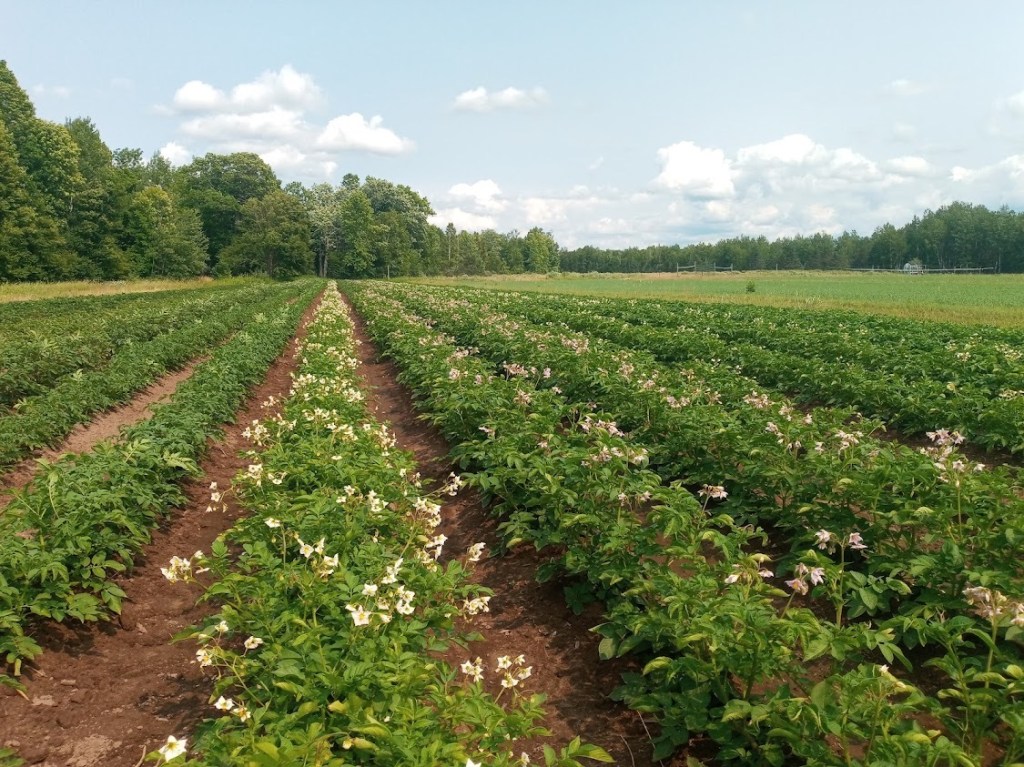


At the end of last week, Janaki took the crew for a walk about the farm to check out everything that’s going on. Things are really starting to pop! The snap peas are crawling all over their trellises and the potatoes are sporting their beautiful white flowers (see above). The biggest melons are palm-sized and starting to ripen. This year we are growing our crowd-favorite, cantaloupe, but we are also trying some watermelons. They’re unlikely to ripen in our climate, but we’re rooting for them! Stay tuned. Also looking to be in good shape are our outdoor carrots (thus far all of the carrots we’ve sent have enjoyed the comfort of greenhouse living).
A highlight for me was learning about Janaki’s growing strategy and how he rotates crops to ensure superb soil quality year after year. He tries to keep a certain level of available resources in each field by incorporating compost, organic matter and planting cover crops after a field has yielded a successful vegetable harvest. For example, he will often interseed clover in mid-to-late summer, which works to replenish important nutrients such as nitrogen levels in the soil. By doing this, we’re able to avoid using fertilizers and other conventional methods to re-establish optimal nutrient levels in our soil for the next round of vegetables. It also aids in weed suppression, meaning we can avoid using herbicides.

We also checked in on a new no-till method we are is testing out. When trying something new at the farm, it’s pragmatic to do a test and a control. In the picture above, you can observe the results at this point in the season. On the left, you can see the control group rows – the soil was turned over before planting and the cabbage is large. On the right, the no-till method shows smaller cabbages, which were planted directly into the clover cover crop. While the control rows appear to be doing much better, what you can’t see is all the work that went into turning over that soil at the beginning of the season before the cabbage could be transplanted. With a no-till method, transplants can go directly into unturned soil. Another benefit of a no-till method is less intensive to no weeding (big win!). The experiment doesn’t look promising now, but we’re waiting until the fall to make a final judgement. With trial and error, we’ve already learned a few things we’d change to make the system better.

In your share this week:
Broccoli – Green-top Carrots – Cucumbers – Garlic Scapes – Greens Mix – Lettuce
Napa Cabbage – Green Onions – Parsley – Snap Peas – Zucchini
This is a recipe forwarded to me from Deb Rausch, A frequent volunteer and friend of the farm. She’s been enjoying a variety of vegetables (mostly kale and chard) with this simple yet tasty dressing. I think it would be great with the broccoli and parsley this week, but use it for whatever feels right to you.
Deb’s Dressing
1/3 c mayo
2 green onions
1 tablespoon champagne vinegar (or rice vinegar)
Miso Glazed Grilled Zucchini
This recipe is a bit intensive but so worth the effort!
2 tablespoons white miso
1 tablespoon honey or maple syrup
1 tablespoon rice vinegar
1 tablespoon soy sauce (or Tamari)
3 medium zucchini (about 1-1/4 lbs)
Cooking oil
Green onions and sesame seeds for garnish
Instructions:
- Preheat oven to 400. Slice the zucchini in half length-wise. Cut a cross-hatch pattern into the cut-side of each zucchini half. Each cut should only be about 1/4-1/8 inch deep.
- Sprinkle each cut-side with a little bit fo salt. Turn the cut-side down onto a paper towel and let drain for 15-20 minutes.
- Once the moisture has been released, quickly rinse the zucchini. Take care not to let the water run over them for too long – you don’t want them to re-absorb water after you’ve drawn out the moisture! Dry off with fresh towels. Make them as dry as possible.
- Heat a cast iron skilled or other oven-proof vessel over medium heat. Add 1-2 tablespoons oil, let it heart up, then place the zucchini cut-side down in the pan. Cook until golden brown (about 7 minutes). You can use tongs to carefully peek at the cut-side while cooking.
- Once browned, place the cast-iron skill into the oven for 15 minutes. While roasting, make the miso glaze. You can add water to thin it out to the consistency of a BBQ sauce if needed. The zucchini should be extremely fork-tender.
- Remove pan from oven and carefully turn over the zucchini so the cut-sides are up. Spoon on the glaze so it covers the zucchini (it doesn’t have to be thick).
- Return the pan to the oven, this time with the cut-side up. Turn on the broil function and watch until the miso glaze just starts to bubble. Finish with green onions and sesame seeds.
Smashed Cucumber Salad
Yield: 4 servings
1 large greenhouse cucumber
handful of snap peas (everything you got in your share)
1 teaspoon kosher salt, plus more for cucumber
2 teaspoon granulated sugar, plus more for cucumber
1 1/2 tablespoons rice vinegar
2 teaspoons sesame oil
2 teaspoons soy sauce or tamari
1 tablespoon grapeseed or olive oil
2-3 garlic scapes, minced
Red pepper flakes, to taste
For garnish:
Small handful of cilantro
1 teaspoon toasted sesame seeds (optional)
Instructions:
- Rinse cucumber and pat dry. Cut crosswise into pieces about 4 inches long. Cut each piece in half lengthwise.
- On a work surface, place a piece of cucumber cut side down. Lay the blade of a large knife flat on top the cucumber and smash down lightly with your hand. The skin will begin to crack, the flesh will break down and the seeds will separate. Repeat until the whole piece is smashed. Break or slice diagonally into bite-sized pieces, leaving the seeds behind.
- Place the cucumber in a strainer and toss with a big pinch of salt and a big pinch of sugar. Place a plastic bag filled with ice on top of the cucumbers to serve as a weight and place the strainer over a bowl. Let drain 15 to 30 minutes.
- Make the dressing: In a small bowl, combine salt, sugar and rice vinegar. Stir until salt and sugar are dissolved. Stir in sesame oil and soy sauce.
- When ready to serve, shake cucumbers well to drain off any remaining liquid and transfer to a serving bowl with snap peas. Drizzle with grapeseed or olive oil and toss. add half the dressing, half the garlic scapes and the red pepper flakes to taste, and toss. Keep adding dressing until cucumbers are well coated but not drowned. Taste and add more pepper flakes and garlic if needed. Serve immediately, garnished with cilantro and sesame seeds.
For the farm crew,
Charlie



 Food Farm