Summer CSA Week 15

It’s hard to believe that we are already on the 15th week of the CSA, it feels like the season just started last week!? Anyways, while we are excited to share with you the vegetables of the week, there are still a few that you may not see this week, or next. Crops like brussels sprouts take a long time to mature–they’re seeded in early June and usually aren’t ready until the last week of the CSA. Most crops, like the celery in your shares today, are a couple of weeks ahead of schedule, but the brussels are actually slow enough that they may not even mature in time. I’m excited to eat them even if we have to wait for the winter shares.

This past weekend we attended the Harvest Festival at Bayfront and enjoyed seeing many familiar and new faces at the booth. The crew worked all day Friday harvesting vegetables to ensure that festival-goers received the freshest produce possible. It was great to see everyone after a year off from the festival.

The theme of last week seemed to be our potatoes. We worked on getting out the rest of the first planting of potatoes which included whites, russets, and yellows. Potatoes rock our world in so many ways and are incredibly versatile. I thought it might be useful to include a guide as to what potatoes are good for different potato cooking techniques. Disclaimer: this guide is based on a quick Google search and really, you can do whatever you want to your potatoes.

Fingerlings: great for baking, roasting, and potato salads. Not as good for soups.

Russets: These are the long brown potatoes in the share today. These are good for baking, mashing, french fries, and chips.

Reds: Unlike Russets, red potatoes do not fluff up as much when cooked. This makes them good for soups and stews.

Yellow/Gold: Creamier than most and are great for mashing, roasting, and grilling.

White: Great for french fries and hashbrowns. Doesn’t necessarily need peeling due to thin skin.

That’s the reference guide I use when choosing potatoes, but I use the different varieties interchangeably for the most part. Next up, I felt compelled to include a recipe for a classic potato dish that I grew up eating at every family gathering and holiday, and I hope you did too.

Thanks for reading,

Emily
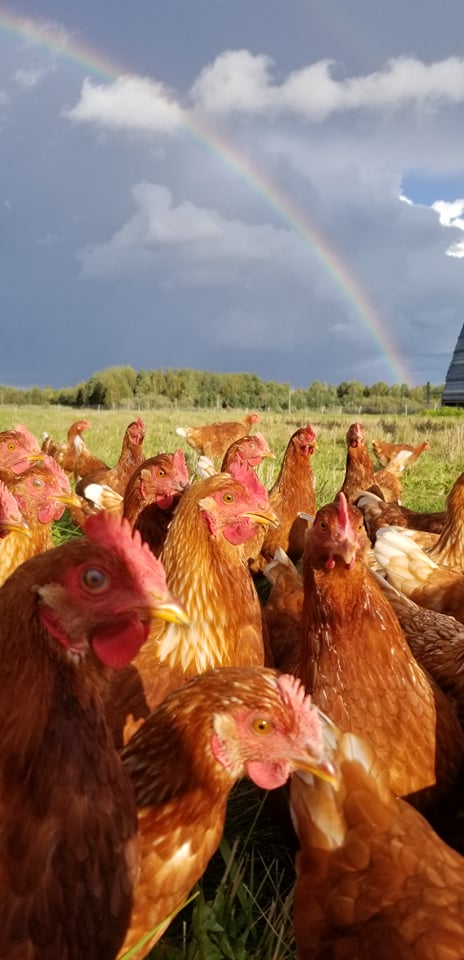
We were fortunate to receive a few random rain showers and a big rainbow last week.

In your shares this week:

Beans – Broccoli – Carrots – Celery – Cucumbers – Dill – Lettuce – Onions – Red Peppers – POTATOES – Acorn Squash – Tomatoes

Farmer Kathleen driving the crew back to the potato fields for harvesting.

Potatoes au Gratin by RecipeTinEats

  • 1 1/2 cups cream
  • 2 garlic cloves, minced
  • 2 tbsp unsalted butter,melted
  • 2 lb starchy potatoes, Russet
  • 1 tsp salt
  • 1/4 tsp pepper
  • 2 1/2 cups gruyere cheese (or mozzarella)
  • 2 tsp thyme leaves
  • Cream Mixture: Place butter, cream and garlic in a jug or jar. Mix until combined.
  • Preheat oven to 350°F.
  • Slice potatoes: Peel the potatoes and slice them 1/8″. Or use a slicer!
  • Layer 1: Spread 1/3 of the potatoes in a baking dish, then pour over 1/3 of the Cream Mixture, scatter with 1/3 of the salt, pepper and thyme. Sprinkle with 3/4 cups cheese.
  • Layers 2 & 3: Repeat for the 2nd and third layer, but do not finish with cheese on the top layer (will add later).
  • Cover & bake: Cover with lid or foil, and bake for 1 hr 15 min or until the potatoes in the middle are soft (use knife to test).
  • Top with cheese, bake again: Remove foil, top with cheese. Bake for a further 10 to 15 minutes until golden and bubbly. Stand 5 minutes before serving.

Cream of Celery Soup by AllRecipes

  • 3 quarts vegetable stock 
  • 1 head of celery, coarsely chopped
  • ½ pound carrots, julienned
  • ½ pound onions, chopped 
  • 1 cup all-purpose flour 
  • 1 tablespoon salt
  • 1 teaspoon ground white pepper
  • 3 quarts hot milk
  • 1 cup margarine
  • Step 1 Pour the vegetable stock into a large pot, and bring to a boil. Add the celery, carrots and onion to the pot.
  • Step 2 Whisk together the flour, salt, pepper, and milk; add to the pot along with the margarine.
  • Step 3 Boil for 10 minutes, then strain out the vegetables by pouring through a sieve, or if the vegetables are large enough, a colander may be used.


Summer CSA Week 14

This week was a big week for our dear friends the alliums. Alliums are a genus of plants that include onions, garlic, leeks, and shallots. Onions! Enough to make a grown man cry. To say that these crops are the very backbone of savory dishes in the Midwest is an understatement. Not only do they provide great flavor and texture to our food, they also make the air smell great when you harvest them for several hours. And what do you say to a small onion that has helped you? Thanks shallot. We also started to sort out seed garlic which involves picking out the most perfect heads of garlic to use for next years garlic crop. This process, over the course of years, helps us yield the best looking heads of garlic to give to our dear members and the community.

Soup season is just around the corner, unless you’re like me and believe soup shall not be limited to colder weather. Either way, I feel compelled to throw in a decent soup recipe in these newsletters each week. They’re great for many things but amazing for using up random veggies in your fridges. Great for budgets and your stomachs. This may very well be the beginning of canning season for your household, for which soup is a fantastic candidate. Our dear friend the leek has been patiently waiting it’s arrival in your shares. And you had better believe there’s a soup recipe in this newsletter whose sole intention is to use a decent amount of leeks. Personally, I think the leeks this year look way bigger than last years. This is probably due to the warmer temperatures we have been experiencing.

This weekend you’ll find the Food Farm crew at the Sustainable Farm Association’s annual Harvest Festival at Bayfront Park in Duluth. Have you been wishing to have just a few more heads of broccoli this year? Perhaps you’re wishing for some more tomatoes? Fear not, as we will likely have a wide variety of food available to you. My favorite thing about these festivals as a consumer is seeing the value added goods that people create. Every year there is something new to try and it’s even better knowing it’s local. The annual Harvest Festival is a fun and great way to connect producers directly to consumers. Aside from these newsletters, there are only a handful of ways in which we are able to directly connect with our share members and the general public. We hope to see all of you there! We’ll be there from 10am – 4pm.

Some exciting news from our newest farm hens, they’ve laid their first eggs! These relatively tiny eggs will not be included in the egg shares yet. However, they are a reminder that these chickens play a valuable role on the farm. They provide our members with food and our fields with fertility. Plus they’re cute and full of personality – what more could you ask for in your coworkers?!

If anyone has a soup recipe suggestion, please do not be shy. We must all prosper in the richness that is liquid food.

Your local soup enthusiast,

Emily

In your shares this week:

Broccoli – Carrots – Cilantro – Cucumbers – Garlic – Greens Mix – Leeks – Onions – Hot Pepper – Red Peppers – Potatoes – Tomatoes – Zucchini

Bumble bees are fond of our bean plants and their flowers. I call this photo: “Bumble Bean”

Potato Leek Soup from Tasty

  • 2 tablespoons butter
  • 3 large leeks, chopped
  • 3 cloves garlic, minced
  • 2 lbs potato, cubed
  • salt, to taste
  • pepper, to taste
  • 6 cups vegetable broth
  • 2 cups water
  • 2 sprigs fresh thyme
  • 1 bay leaf
  • ¼ cup fresh chives, chopped
  • hot sauce, to taste
  1. Melt butter on medium heat in a large pot. Add the chopped leeks and stir until coated with butter.
  2. Cover the pot and lower heat, cook for around 10 minutes until the leeks have softened.
  3. Increase to medium-high. Add garlic, potatoes, salt, and pepper. Cook for 1 minute, then add vegetable broth, water, thyme, and bay leaf. Bring to a boil.
  4. Lower heat and cover pot with a lid and simmer for 15 minutes, or until potatoes are tender and easily speared by a fork.
  5. Uncover and remove thyme and bay leaf.
  6. Use an immersion or countertop blender to blend the soup until smooth.
  7. Stir in chives and hot sauce (optional).
  8. Allow to cool 2 minutes and serve

Cucumber Avocado Salsa by To Simply Inspire

  • 1 large cucumber peeled, seeded and finely chopped
  • 1 avocado finely chopped
  • 1 medium tomato finely chopped and seeded
  • 1/4 cup red onion finely chopped
  • 2 – 3 tablespoon fresh cilantro finely chopped
  • 1 garlic clove minced

For the sauce:

  • 1/4 c reduced-fat sour cream
  • 1-1/2 tsp lemon juice
  • 1-1/2 tsp lime juice
  • 1/4 tsp ground cumin
  • 1/4 tsp salt
  1. In a medium bowl, combine the first six ingredients and gently toss
  2. In a separate bowl, combine the sour cream, lemon juice, lime juice, cumin and salt.
  3. Pour over cucumber mixture and gently toss to coat.
  4. Serve with tortilla chips.

Summer CSA Week 13

Every day was super eventful on the farm this past week. The crew adjusted the solar panels along the driveway to match the sun’s fall position in the sky. We are also gearing up for the fall harvesting that will be happening soon, especially for the storage crops. On Wednesday we harvested about 13 tons of carrots – all before lunch. It’s days like those that really make us realize the impact we have on the local food system. Also, not to scare anybody but there are at least 30 more tons (hopefully) that still need to be harvested before late October. And those are just the carrots. Our list of things to do seems like it should be getting smaller but let’s be honest – it’s definitely going to get bigger.

Early this week we said a heartfelt goodbye to Karin who has been the backbone of the farm crew for 7 seasons. She will be deeply missed, but we all wish her the best of luck with this transition in her life. In her honor we built a huge shrine with some parts we found laying around in the barn and it’s just outside the pack shed so she is never forgotten. It doubles as a second bucket-drying rack. Just kidding – that’d be weird. But truthfully, she deserves the recognition for being so cool.

As many of you probably experienced this week, the air quality was very poor from the wildfires burning north of us. As a farmer, I never realized how much I had been taking good air quality for granted. Luckily, wearing a mask helps a lot. There was some rain at the end of the week (yay!) that helped improve the air quality. As a bonus we got to finally experience some autumn-ish weather that the storms brought with them – cool breezes and chilly mornings. Rain also gives us all some excitement knowing that our veggies will be that much happier.

Our newer hens have been adjusting nicely to their new home in the last month. They live on the far side of the farm in a mobile coop that gets moved every few days. This ensures the field they are in is getting an equal distribution of fertilization from the chickens. Earlier this season Farmer Janaki taught us that the fields that have had chickens rotated around in them are significantly more fertile than their non-chicken bearing neighbors. This is just another way the Food Farm builds soil and improves soil quality. What that means for our share members is more nutrient dense veggies.

Thanks for reading my first newsletter, I am excited to carry on this task.

Emily

In your shares this week:

Cucumber – Zucchini – Potatoes – Carrots – Hot Peppers – Red and Green Peppers – Onion – Dill – Tomatoes – Greens Mix – Beans – Beets

Zucchini Lasagna from PBS

  • For the Tomato Sauce:
  • 1 – 28 oz can of crushed tomatoes (or about 4 pounds of fresh tomatoes)
  • 1 large garlic clove, minced
  • 1 Tbsp. fennel seed, crushed slightly to release the flavor
  • 1 tsp. ground oregano
  • 1/4 cup finely chopped basil
  • 1 tsp. cane sugar
  • 2 Tbsp. olive oil
  • For the Cheese Filling:
  • 1 pound of ricotta cheese (or cottage cheese)
  • 1 cup grated parmesan cheese
  • 1 egg
  • Salt and Pepper to taste
  • For the Vegetables:
  • 2 to 3 medium-sized zucchinis, no bigger than 4 inches diameter (or 4 to 5 small zucchinis)
  • 2 tsp. salt
  • 3 Tbsp olive oil
  • 1 pound of mushrooms, sliced
  • 1 bunch of swiss chard or spinach (about 4 cups, chopped)
  • 1 large onion, minced
  • 2 Tbsp. flour (can be gluten-free flour)
  • A dozen or so fresh basil leaves (optional)
  • 4 cups shredded mozzarella (about 1 pound)
  1. Slice the zucchinis lengthwise to between 1/8 to 1/4 inch thick. Use a mandolin if you have one, it will help you slice the zucchini faster and in perfect consistent slices. Otherwise, slicing with a knife is fine too. Place the slices on a clean towel and pat the zucchini very dry. Rub 1 Tbsp of olive oil onto an extra-large baking sheet (or 2 smaller ones) and place the zucchini slices in a single layer. Roast in a 375F oven for about 10 minutes. Allow to cool.
  2. If using fresh tomatoes, deseed the tomatoes (if you wish remove the skins). Bring the tomatoes to a boil and add the minced garlic, chopped basil, crushed fennel seeds, ground oregano, olive oil, sugar, and salt to taste. Simmer until thick and reduced. It’s important to use a thick lasagna sauce in this recipe because the lasagna can otherwise be on the soupy side without the pasta to soak up the extra liquid as it bakes.
  3. In a large skillet or wok, heat 2 Tbsp olive oil and sauté the onions for 3 to 4 minutes. Add the mushrooms and continue cooking. Once the mushrooms are soft, add the chopped swiss chard. When the chard is cooked, remove from heat and drain any juices (save these for great soup stock). Add 2 Tbsp flour to the mixture and mix well to incorporate.
  4. Oil a 9 x 13 inch lasagna dish and spread about one third of your sauce on the bottom. Add a layer of roasted zucchini to cover the tomato sauce. Add the ricotta and parmesan cheese mixture and spread evenly. Add another layer of zucchini slices. Add a second round of tomato sauce and spread evenly, followed by the vegetable mixture and half of the shredded mozzarella cheese. Add a last layer of zucchini slices followed by the third and last round of tomato sauce. Place the twelve basil leaves on top of the sauce and sprinkle the rest of the shredded mozzarella on top. Pro tip: place a baking tray on the rack beneath the lasagna pan to catch any bubbling juices from falling to the bottom of your oven. Bake for about 40 minutes at 350F until the cheese is melted.

Cucumber Tomato Salad from Spend With Pennies

  • 2 cucumbers (sliced)
  • 2 large tomatoes (diced)
  • 1/2 onion (sliced)
  • 1 tablespoon of dill
  • 2 tablespoons of olive oil
  • 1 tablespoon of red wine vinegar
  • salt and pepper to taste

Combine all ingredients in a boil and toss well.

Summer CSA Week 12

At week twelve we are about three months through our Summer CSA. So many weeks to go still – and so much bounty to be brought in from the fields. The mid-summer CSA crops are so enjoyable, and many will last through to the end. They’ll be joined by cool, end of season crops for some very colorful and full of variety (and heavy!) share boxes: winter squash, Brussels Sprouts (hopefully), maybe spinach again (though it’s not germinating well), and sweeter carrots from cooler nights!

Most of the heavy lifting that happens, harvest wise, happens in the last few weeks of the season, as we transition from harvesting what we need here and there for the CSA or our wholesale deliveries to harvesting larger and larger amounts of storage crops out of the field. Already, the crew is starting to cross some things off the list: the first planting of carrots, the first planting of red potatoes, garlic. Soon to add the whole first planting of potatoes and the onions. Bucket-full by bucket-full loaded onto the ever-in-motion trailer: all the produce will make it’s way down to the root cellar.

Getting into the rhythm of the fall harvest is one of my favorite times on the farm. I like working out the timing just right of when produce should get loaded up, and how many people should do what task so that we’re working as efficiently as possible. Sometimes that is the hardest when the most efficient thing to is to wait for a machine, and just hang tight for 2 minutes. I say getting into the rhythm, but more often I feel I have a rhythm just as we’re at the end of harvesting one crop and moving on to another. Rhythm or not, it seems to usually work out by some miracle.

This year I’ll be doing none of the harvest work- I am going to be done with my time on the farm, for now. I have my own tiny early-fall project to work on. Hint: it’s like a butternut squash that tries to kick my cup of (decaf) coffee off its new resting spot. Other hint: the little project wants me to stop bending over at work so much*. I am thinking of asking Janaki about putting in 30 acres of 4′ high raised beds. I think he might go for it.

Depending on how you count it (and I am the only one counting I suppose) this has been my 7th season on the Food Farm. The farm has grown since my first year, and many changes have happened on the farm, and in the peoples’ lives who surround the farm. I think I’ve learned a lot since starting, but the truth is I probably had to relearn it all just this past April and so it might not be a cumulative knowledge. Every spring I just start with a “green side up” mantra for transplanting and go from there. That red cabbage makes the mantra tricky… farming keeps one on their toes.

I’m not really mentally prepared to be done. Working on the farm has brought me a lot of joy, and has been a big part of my life for a long time now. The quick but odd moment in life of something going from an every-day reality to a memory is never a comfortable transition for me. Much of being on the farm; the work, the interactions with people, the little details, feels like a memorized little dance that happens each year. Some times more gracefully than others. Soon the little details in my head will become totally obsolete in my life. Then they’ll be forgotten entirely. Shall I document some for you? You won’t mind?

16 pounds of jalapenos fit in a 5 gallon pail and about 25 pounds of anything else. Our pallet boxes weigh 110 pounds. The flat trailer fits 76 buckets on it, but if you drive in 4th gear over a bump there is a good chance you could loose the bucket on the back left corner. Field 14a is Janaki’s favorite field, because the soil is so delicious, and Field 14b has a purslane problem on the whole south half. Dave wants 13 pounds of sand in a sandbag. It’s his lucky number, I guess.
Beyond the numbers it has been nice to get to know the ever changing crew each year, and of course the people who are always around too. I could probably list dozens of little quirks and traits of all the farmers (as I have no quirks of my own, I really notice other people’s) but the newsletter would get long, and I would probably cry.

It has been an honor to have grown and harvested for you these several years. Thanks for supporting the farm so that it could support me – and all the workers over these years. Some part of me, and any farmer or farm-worker anywhere, goes to be with you in your kitchen and at your table. All the more so if you’re eating potatoes we had to pick up after the bucket tipped off the corner of the trailer.

Keep eating good food, and keep reading the newsletter as “Farmer Emily” (as my son says) takes over next week.

With affection, and just for myself this time,

Karin

*my little project is a baby!


In your share this week:
Green Beans – Broccoli – Carrots – Cucumbers – Kale – Melon – Onions – Red, Green, and Hot Peppers – Tomatoes – Zucchini


Curried Carrot Soup

From the Leek and the Carrot

It was under 60 degrees this morning… time to make soup!

  • 2 tablespoons butter
  • 2 tablespoons olive oil
  • 1 medium yellow onion, diced
  • 4 garlic cloves, minced
  • Kosher salt
  • Freshly ground black pepper
  • 1 pound carrots, peeled and roughly chopped
  • 2 teaspoons sweet curry powder
  • 1 teaspoon hot curry powder
  • 1 teaspoon siracha hot sauce
  • 13.5-ounce can coconut milk
  • 4 cups chicken (or vegetable) stock

Add butter and oil to a large stock pot. Melt butter over medium-low heat. Add the onions and garlic as well as a sprinkling of salt and pepper. Cook until onions are translucent and fragrant, about 10 minutes. Add the carrots, spices and hot sauce and turn the heat up to medium. Cook for 20 minutes, stirring occasionally. Add the coconut milk and stock. Bring to a boil, reduce to a simmer and cook for 30 minutes until carrots are tender and liquid is nicely reduced.
Let cool and puree with an immersion blender. We don’t puree until completely smooth. We like some small chunks of carrot in there, but that is up to you. Taste and adjust seasoning. Top with chickpeas if you are feeling extra fun!

CUMIN ROASTED CHICKPEAS
15-ounce can chickpeas, drained and rinsed
2 tablespoons olive oil
2 teaspoons ground cumin
1-2 teaspoons Kosher salt
Freshly ground black pepper

Preheat oven to 400 degrees. Toss chickpeas with oil, cumin, salt and pepper. I use 1 teaspoon of salt if I’m making these chickpeas for my carrot soup (because it’s already a little salty) and 2 teaspoons of salt if I’m making these chickpeas as a non-soup-addition, generally-delicious snack. Roast for 20 minutes or until crunchy. Take out the pan and shake it occasionally for more even crisping.

Summer CSA Week 11

I am sure I have said in newsletters of yore that recipes aren’t really my thing. Finding them for the newsletter – I just do the laziest thing which, depending on what I’m looking for, is either just googling “spinach recipes” or whatever, or going to a couple of my go-to sites for ideas and seeing what they say. Recipes aren’t really my thing, but I do like pretty pictures of food, and being forced to look up new ideas for the newsletter does help me snap out of a rut (re: last week’s zucchini fritters comment).

A lot of the way I cook (when I’m not “cooking” eggs and toast) feels like just throwing what I have lying around together, often in one or two pots and then eating all of whatever it is in a bowl. Sometimes I don’t feel like it counts as a “meal”- the Midwest concept of what a meal is has imbedded itself in my brain. Sometimes I don’t feel like it counts unless there’s meat (duh) and two sides (one being potatoes) and dessert. I’ll skip the glass of skim milk at dinner… but thanks for offering.

With shares like this week’s especially, I feel like all the food is just waiting to be chopped up and eaten together. I do recommend cooking the potatoes first. All these veggies would be great in a grain bowl for example. Is that so 2017? 2017 BCE? I just made a salad that is not unlike the quinoa chickpea salad below, but instead of a mustardy dressing, I used a huge scoop of fresh basil-pesto in the dressing. So good.

You also don’t have to chop all the veggies and mix them all together this very night. So much chopping! So much time! No matter what I do, I don’t feel like I get any faster at processing whole veggies and working with any whole food takes time. You’re allowed to cut a zucchini in half, cover it in cheese and store bought sauce and roast the living daylights out of it. You can even call that dinner. No milk and no meat, no problem!

All of this is partially a pep talk to myself to get me to do something with the cauliflower in my fridge before another one ends up there!

For the farm crew,

Karin


In your share this week:
Basil – Beans – Cabbage (Monday), or Cauliflower (Thursday) – Carrots – Cilantro – Lettuce Mix – Melon – Onions – Sweet and Hot Peppers – Red Potatoes – Tomatoes – Zucchini


Zucchini Turkey Meatballs with Zoodles

  • 1 pound ground turkey
  • 2 teaspoons garlic powder
  • 1 cup shredded zucchini
  • ¾ cup unseasoned breadcrumbs, or you could use seasoned
  • 1 large egg
  • 1 teaspoon kosher salt
  • ¼ teaspoon ground black pepper

FOR THE NOODLES
2 medium zucchinis, zoodled with a spiralizer (or…https://topwithcinnamon.com/lazy-girls-zucchini-spaghetti-no-fancy-tools-required-with-peas-creme-fraiche-and-pesto/)

Your favorite pasta sauce


Line a large baking sheet with wax paper.
Place all the ingredients for the meatballs in a large bowl. Using your hands, gently work all the ingredients together, careful to not overwork the meat.


Using a two tablespoons, scoop meat into individual balls and place on the prepared baking sheet. Once all is scooped, form the meat into balls. Freeze 20 of them in a freezer-safe plastic bag or container and place 10 of them onto a plate to set aside to cook.
In a large skillet over medium-high heat, add olive oil.


Once the oil is hot, carefully place the meatballs into the skillet and let brown on one side then turn with tongs. Continue cooking until meatballs are all cooked through, about 7-10 minutes.
For the zoodles, you can either just blanch them in hot water and add sauce on top along with the meatballs or you can throw them into the same skillet and cook them until softened and pour sauce on top along with the meatballs.
Serve warm!

The meatball mixture makes roughly 30 meatballs. They freeze really well and I love having the ability to pull them out of the freezer during busy work weeks! 🙂

Quinoa Chickpea Salad with Summer Veggies!

From the Crowded Kitchen

  • 1 cup dry quinoa, cooked according to package directions
  • 1 tablespoon olive oil
  • 1 cup yellow onion, diced (1 small onion)
  • 2 teaspoon fresh garlic, minced (2 cloves)
  • 1 cup finely chopped spinach (or any leafy green)
  • 1 cup cherry tomatoes, halved
  • 1 cup cucumber, finely diced
  • ¾ cup grated carrot
  • ¾ cup finely diced yellow bell pepper (1 small pepper)
  • 3 tablespoon finely chopped fresh parsley
  • 1 14.5 oz can chickpeas (garbanzo beans), drained and rinsed well
  • ¼ cup grated vegan parmesan (or regular)

VINAIGRETTE:

  • ¼ cup extra virgin olive oil
  • 2 tablespoon balsamic vinegar
  • 1 tablespoon whole grain dijon mustard
  • 1 ½ teaspoon maple syrup (or agave)
  • 1 teaspoon fine grain kosher salt
  • ½ teaspoon ground black pepper

INSTRUCTIONS

  1. Cook quinoa according to package directions and add ½ teaspoon of salt to the water.
  2. While quinoa is cooking, add olive oil to a small skillet over medium heat. Add onions and sauté for 4-5 minutes. Add garlic and continue cooking for 2-3 minutes, until softened and slightly browned. Remove from heat and set aside to cool. 
  3. Once the quinoa is done cooking, transfer to a bowl to cool slightly (you can place in the fridge or freezer to speed this up). 
  4. Add all vinaigrette ingredients to a small mixing bowl and whisk until well combined.
  5. Prep the spinach, tomatoes, cucumber, carrots, pepper and parsley.
  6. Add all ingredients (cooked quinoa, onions/garlic, vegetables, parmesan) to a large mixing bowl and toss well with the vinaigrette.
  7. Optional: refrigerate for 30 minutes-1 hour before serving (or enjoy right away!).

Summer CSA Week 10

We’re just over half way through the 2021 summer share! We hope you’ve been enjoying the ever more summery selection! Our item list on the white board hardly fits any more – time to write it smaller. The crew has more of a routine as the summer goes on as different people take on a different, regularly harvested crop like daily zucchini and cucumbers, and almost daily melons (for a while), peppers and broccoli (never ending!). The addition of increasingly more harvesting is butting up against some later-than normal season weeding as rains have helped both crops, and the little (and not so little) unwanted plants in our fields.

We will be getting into a more regular rhythm of harvesting large amounts of things at a time too, to have available for a week or two at a time. The first planting of carrots got harvested a week and a half ago, and we have a few bins of cabbage in the cooler waiting for wholesale orders and for CSA delivery. The garlic is out of the ground, a couple weeks ahead of usual, and is curing in the greenhouse for now. Soon we’ll trim those stalks and move the garlic to make way for onions. Bit by bit the harvest ramps up, and we can start ticking entire crops off the list.

How about all of you? Do you feel like you’re in a good rhythm of using your share, or are you stuck in a rut? Hopefully you won’t ever feel too stuck since the veggies change throughout the season, though I think my household is already ready to move on from zucchini fritters… Time to move on to my regularly occurring (but it’s been a while!) potato salad I guess!

August in Minnesota always feels so full and so fast with late summer camping trips, or weddings and planning for the fall and school season ahead. Even if school isn’t a part of your life any more, there seems to be a different pace to things come September. I hope you are all finding satisfying ways to spend these last summery weeks. Perhaps in a couple of weeks, on the 21st (3-5pm), you’ll find yourself out here at the Food Farm for our farm gathering, or up the road for the Free Range Film Festival (7pm)! What could be more summery than an afternoon drive out to Wrenshall?

For the busy crew,

Karin


In your share this week:
Green Beans – Broccoli – Carrots – Cucumber – Dill – Melons! – Sweet Onion – Green Onions – Sweet and Hot Peppers – Potatoes – Tomatoes – Zucchini


Cream of Broccoli Soup, By Farmer John

One large head of broccoli “the biggest you can find”, chopped
One large onion, the biggest you can find, chopped (not a sweet onion… sorry)
One large carrot, also the biggest you can find, chopped

2 Cloves Garlic
2 Tbsp, (but he uses 3) butter
2 Cups chicken or veggie broth
Salt to taste
1 Cup milk

Cook veggies in broth until quite soft, and then blend the living daylights out of it with an immersion blender. Add milk, stir and taste.
We talked about the option of freezing the soup – perhaps freeze it before blending, and adding the milk, so as to simplify the reheating. Then thaw, heat, blend and add milk when you’re ready to serve.

Ultimate Zucchini Bread

From The Smitten Kitchen

I have been making this like it’s going out of style… but it never will in my house! If you want a fun little description about how she got to this recipe from other less satisfying versions, look it up on her website – all her complaints about plain old zucchini bread were also my own- but I love this recipe! Disclaimer… it is basically eating cake for breakfast.

  • 2 cups (13 ounces or 370 grams) grated, packed zucchini, not wrung out, grated on the large holes of a box grater
  • 2 large eggs
  • 2/3 cup (160 ml) of a neutral oil (I use safflower), olive oil, or melted unsalted butter
  • 1/2 cup (95 grams) packed dark brown sugar
  • 1/2 cup (100 grams) granulated sugar
  • 1 teaspoon vanilla extract
  • 1 teaspoon fine sea or table salt
  • 1 1/4 teaspoons ground cinnamon
  • 1/8 teaspoon ground or freshly grated nutmeg
  • 3/4 teaspoon baking soda
  • 1/2 teaspoon baking powder
  • 2 cups (260 grams) all-purpose flour
  • 2 tablespoons (25 grams) raw or turbinado sugar

Heat oven to 350 degrees F. Lightly coat a 6-cup or 9×5-inch loaf pan with nonstick spray. Place grated zucchini in a large bowl and add oil, eggs, sugars, vanilla, and salt. Use a fork to mix until combined. Sprinkle cinnamon, nutmeg, baking soda, and baking powder over surface of batter and mix until combined — and then, for extra security that the ingredients are well-dispersed, give it 10 extra stirs. Add flour and mix until just combined. Pour into prepared loaf pan and smooth the top. Sprinkle with the raw or turbinado sugar — don’t skimp. Bake for 55 to 60 minutes, until a toothpick or tester inserted into the middle cake but also into the top of the cake, closer to the dome, comes out batter-free.

Let cool completely in the pan. Leave in pan, unwrapped, overnight or 24 hours, until removing (carefully, so not to ruin flaky lid) and serving in slices. Zucchini bread keeps for 4 to 5 days at room temperature. I wrap only the cut end of the cake in foil, and return it to the baking pan, leaving the top exposed so that it stays crunchy.

Summer CSA Week 7

It isn’t an easy summer to be a plant – or someone trying to grow plants. All the trees around town look tired and soft, like a sweaty brochure being used as a fan. Janaki is spending his time running irrigation around to keep vegetables alive in their turn, constant triage ensuring that every crop has what it needs. There are around 42 fields now, some quite large. Wow, I had never counted. No wonder I still get “lost” with the field numbers.

This image has an empty alt attribute; its file name is img_3230.jpg

There is something daunting about the weather this year. It’s not a good rain year. Last year wasn’t a good rain year, nor particularly snowy. Who can say if this is a trend, but who can say what a trend is other than unusual and more intense. It feels unsettling to know that the rest of my life will be marked by these changes. Perhaps some more “normal” feeling seasons or years will still happen- but I fear for more winters with little snow (what is the point of winter if there is no snow!?) and more growing seasons that are hot and dry. And what all will that change? In my life time will pine trees become more rare, will more invasive pests and plants make their way north, will all the ash trees die? Probably. Maybe I’ll find myself accepting change and growing a patch of lavender in my 70s. Or maybe I’ll move somewhere I can still ski.

Going down either an emotional or intellectual rabbit hole of climate worry will drive anyone insane after a while. Beyond my worry is grief, which is easier to be with than worry in the long term, but still not easy.

The other day I found myself thinking how hard it would be to plan and build for these changes we see. From air conditioning in schools to making changes to river banks – a lot could get done and some of it is a guessing game.

On the farm Janaki is continually making those guesses as well as he can in an attempt to mitigate risk and maintain some level of sanity in our work. We can’t make it rain, but he is in the market for a more sustainable and efficient irrigation system. And when (not if) the 5 inches of rain in a weekend fall, he has drain-tile now throughout the fields, to give the water somewhere to go instead of sitting and rotting carrots. We use refrigeration in the root cellar now, instead of solely relying on cold fall air to cool the old cellar for winter storage. Many changes in the past 8 seasons I have known the farm – and many of them just in time. We’re trying, folks. Thanks for coming with us on the journey.

For the farm crew,

Karin


In your share this week:
Broccoli – Carrots – Cucumbers – Lettuce – Green Onions – Peas – Tomatoes


Carrot and White Bean Burgers

From The Smitten Kitchen

  • Olive oil
  • 1/2 cup panko-style breadcrumbs
  • 3 shallots, or 1 small onion, diced
  • 1 tablespoon tomato paste
  • 1 1/2 teaspoons kosher salt
  • 1 cup packed grated carrot (from 2 medium carrots)
  • 1 1/2 tablespoons apple cider vinegar
  • Two 15-ounce cans cannellini or other white beans, drained and rinsed
  • 1 large egg, beaten
  • Freshly ground black pepper
  • Burger accompaniments, as you like

Heat 1 tablespoon olive oil in a large skillet over low heat. Add the panko and cook, stirring often, until lightly browned and crisp, 3 to 5 minutes. Transfer crumbs to a large bowl, then return the pan to the heat.

Add 2 tablespoons olive oil to the skillet, followed by the shallot or onion. Cook until softened and lightly golden, 8 to 10 minutes. Stir in the tomato paste, salt, and carrots and stir frequently until the carrots are soft and a bit blistered, another 8 to 10 minutes. Add the vinegar, scraping up all the browned bits until the pan is dry. Remove from heat and add the bowl with the toasted panko. Add beans and use a wooden spoon or spatula to very coarsely mash the mixture until a bit pasty and the mixture coheres in places—there should still be plenty of beans intact. Add pepper, and more salt if needed, to aste. Stir in the egg. Shape into 6 patties (I used a 1/2 cup measure as a scoop) for the size burger you see here; 4 patties for really large burgers (to warn, I found this size a little unwieldy), or 8 to 10 for slider-size.

To cook the veggie burgers, heat a thin layer of olive oil in a wide skillet over medium heat and carefully cook until browned and slightly firm to the touch, 3 to 4 minutes per side. It may be necessary to cook in batches. Serve hot or at room temperature, with whatever you like on or with veggie burgers.

Quinoa Broccoli Salad

From Cookie and Kate

Slaw

  • ¾ cup uncooked quinoa
  • 1 ½ cups water
  • ½ cup slivered or sliced almonds
  • 1 ½ pounds broccoli (about 2 large or 3 medium heads)
  • ⅓ cup chopped fresh basil

Honey-mustard dressing

  • ½ cup olive oil
  • 2 tablespoons lemon juice
  • 2 tablespoons smooth Dijon mustard
  • 1 tablespoon apple cider vinegar or more lemon juice
  • 1 tablespoon honey
  • 2 medium cloves garlic, pressed or minced
  • ½ teaspoon sea salt
  • Freshly ground pepper, to taste
  • Red pepper flakes, optional (for heat)
  1. To cook the quinoa: First, rinse the quinoa in a fine mesh colander under running water. In a medium-sized pot, combine the rinsed quinoa and 1 ½ cups water. Bring the mixture to a gentle boil over medium heat, then reduce the heat to medium-low and gently simmer the quinoa until it has absorbed all of the water. Remove the quinoa from heat, cover the pot and let it rest for 5 minutes. Uncover the pot and fluff the quinoa with a fork. Set it aside to cool.
  2. Meanwhile, toast the almonds: In a small skillet over medium heat, toast the almonds, stirring frequently, until they are fragrant and starting to turn golden on the edges, about 5 to 7 minutes. Transfer to a large serving bowl to cool.
  3. To prepare the broccoli slice the florets off the stems into manageable pieces. Feed the broccoli florets through your food processor using the slicing blade, then switch to the grating blade to shred the stems. Alternatively, you can shred the broccoli with a mandoline or by hand with a sharp knife.
  4. Combine all of the dressing ingredients in a liquid measuring cup and whisk until emulsified. The dressing should be pleasantly tangy and pack a punch. If it’s overwhelmingly acidic, add a little more honey to balance out the flavors. If it needs more kick, add a bit more mustard or lemon juice.
  5. Add the shredded broccoli slaw, cooked quinoa and chopped basil to your large serving bowl. Pour the dressing over the mixture and toss until well mixed. Let the slaw rest for about 20 minutes to let the flavors meld.

Summer CSA Week 5

It looks like it will cool down this coming week- and maybe bring a little rain (fingers crossed). As I write this however, it is in the mid 80s and it’s late evening… so I have the heat on my mind. Hot days, and warm evenings, make it hard to predict when vegetables will be their best. Broccoli and greens especially don’t want to be this hot. How crazy it is to have the number of 80 degree days we’ve had at the early part of our season. I also have a harder time predicting when I’ll be my best in this heat – but it is probably when both my hands are submerged in the dunk tank with bins of lettuce!

This heat also has me looking at today’s share list and thinking: you can eat all this stuff just how it is, you don’t even need to stand over a stove! This will obviously read differently on a 70 degree day later in the week–hold on future self, I’m coming! Truly though, I do love the weeks where the share can almost all be chopped up and served together in a big, colorful heap of verdant goodness. Add some dressing, nuts, and maybe (definitely) feta and you’re good to go! Disclaimer: I wouldn’t eat all the garlic scapes at once…

Picking up your share on hot days (should you be picking up Monday) can also be a bit more work. I have the luxury of raiding the cooler or fields on the farm on an as-needed basis. But getting veggies out of the heat and into cool water or the fridge to freshen back up is important for peak quality. Pick up your share as early as possible on days like this, and don’t hesitate to fill a side of your sink and let things like broccoli, chard and head lettuce rehydrate and cool for a bit if they seem warm. Even if your kitchen feels hot to you, the cold tap water will bring the heat back out of them much more quickly than just going into the fridge dry.

I hope this week’s share finds you all well. And I hope that the abundance of produce brings extra joy to your table- maybe someone else’s table too!

For the farm crew,
Karin


In your share this week:
Beets – Broccoli – Carrots – Cauliflower – Chard – Cucumbers – Garlic Scapes – Lettuce – Napa Cabbage – Green Onions


Mango Slaw with Cashews and Mint

From The Smitten Kitchen

2 mangoes, peeled, pitted and julienned
1 to 1 1/4 pounds Napa cabbage, halved and sliced very thinly
1 red pepper, julienned
1/2 red onion, thinly sliced
6 tablespoons of fresh lime juice, from about two limes
1/4 cup rice vinegar
2 tablespoons oil of your choice
1/2 teaspoon salt
1/4 teaspoon red pepper flakes, or to taste (or omit this and whisk in a chile paste to taste)
1/4 cup thinly sliced fresh mint leaves
1/4 cup toasted cashews, coarsely chopped

Toss mangoes, cabbage, pepper and onion in a large bowl. Whisk lime juice, vinegar, oil, salt and red pepper in a smaller bowl and pour over slaw. You can either serve this immediately or leave the flavors to muddle for an hour in the fridge. Before serving, toss with mint leaves and sprinkle with cashews.

About the mango: This salad will work with almost any variety or ripeness of mango, whether sour or sweet. Use the one you can get, or that you enjoy the most. In general, a firmish not overly ripe mango (unlike the very ripe, sweet one I used) holds up best but all will be delicious in this salad.

Easy Caesar Dressing

From Cookie and Kate

  • ½ cup mayonnaise
  • 1 medium garlic clove, minced (or you could try a scape!)
  • 2 teaspoons lemon juice, to taste
  • 1 teaspoon Dijon mustard
  • ½ teaspoon Worcestershire sauce, to taste
  • ⅛ teaspoon fine salt
  • ⅓ cup (1 ounce) finely grated Parmesan cheese
  • 1 tablespoon water
  • Freshly ground black pepper, to taste
  1. In a liquid measuring cup or bowl, combine the mayonnaise, garlic, lemon juice, Dijon, and Worcestershire sauce, and salt. Stir to combine.
  2. Stir in the Parmesan, followed by the water. Season generously with black pepper, to taste. I usually think the dressing tastes just right, but if you’d prefer a more bold dressing, add another ¼ teaspoon Worcestershire sauce, or for more zippy dressing, add up to 1 teaspoon additional lemon juice. Serve as desired. Keeps 5 days.

Summer CSA Week 2

I don’t think of myself as a superstitious person typically, but in the past couple weeks I have: left car windows open, left laundry on the line over night, left an open bag of potting soil on my deck (for days), not washed the car, left the garbage lid open, and left the deck chairs out instead of tipped up. This list isn’t just to show how lazy I am, it’s to show that I am TRYING to send a message (to whom it may concern) that we need rain! If I leave these things this way maybe they can be a sacrifice of sorts for rain. None of the passing showers that went through the area have hit the farm and we’ve had less than 1/4″ of rain in the last three scorching weeks, so I invite you all to participate in my efforts such as they are. Maybe the message will get through (and we’ll all have to take in that sopping laundry with joy).

These hot windy days are not only very drying, but also prevent us from irrigating during the day, so Janaki has been moving the irrigation around a lot at night (you know, in his spare time) to make sure all the plants get what they need, especially when so many are tiny seedlings without deep roots yet.

What can we say but say the so-annoying phrase “new normal”? Late spring used to bring rain fairly consistently, and in a soaking, spread out kind of way. And they sometimes still do. Sometimes there are still 45 and foggy days in the end of May- we had a few of those this year. Predictability and farming have never danced well together, but this new climate has scratched up the record we were trying to dance to. In the back of my head now I have a fear about dry-dry-dry and then a deluge of 5 inches of rain over night. It seems to be what happens.

On a sort of lame flip side – I think we’re staying on top of the weeds pretty well so far. Turns out they need water too (though somehow less…. how is that fair?) This past week saw the second and largest planting of potatoes in the ground, as well as the 5th and BY FAR largest planting of cabbage and some broccoli. Good luck out there little babies. We’re on your side!

We are happy to send a box that’s a little fluffier and fuller this week. It would have been a hot week to try to save the rhubarb and early spinach through -hopefully you found that harvest to be worth it! Each week -bit by bit there will be more variety in the boxes headed your way. As you get home with your share, especially on these warm days, a quick soak in a sink full of cold water can help prolong the life of many greens like pac choi and lettuce. They get cooled after we harvest them, but may warm up again at your pick up site. Cut-greens like this week’s greens mix could be put in the fridge with the bag open, but make sure to close the bag up again before night so they don’t dry out. If you use radish and turnip greens, good for you! They could also benefit from a cold soak, though I would really try to dry them well and then use them sooner than later.

Like greens, humans keep better with a good dunking now and then. If not that, maybe you can at least make time to dump some water on your head, or run your wrists under some cool water (trust me, it helps). And, if you do those things, maybe stand by a plant to share some of that water!

Enjoy the veggies!

For the farm crew,

Karin

Flying row cover!

Floating row cover!


In your share this week:
Greens Mix – Romaine Lettuce – Pac Choi – Radishes – Spinach – Turnips


Turnip and Kale Gratin
-From Bon Appetit

In the body of text about this recipe, it says that turnip greens can be used in place of the kale! Voila!

5 garlic cloves, thinly sliced
2 cups heavy cream
½ teaspoon dried thyme
2 tablespoons unsalted butter, divided
3 medium onions, thinly sliced
Kosher salt
3 bunches Tuscan kale, ribs and stems removed, leaves torn
4 medium turnips (about 1¾ pounds total), trimmed, peeled, cut into ½-inch pieces
3 large eggs, beaten to blend
4 ounces Fontina cheese, grated (about 1 cup)
1 ounce Parmesan, finely grated (about 1 cup)
8 ounces day-old white country-style bread, cut into ½-inch pieces
Freshly ground black pepper

Preparation

Step 1

Bring garlic, cream, and thyme to a bare simmer over medium heat. Reduce heat to low and let cream simmer 30 minutes. Let cool.

Step 2

Meanwhile, heat 1 Tbsp. butter in a large skillet over medium-low. Add onions, season with salt, and cook, stirring occasionally and adding a splash or two of water if onions begin to stick to pan, until caramelized and amber colored, 45–60 minutes. Transfer to a large bowl and let cool. Wipe out skillet.

Step 3

Heat remaining 1 Tbsp. butter in same skillet. Working in batches, add kale, tossing and letting it wilt slightly before adding more; season with salt. Cook until kale is wilted and tender, 5–8 minutes; transfer to bowl with onions.

Step 4

While kale is cooking, cook turnips in a large pot of boiling well-salted water until crisp-tender, about 2 minutes; drain. Transfer to a bowl of ice water and let cool. Drain; pat dry. Transfer to bowl with onions.

Step 5

Preheat oven to 375°. Whisk eggs, Fontina cheese, Parmesan, and cooled cream mixture in a large bowl to combine. Add onion mixture and bread; season with salt and pepper. Transfer to a 13×9″ baking dish and press down on mixture with your hands to form a tight, even layer. Bake gratin, uncovered, until well browned, 40–50 minutes. Let rest 10 minutes before serving.

Gratin can be assembled 12 hours ahead. Cover and chill.


Pac Choi and Shiitake Stir-fry
From The Spruce Eats

3 to 4 cloves garlic (minced)
1 cup shiitake mushrooms (sliced OR 1/2 cup sliced shiitake mushrooms and 1/2 cup sliced button mushrooms)
2 teaspoons canola oil or other high-heat oil
1 tablespoon soy sauce (or, use tamari)
1 pac choi
5 to 6 green onions (sliced)
1/4 cup vegetable broth
2 teaspoons fresh ginger (minced or grated)
2 teaspoons sesame oil
2 tablespoons sesame seeds (optional)

Saute the garlic and mushrooms in oil for 3 to 5 minutes then add in the soy sauce, the bok choy and scallions, and cook for a few more minutes. Reduce heat to medium-low and add vegetable broth and ginger. Simmer for another 3 to 5 minutes. Finally, stir in the sesame oil and the optional sesame seeds and remove from heat.

Eat as is or enjoy over rice or another grain!

Summer CSA Week 1

Happy first Summer CSA 2021 to you all! -and what a summery start indeed! I trust if you are reading this you didn’t totally melt this past weekend. It’s a warm week for farming, and we’ll be staying hydrated while getting back into the swing of harvest and the rhythm that the CSA brings to our summer weeks. The farm crew will be moving from mostly greenhouse seeding, transplanting, and miscellaneous spring cleaning projects into a routine of harvest, weed, weed, plant, weed, plant, harvest, weed.

Aside from the weather weirdness, this farm season is feeling a little bit more normal since we are our own vaccinated bubble of sorts. We’re not quite back to sharing water out of the same cup yet (ever again?) but at least we can enjoy each other’s company a bit more. What a good feeling after a year of extra stress.

We’re glad you’re a part of our farm- all of your share memberships make what we do possible. Whether you’ve been with us for decades or this is your first year, welcome! If this is your first year, we hope you won’t hesitate to reach out with questions if any arise during the season.

Hopefully you all are also excited for the rhythm that the weekly CSA brings to your summer. We know it takes extra time to utilize whole food and to do the work of unpacking and repacking produce in a way that keeps it fresh. Thanks for taking on the food-work! Any time we don’t reach for convenience food shipped from miles and miles away we do something good for our community, planet and ourselves. Whole food is a counter-cultural act these days.

We look forward to growing (and mostly weeding) for you during the season. Thanks for choosing our veggies to feed yourselves with!

For the farm crew,
Karin

In your share this week:

Greens Mix – Kale – Rhubarb – Spinach – Oregano & Sage

Oregano and sage may seem like an odd addition to a spring share, but they were too pretty and fresh for us to ignore. They come from a little corner of the greenhouse and managed to survive the winter, got mowed to the ground, and have recovered with some beautiful spring growth so we hope you will enjoy them now or hang them up to dry for future use. 

This first box is significantly smaller than usual, but early shares generally include a goodly portion of greens. It can become easy to feel daunted by the volume in your weekly box. After a winter of store bought veggies (potato chips are veggies?) getting back in the swing of eating up a box of veggies can be a switch. No shame! I spent this winter eating bagels and pasta so it’s a switch for me too. A couple of things about greens: they all cook down. True, you may not be making lettuce soup this summer (please don’t), but all the other greens you get that seem like so much will disappear when stir-fried, tossed into a soup, cooked in an egg bake or made into a savory pie.

It also helps to have some dressings on hand that you LOVE for fresh greens. Adding a fat to salad is actually really healthy because that is what helps our brain recognize when we’ve eaten enough of something. So dressing, feta, avocado and things like that are perfect additions. You should add whatever you need to a salad to get you excited about eating it.

Here are some dressings that I am stealing from our friends at the Duluth Grill. Whip up a couple of these for your greens if you fancy!

Cilantro Lime Vinaigrette

2 Tbsp lime juice
1/2 cup cilantro
1/2 cup olive oil
1/4 tsp salt
1/4 tsp white pepper
1/4 cup maple syrup (I bet you could use honey or agave nectar at about the same ratio)
2 Tbsp apple cider vinegar
2 Tbsp orange juice
1 tsp brown mustard

Combine all ingredients except olive oil in blender. Blend until smooth, then add olive oil slowly to emulsify. Yield about 1 1/12 cups.

Curry Sauce

1/4 cup seeded serrano chilies
1 1/2 tsp coriander seeds
1/4 tsp cumin
1/8 tsp black pepper corns
1/2 stalk lemongrass (the Co-op often carries this)
1 tsp chopped cilantro
1 Tbsp grated fresh ginger
1/2 lime zest and 1 tsp lime juice
1 Tbsp chopped garlic
1 Tbsp diced onion
1 1/2 tsp aminos (or soy sauce might be fine)
1 1/2tsp salt
2 Tbsp sugar
1 1/2 tsp turmeric
1 -15oz can coconut milk

Toast coriander seeds and black pepper corns in a skillet. Trim and chop lemongrass. Combine all ingredients except coconut milk in a food processor until smooth.

Place puree into a medium pot and simmer for 5 minutes. Add coconut milk, whisk and simmer for another 15 minutes. Serve over greens (or anything)