Summer CSA Week 13

Last week I promised you all an official update on how the caterpillar tunnel experiment went. I know a few of you were heartbroken to learn that this was not in fact a fun tunnel that we let caterpillars run through all day, but instead it was an effort to save our sad looking tomatoes.

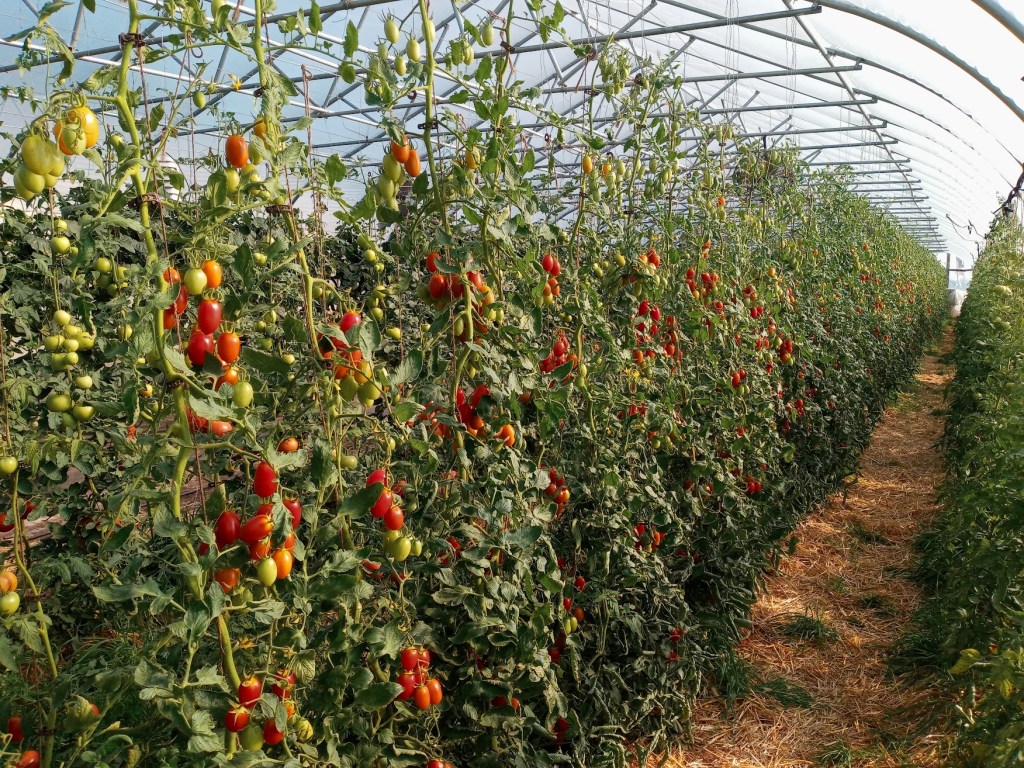
At the beginning of the season, before we put the caterpillar tunnel up, the field tomatoes looked very stressed. They had gotten their leaves pelted by so much rain and the soil was soaked. As we hustled to get the tunnel up before yet another 2″ rain, we worried that it might be too late for them to recover. I am happy to report that the exact opposite happened. We put the caterpillar tunnel over the tomatoes, and in just a few weeks, they looked like entirely different plants. The leaves went from a dry, shriveled, brown color to a soft, vibrant green color. The plants started producing more leaf sets, growing taller, and eventually putting on flowers and fruit. We think the protection from the elements really saved them because the rest of the field tomatoes developed early blight.

The fruit has been slow to ripen, but that could be because we pinched off the first one or two sets of flowers in an effort to convince the plant to focus on getting healthy rather than producing fruit. We have been able to harvest a few tomatoes, but most of the fruit on the plants is still green.

The most important factor in determining if this tunnel was a success came down to the taste. First, for background, we haven’t been satisfied with our greenhouse tomatoes for a few years so this year we tested out new fertility sources. Previously, our nitrogen source was coming from fish fertilizer, and our potassium source was mineral based. Nitrogen is important for the chlorophyll formation in plants. Chlorophyll is what makes plants green which allows them to absorb sunlight through photosynthesis. Without adequate nitrogen, plants won’t be “green” enough to absorb sunlight thus stunting their growth, and possibly preventing them from fully maturing. Potassium is important for plants because it aids in regulating the rate of photosynthesis, and it is associated with the movement of water and nutrients throughout the plant. Without adequate potassium, plants have reduced yield, stunted growth, and poor flavor. 

Our previous fertilizer mixture worked okay (though applying fish fertilizer through drip tape is a smelly hassle), but we wanted to see if we could do better so we tried an amino acid based nitrogen. This is beneficial to the plants because amino acids are immediately available for the plants to absorb. The fish fertilizer delivered nitrogen in the form of proteins which can take a while to break down so they can be absorbed by the plants. We also switched to using a plant based potassium source instead of a mineral based source. Mineral based sources can often lead to a build up of minerals at the roots of the plant, preventing the plant from being able to absorb other nutrients. We also added calcium and micronutrients to round out the program.  

Farmer Janaki thought this new fertilizer combination made the greenhouse tomatoes taste significantly better than in previous years. This meant the caterpillar tunnel tomatoes had to be really great in order to earn the top spot for best tomatoes on the farm this year. We had lots of people taste testing, and we all came to the same conclusion: for our Geronimo (large slicing tomatoes) we compared one from our regular greenhouse and one from our caterpillar tunnel, and the greenhouse won. They both had a similar texture, but the greenhouse tomato had more flavor. We also compared an Early Cascade (small canning tomato) from outside and one from the caterpillar tunnel. In this test the caterpillar tunnel won. Again, they had similar textures, but the appearance and flavor of the caterpillar tunnel tomatoes was better. Oddly, the caterpillar tunnel fruit ripened later than both the high tunnel and field tomatoes. We only did a small sample so far, and this is just one year, so we are excited to keep this in mind and see if we feel the same again next year. In farming, there are so many variables that it’s hard to run true experiments that inform results year-to-year, but we keep trying to zero in on better ways of growing healthy food!

In your share this week:

Green Beans – Broccoli – Cucumbers – Zucchini – Tomatoes – Sweet Onions – Carrots

Hot Peppers – Sweet Peppers – Potatoes – Melons – Lavender

Marcella Hazan’s Tomato Sauce 

2 cups of tomatoes with juices

5 tablespoons of butter

One onion, peeled and cut in half

Salt

Combine tomatoes and juices, butter and the onion halves in a sauce pan with one or two pinches of salt.  

Place over medium heat and bring to a simmer. Cook uncovered for 45 minutes occasionally stirring and breaking up chunks of tomatoes with the back of the spoon.

Discard the onion before pouring sauce on cooked pasta.  This recipe creates enough sauce for 1 pound of pasta.

Marinated Vegetable Antipasto

Vegetable suggestions: Blanched and chilled broccoli, cauliflower, and carrots.  Onion, celery, sweet peppers, zucchini

Marinade:

1/2 cup water

1-1/2 cups wine vinegar

1 cup olive oil

2 tbsp sugar

2 tsp fresh oregano, minced

1/2 cup pitted olives

Salt and pepper to taste

Prepare appx 8 cups vegetables by cutting into bite-size pieces.  Bring marinade ingredients to a boil in a larger saucepan.  Add approximately 2 quarts of cut up vegetables – cover and cook 3 to 4 minutes, stirring once.   Uncover, cool and refrigerate for at least two hours. Drain before serving.

Summer CSA Week 10

First things first, let’s get the business out of the way. It ‘s now August which means Coffee on the Farm is right around the corner. Please join us on Saturday, August 24th from 10am-12pm to have some delicious coffee, tour the farm, meet other CSA members, and taste some veggies straight out of the ground. This event is open to CSA members and those who are farm-curious. Bring your friends, family, neighbors, or anyone else you know who likes coffee and veggies!

Now for the fun! Last week, Janaki enjoyed some much deserved time off with his family. Thankfully he has an awesome crew who keeps things going while he’s away. This annual vacation marks 2 important timelines on the farm: garlic harvest and what I like to call “crop transition”. This is the beautiful time of year where we say our official goodbye to early season crops, and welcome the vegetable abundance that comes with the warmer weather crops.

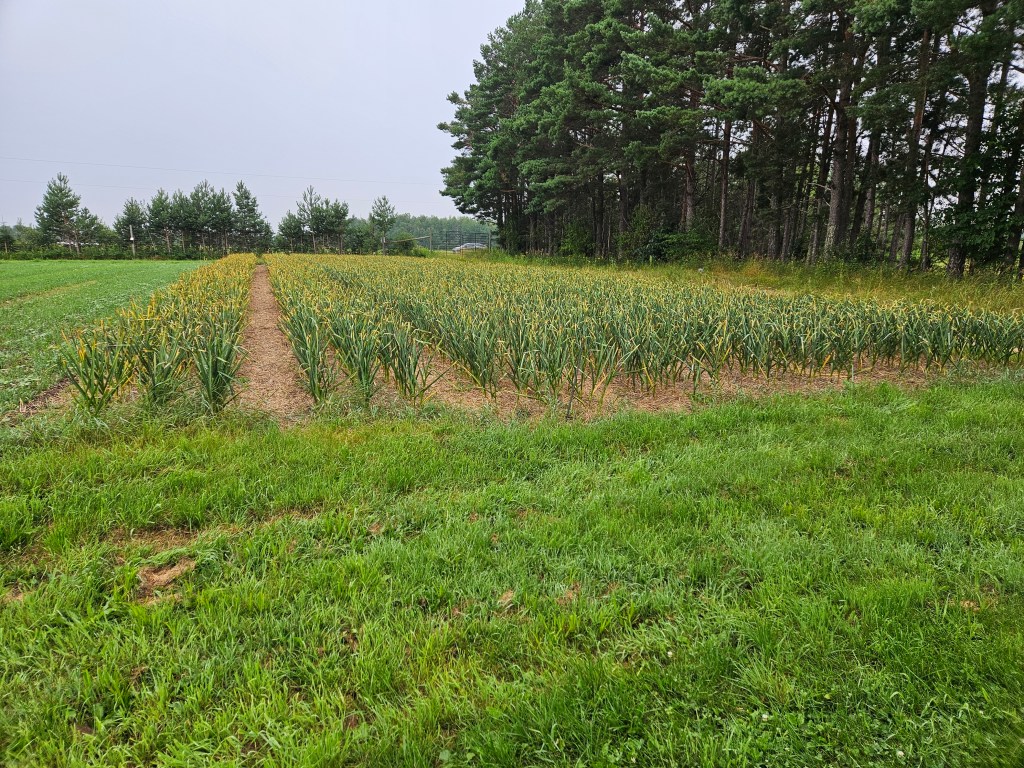
We finished up harvesting all of the garlic, and it is set to spend the next few weeks drying away with the first group of garlic that we harvested 2 weeks ago. This marks the first empty field of the year. an exciting, but bittersweet moment.

We spent the rest of the week giving our attention to the crop transition that comes with veggie abundance. This meant saying goodbye to spring and early season crops like snap peas, napa cabbage, and Pak Choi. This meant getting any of these vegetables that might be remaining, out of the field, and taking down the pea fencing so we can put it into storage until next year.
Now we can start paying more attention to our warm weather crops such as outdoor cucumbers, tomatoes, zucchini, and peppers. It’s their time to shine, and thanks to that heat wave we got, the plants are thriving!

Last week marked the first of our peppers going out. It was great to get some peppers off the plants so smaller fruit has more space to grow. You’ll get to enjoy green peppers for a while, and as the season progresses, so will the plants resulting in delicious red peppers. Did you know that a green pepper is a pepper at its first point of maturity? Most bell peppers start out green, and as they mature they turn red, yellow or orange depending on the variety. The Jalapenos are also loving the weather lately, and we are excited to introduce these to you all this week. Be warned: these beauties pack some serious heat, so a little goes a long way.

Our zucchini got kind of a rough start this year, but looks like they’re finally coming around. When we first planted them, they immediately got attacked by squash and cucumber beetles. This left the plants weak and struggling. We put a clay spray on the plants to make them less tasty for the bugs, and it worked. The plants started growing and began producing fruit and flowers. The zucchini flowers need to be pollinated in order for fruit to grow. Ours weren’t pollinated consistently for the first few weeks, which results in strange and deformed fruit. These still taste okay, but they are unsightly and only last a day or two before they get wiggly or start to rot so we don’t send them to shares. We suspect the issue is that we planted the zucchini right next to a bed of melons, and the bees seem more interested in melon flowers rather than the zucchini flowers. This means fewer zucchini in your share, but hopefully lots of delicious and juicy melons later this month.

The outdoor tomatoes are starting to ripen, and the greenhouse tomatoes continue to get bigger and ripen at rapid speed. If you get overwhelmed by tomatoes, a great option is to freeze them and use them later for sauces, stews, salsa, or many other things. If you freeze the tomatoes with the skin on, once they’ve defrosted, the skin slides right off. No boiling necessary. This is my favorite trick to be able to enjoy the delicious taste of fresh tomatoes in the middle of winter when we’re all thinking of warmer times.

Another new introduction to your share this week is potatoes. You already got to try two of our other pre-storage crops with the green garlic and the onions. Potatoes are the next addition to this collection. We call them “new potatoes”. This means that they are young and not fully developed. They have a thin skin, and delicious flavor. We love sharing these with you as soon as possible. However, this means they aren’t fully mature. You’ll likely notice that their skin is really thin and flaky. This is because they haven’t been in the ground long enough to create the sturdy outer skin we are all used to. On the plus side, this means no peeling needed. On the downside, this means they won’t store as long, and they should be kept in the fridge. The outer skin protects the potatoes and allows them to be stored longer. Without the shell, the potatoes will turn brown and spoil quite quickly if left out at room temp for too long.

In your share this week:

Beets – Beans – Cucumbers – New Potatoes Zucchini – Baby Carrots

Broccoli – Greens Mix – Cilantro – Cucumbers – Hot Peppers – Onions – Green PeppersOregano – Tomatoes

Broccoli Pasta Salad

Ingredients

  • 3 cups small broccoli florets
  • 1 cup cut green beans
  • 2 cups uncooked gluten free fusilli pasta
  • 1 small zucchini, thinly sliced and cut into half moons (or spiralized)
  • 1 cup sliced cherry tomatoes
  • 4 oil-packed sun-dried tomatoes, chopped
  • 8 fresh basil leaves, thinly sliced
  • ¼ cup pine nuts
  • sea salt and freshly ground black pepper
  • Lemon Tahini dressing: (can be made ahead)
  • 3 tablespoons extra-virgin olive oil
  • 3 tablespoons tahini
  • 3 tablespoons fresh lemon juice, more for squeezing at the end
  • 2 tablespoon white wine vinegar
  • 1 garlic clove, minced
  • ½ teaspoon Dijon mustard
  • ½ teaspoon maple syrup
  • ½ teaspoon sea salt
  • 3 tablespoons water
  • Instructions:
  • In a small bowl, whisk together the olive oil, tahini, lemon juice, vinegar, garlic, mustard, maple syrup, salt and water. Set aside.
  • Prepare a large pot of salted boiling water and a large bowl of ice water. Drop the broccoli and green beans into the boiling water and blanch for 1-2 minutes, until tender but still bright green. Remove and immediately immerse in the ice water to stop the cooking processing. Keep in the ice water long enough to cool completely, about 15 seconds. Then, drain and and place on a kitchen towel to dry.
  • In a large pot of salted boiling water, prepare the pasta according to the instructions on the package, cooking until al dente. Drain and rinse with cold water.
  • In a large bowl, combine the broccoli, green beans, zucchini, tomatoes, basil and the pasta. Drizzle with the dressing and toss. Season to taste with salt, pepper, and squeezes of lemon, if desired. Sprinkle with the pine nuts and chill for 15 minutes. Can be stored in the refrigerator for up to 2 days.

Veggie Fajitas

SIMPLE PICO

  • 2 tomatoes, diced small
  • 1 garlic clove, minced
  • 1 jalapeño, minced
  • 1 lime, juiced
  • 1 small onion, diced small
  • 1/2 tsp. kosher salt
  • 1/4 tsp. black pepper
  • 3 Tbsp. fresh cilantro, chopped

FAJITAS

  • 2 Tbsp. salted butter, divided
  • 2 Tbsp. olive oil, divided
  • 6 oz. white button mushrooms, halved
  • 1 small red onion, sliced
  • 1 Tbsp. steak seasoning
  • 1 bell pepper, sliced into strips
  • 1 poblano pepper, sliced into strips
  • 1 small yellow squash, halved lengthwise and cut into half-moons
  • 1 small zucchini, halved lengthwise and cut into half-moons
  • 2 limes, juiced
  • 1 Tbsp. honey

Directions

For the simple pico: Combine the tomato, garlic, jalapeño, lime juice, onion, salt, pepper, and cilantro in a medium bowl.

For the fajitas: Heat 1 tablespoon of the butter and 1 tablespoon of the oil in a large heavy-bottom skillet over medium-high heat. Add the mushrooms and onions in a single layer. Let cook undisturbed for 2 to 3 minutes, allowing the vegetables to char. Season with half of the steak seasoning, and stir. Remove to a plate and set aside.

Add the remaining 1 tablespoon butter and 1 tablespoon olive oil to the skillet and heat over medium-high heat. Add the bell pepper, poblano, yellow squash, and zucchini in a single layer. Let cook undisturbed for 2 to 3 minutes, allowing the vegetables to char. Season with the remaining steak seasoning, then stir in the reserved mushrooms and onions. Let cook until the vegetables are tender but still have some bite, about 2 minutes more. Stir in the lime juice and honey, and remove from the heat.

Serve the fajitas with the simple pico, tortillas, cheddar jack, crema, lime wedges, and hot sauce.

Summer CSA Week 9

Last week was an exciting week here on the farm. It was garlic harvest! Well, part one of two for garlic harvest.

This is a much anticipated time on the farm. Garlic is the crop that takes by far the longest to go from being planted to being ready for harvest. Garlic gets planted in the Fall, usually by Halloween, and doesn’t get harvested until the end of July or early August. That’s almost 9 months of growing to create the beautiful bulbs that you all get to enjoy.

A little background about garlic, there are two main types of garlic: hardneck and softneck. Hardneck garlic is what we grow on the farm, while softneck garlic is generally what you find in most grocery stores. Hardneck garlic gets its name from the hard neck or stem that grows in the middle of the bulb. This is actually where the garlic scapes came from (remember those from a few weeks ago?) making it two crops in one. If the scapes are left on the plant, it will eventually create a flower. However, this also results in a very small garlic bulb because the plant has spent all its energy on creating a flower rather than on creating the garlic bulb. By removing the scapes, we redirect the plant’s energy back to creating a big, beautiful bulb. Hardneck garlic needs to experience a hard freeze in order for the individual cloves to form. The freeze initiates the division of the cloves. Without a freeze, you end up with what’s called a “round”. This is one massive garlic clove. Makes for easy peeling, but really difficult to use since I’ve never found a recipe that calls for that much garlic at one time. This is why we have to plant the garlic in the fall, then wait so long before harvesting.

 We know the garlic is ready to harvest when about half of the leaves have started to brown and die. If the garlic is harvested too early, the cloves won’t be fully formed and you’ll end up with a small bulb.You also run into the possibility of air pockets between the skin and the cloves which could lead to moisture getting trapped and hindering the drying process. If we wait too long to harvest, the bulb will start splitting which exposes the cloves and prevents the bulb from being stored. It’s a delicate balance. Janaki wasn’t sure if the garlic was ready to harvest, so we decided to harvest half of the garlic that seemed further along, and leave the rest of the garlic for another week to give it more time to mature. 

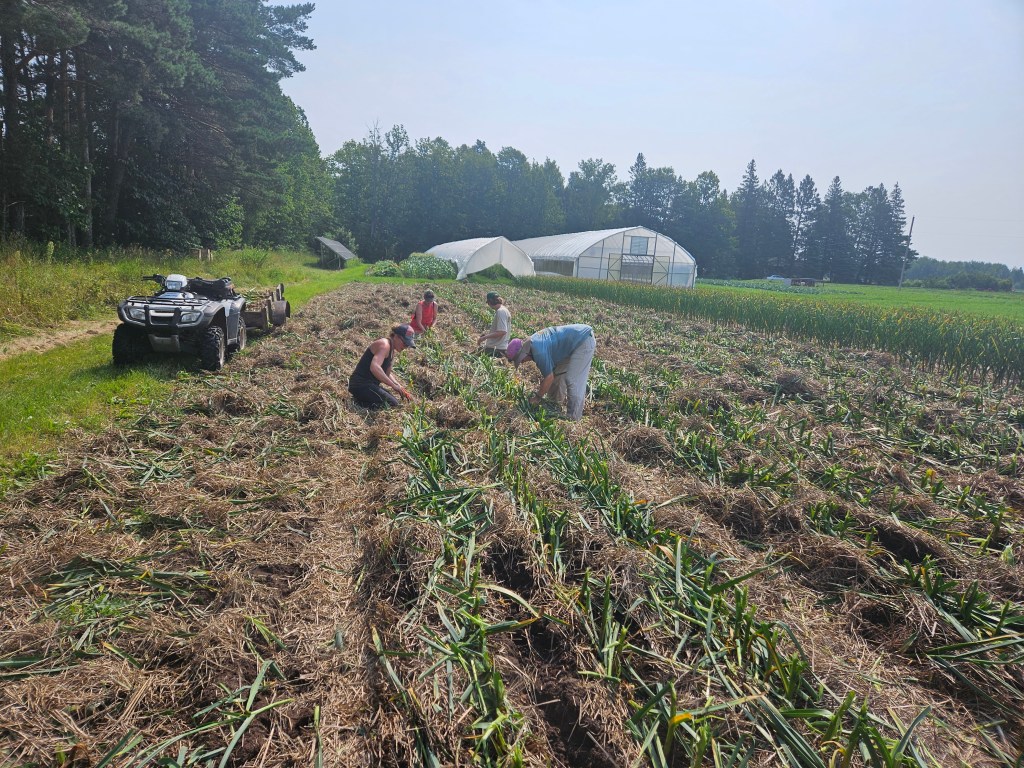
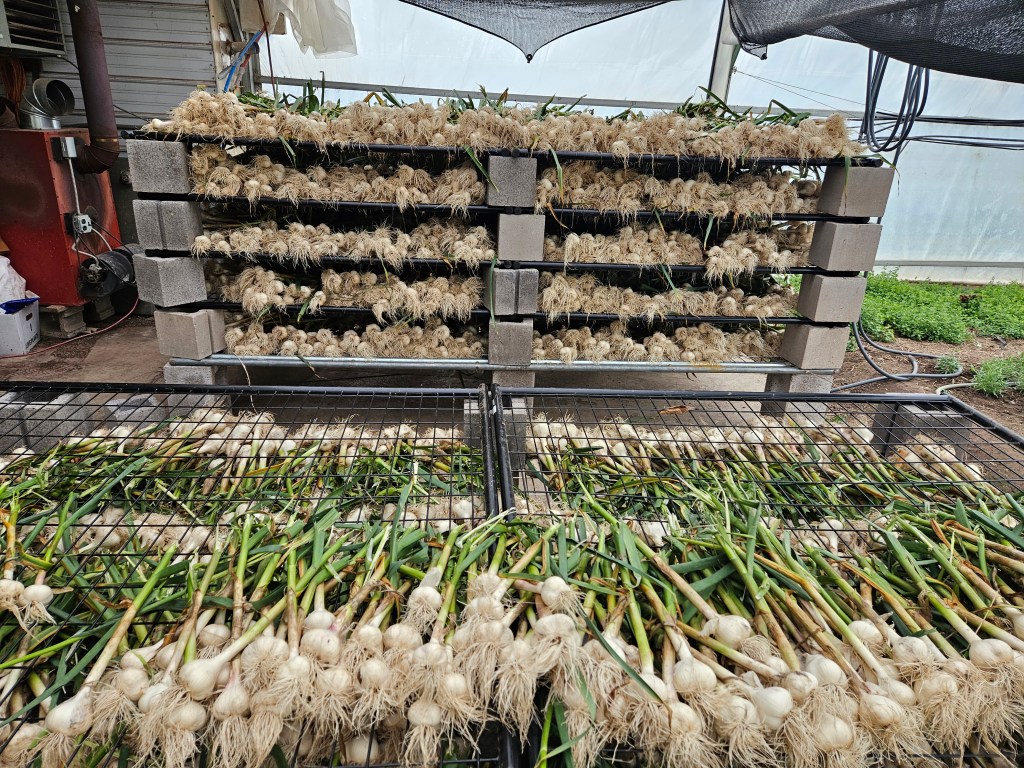
On harvest day, we mow off some of the foliage to make them easier to handle. Then Janaki uses a tractor attachment to gently loosen the bed so it’s easier to pull the bulbs from the soil. At this point, one crew jumps in and we start pulling all of the garlic bulbs out one by one. They get loaded onto a trailer, then moved over to the greenhouses to be washed. Another crew gently sprays off any excess dirt, and lays them on racks in front of industrial sized fans to begin the drying process.  After harvest, the garlic needs to dry for about a month (timeline depends on temps and humidity) in order for the papery, protective shell to properly form. You can eat the garlic before it’s dried, but it won’t store if it doesn’t get properly dried. After the garlic is dried, we save the biggest, best looking bulbs to use for next year’s planting. That’s right, garlic is the gift that keeps on giving. We harvest the garlic, dry it, select the best bulbs, break them apart into individual cloves, plant the cloves in the Fall, and repeat. Once you get garlic, you never have to buy it again because you can keep planting it over and over. Because you can keep using the garlic over and over to plant, I asked Janaki when the last time garlic was purchased to use for seed, and he said it had been so long that he couldn’t remember but knew it was long before 2010 (the year he and Annie took over the farm). That’s more than 14 years of the same garlic being used over and over! He did say that this might be the first year he may purchase more seed garlic since the garlic preserving shares sold this year were at an all time high. Thanks for all the garlic love!

In your share this week:

Cauliflower – Cucumber – Carrots – Green Garlic – Kale – Onion – Parsley – Green Pepper – Sage – Tomatoes – Zucchini

Zucchini stuffed with sausage and sage

INGREDIENTS

  • 2 to 3 pounds zucchini
  • 1/2 cup walnuts
  • 1 pound sausage
  • 1 onion, diced
  • 8 ounces mushrooms, diced
  • 3 to 4 cloves garlic, minced
  • 2 tablespoons minced fresh sage
  • 2 eggs
  • 1 cup shredded pecorino cheese, divided

INSTRUCTIONS

  • Pre-heat the oven to 375° F.
  • Cut the zucchini in half lengthwise and scoop out the seeds. Leave an inch or so of zucchini. Set the zucchini in the baking pan cut-side up and season it with olive oil, salt, and pepper. Pour a quarter inch of boiling water into the pan, cover with foil, and bake for 10 minutes, just until the zucchini is no longer raw. Set aside to cool enough to handle.
  • Spread the walnuts on a baking sheet and roast them alongside the zucchini for 5-10 minutes, until fragrant. Chop into small pieces and set aside.
  • Heat a large skillet over medium-high heat. Brown the sausage, breaking it up into medium-sized bits as you go. Transfer to a bowl and drain off all but a teaspoon of the grease. Add the onions to the pan with a good pinch of salt, and cook until soft and golden. Add the mushrooms and another pinch of salt. Cook together until the mushrooms have turned golden and any moisture they released has evaporated. Stir in the garlic and sage. Cook for about thirty seconds until fragrant.
  • Combine the walnuts, cooked sausage, onions, and mushrooms in a large bowl. Beat the eggs together. Stir the eggs and 3/4 cup of the pecorino into the stuffing mixture.
  • Pat the zucchini dry and fill the cavity with the stuffing..
  • Drain the liquid from the baking pan, rub it with a little butter or olive oil, and place the stuffed zucchini back inside. Cover with foil and bake for 30 minutes. Uncover, sprinkle the remaining cheese over the zucchini, and bake for another 10-15 minutes until the filling is bubbling and the cheese is crispy.
  • Allow the zucchini to cool slightly. Slice into portions and serve. Leftovers will keep refrigerated for one week

Mediterranean tuna salad

  • 1 (5-ounce) can albacore tuna in water, drained
  • 1 small bell pepper, halved, cored, and finely chopped (1 cup)
  • 2 tablespoons extra-virgin olive oil
  • 2 tablespoons fresh lemon juice
  • 1 teaspoon grainy mustard
  • 3 tablespoons chopped capers
  • ½ cup chopped fresh parsley
  • Kosher salt and freshly ground pepper
  • Dressed salad greens for serving
  • Sliced cucumbers and crackers, for serving

Directions


Place tuna in a bowl and flake with a fork.
Add bell pepper, oil, lemon juice, mustard, capers, and parsley; stir well to combine and season with salt and pepper.
Serve with salad greens, cucumbers, and crackers on the side

Summer CSA Week 12, 2023

It was so nice to see Food Farm folks this Saturday–we enjoyed speaking with so many of you and show off our hard work!

As some of you may have noticed, the root cellar is gradually filling up with a colorful abundance of carrots, beets, cabbage and potatoes. The farmers have been diligently packing up more and more of these vibrant vegetables, destined for grocery store shelves and eager CSA members.

Moreover, last week marked the collapse of our onion tops. This may sound slightly catastrophic, but don’t worry – it’s a good thing! The leaves fall over simply because the plant has matured and is no longer developing. It’s also how we know they are ready for harvest. In the photo (see left), you can see Teri & Aaron gently lifting them from the ground before laying them out to dry. Careful handling is essential during harvest to avoid bruising, which makes the bulbs susceptible to storage rot. Following the uprooting, these onions will begin their curing process in the fields for a week or so before having their tops removed and transferred to a well-ventilated indoor storage space.


In your share this week:

Basil – Beans – Broccoli – Cauliflower – Carrots – Celery – Cucumber – Melons

Sweet Onions – Bell Peppers – Potatoes – Tomatoes – Zucchini


The recipes this week have a lot of room to make them your own. Either one would be good with just about any item in the share (excluding the melons). So feel free to follow them as directed or create your own pizza & curry experiments…


Zucchini Crust Pizza, from The Cozy Cook

2 cups shredded zucchini
1/4 teaspoon salt
3 large eggs, beaten
1/2 cup all purpose flour (almond flour, coconut flour, and whole wheat flour may also be used)
1/3 cup shredded parmesan

  1. Preheat oven to 350°.
  2. Spread the shredded zucchini out on a lightly greased baking sheet and sprinkle lightly with salt. Bake for 15 minutes. Remove and transfer the zucchini to paper towels or a cheesecloth.
  3. Increase oven temperature to 450°.
  4. Squeeze out as much additional moisture from the zucchini as possible. Add the zucchini to a large bowl along with the whisked eggs.
  5. Sprinkle the flour in gradually, stirring to incorporate. Continue to add flour until desired consistency is obtained. (I use the entire ½ cup for all-purpose flour.)
  6. Spread out onto a lightly greased 12-inch pizza pan, leaving 1-inch or so around the edges.
  7. Top with shredded Parmesan cheese and bake for 18 minutes, until it begins to brown slightly. Remove from oven.
  8. Reduce heat to 400°.
  9. If possible, let the crust cool for extra crispy results.
  10. Top with desired pizza toppings. Bake for ~10 minutes, until the cheese is melted and bubbly.

Summer Vegetable Curry, Inspired by Half Baked Harvest

Basil Coconut Ginger-Lime Rice:

1 (14 ounce) can coconut milk
1 cup jasmine or basmati rice
1 tablespoon fresh ginger grated
1 lime juiced + zest

  1. Add the coconut milk to a medium size pot. Bring to a low boil and then add the rice, salt, and ginger. Stir to combine and then place the lid on the pot and turn the heat down to the lowest setting possible. Allow the rice to cook ten minutes on low and then turn the heat off completely and let the rice sit on the stove, covered for another 20 minutes (don’t take any peeks inside!). After 20 minutes remove the lid and add the lime juice + zest.

Curry:

4 tablespoons extra virgin olive oil
1 pound boneless, skinless chicken, diced
2 bell peppers, chopped
1 zucchini, chopped
2 cups green beans, chopped
1 cup broccoli, diced
1 cup cauliflower, diced
1 cup carrots, diced
1 tablespoon fresh ginger, grated
2 cloves garlic, grated or minced
2-3 tablespoon thai red curry paste
1 (14 ounce) can coconut milk
1 tablespoon fish sauce
1/2 cup fresh basil, chopped
1 mango, diced
1 jalapeño, seeded + diced
fresh naan and goat cheese, for serving

  1. Heat a little olive oil in a large skillet over high heat. Add the chicken and cook until browned and cooked through, about 5-10 minutes.
  2. Add another drizzle of olive oil to the skillet. Add the peppers, zucchini, beans, broccoli, cauliflower, carrots, ginger and garlic. Cook the veggies 5 minutes or until they just begin to soften.
  3. Add the coconut milk, curry paste, and fish sauce. Stir to combine, bring the mixture to a boil, cook 5 minutes or until the sauce thickens slightly. Remove from the heat and stir in the basil.
  4. In a small bowl toss together the mango and jalapeño.
  5. Serve the curry over the rice. Add a spoonful of the mangos and a sprinkle of goat cheese. Eat with Naan!

For the farm crew,

Charlie

Summer CSA Week 11, 2023

It’s farm tour time–this Saturday from 10-noon, we’d love to see you!

It’s melon mayhem at the Food Farm! We recently set our new daily harvest record with a whopping 377 cantaloupe. That is more than 800 pounds of weight to pull from the field! We expect them to slow down soon, so enjoy it while it lasts.

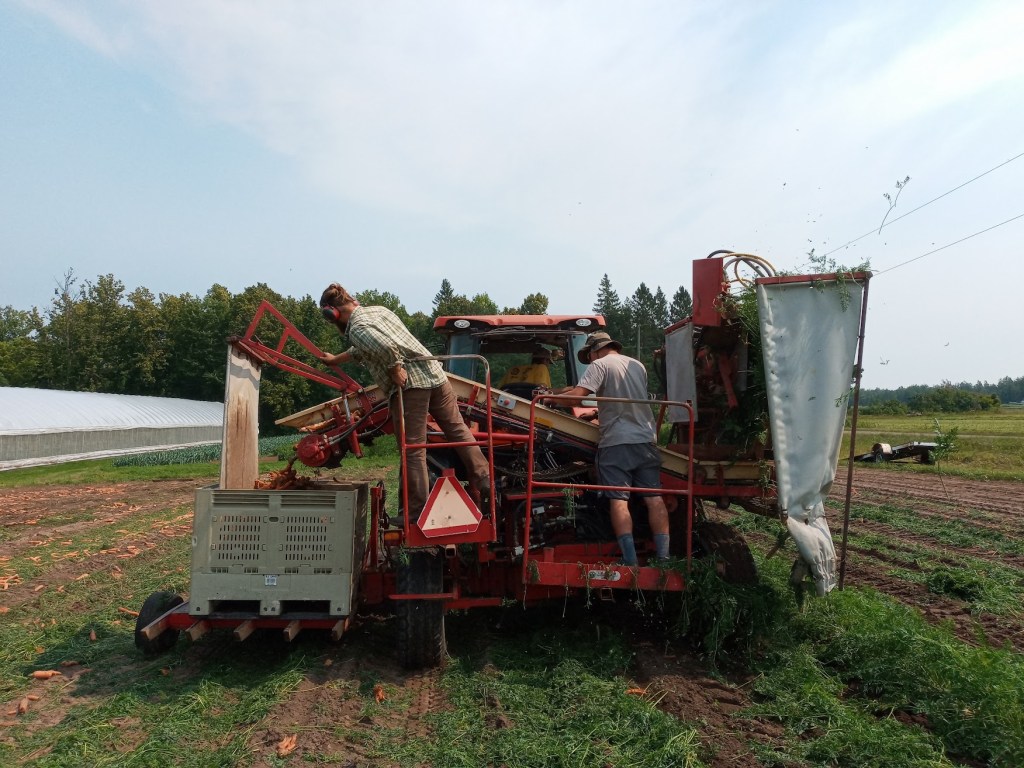
In other news that is orange, the crew christened a “new-to-us” carrot harvester. A lucky few climbed aboard as it took its maiden voyage through the fields, while the rest of the crew assembled at the washing stations. There were certainly some wrinkles to iron out, as there often is with any new piece of machinery, but by the end of the week the process seemed to be moving along rather quickly.


Beans – Broccoli – Carrots – Cilantro – Cucumbers – Dill – Greens Mix – Melons

Onion – Bell Peppers – Hot Peppers – Potatoes – Tomatoes – Zucchini


Usually the melons are best enjoyed straight up in all their glory. That way you can fully appreciate the depth of their flavor. This week though, because there are so many, I thought it would be nice to include a recipe with them in it. It does include basil, which we are not sending this week… I’m hoping some of you still have a few sprigs leftover from last weeks share, or can maybe snag some from a friendly neighbor’s garden.

P.S. The vinaigrette would also go great on the greens mix in today’s share 🙂

Melon Caprese Salad, from Half Baked Harvest

Honey Herb Vinaigrette:
1/4 cup extra virgin olive oil
2 tablespoons honey
Juice of 1 lemon
1 tablespoon white balsamic
1 cup fresh basil
1 tablespoon toasted pine nuts
1 pinch flaky sea salt

  1. To make the vinaigrette, combine all ingredients in a blender and blend until smooth.

3 balls fresh burrata cheese
4 cups melon balls
1/2 cup fresh basil leaves
2 tablespoons fresh mint
6 slices prosciutto

  1. Break the burrata in half and place each half in the bottom of a small bowl or glass (about 8 ounces). Over the burrata, layer the melon balls, basil, and mint. Top with a slice of prosciutto. 
  2. At this point the salad can be covered and placed in the fridge for up to 6 hours. 
  3. Before serving, drizzle over the vinaigrette.

Blistered Green Beans w/ Tomato-Almond Pesto, from Bon Appétit

1 1/4 cups diced tomatoes
1/8 cup unsalted, roasted almonds
1 garlic clove, grated
1 tablespoons olive oil
1 tablespoons Sherry vinegar or red wine vinegar
1/2 teaspoon paprika
Pinch of cayenne pepper
Kosher salt, freshly ground pepper
1 1/2 teaspoons vegetable oil
1 pounds green beans, trimmed

  1. Preheat oven to 450°F. Roast tomatoes on a rimmed baking sheet, turning once, until blistered and lightly charred, 15-20 minutes. Let cool slightly. Finely chop almonds in a food processor. Add garlic, olive oil, vinegar, paprika, cayenne, and half of tomatoes; pulse to a coarse pesto consistency. Season with salt and pepper.
  2. Heat 3/4 tsp. vegetable oil in a large skillet over medium-high. Add half of beans; cook, undisturbed, until beginning to blister, about 2 minutes. Toss and continue to cook, tossing occasionally, until tender, 7–9 minutes; season with salt and pepper. Spread beans out on a platter; let cool. Repeat with remaining vegetable oil and beans.
  3. Toss beans with pesto; season with salt and pepper if needed. Add remaining tomatoes and transfer to a platter.

Summer-Vegetable Casserole, from Food & Wine

Extra-virgin olive oil, for drizzling
1/2 pound potatoes, peeled and sliced 1/4 inch thick
Salt and freshly ground pepper
1 bell pepper, thinly sliced
1 small onion, thinly sliced
1 large garlic clove, minced
1 teaspoon thyme leaves
1/2 pound tomatoes, sliced 1/4 inch thick
1 medium zucchini, sliced on the diagonal 1/4 inch thick
3 tablespoons freshly grated Parmigiano-Reggiano cheese

  1. Preheat the oven to 350°. Coat a 9-inch baking dish with olive oil. Spread the potatoes in the dish in an even layer; drizzle with oil and season with salt and pepper. In a bowl, combine the bell pepper, onion, garlic and thyme and season with salt and pepper. Arrange two-thirds of the bell pepper mixture over the potatoes and drizzle with oil. Top with the tomatoes and the zucchini; drizzle with oil and season with salt and pepper. Cover with the remaining bell pepper mixture and sprinkle with the cheese.
  2. Cover the casserole with foil and bake for 40 minutes. Increase the oven temperature to 425°. Uncover the casserole and bake for about 20 minutes longer, until the vegetables are tender and glazed on top. Let stand for 10 minutes. Serve warm.

For the farm crew,

Charlie

Farm update and Week 6 CSA

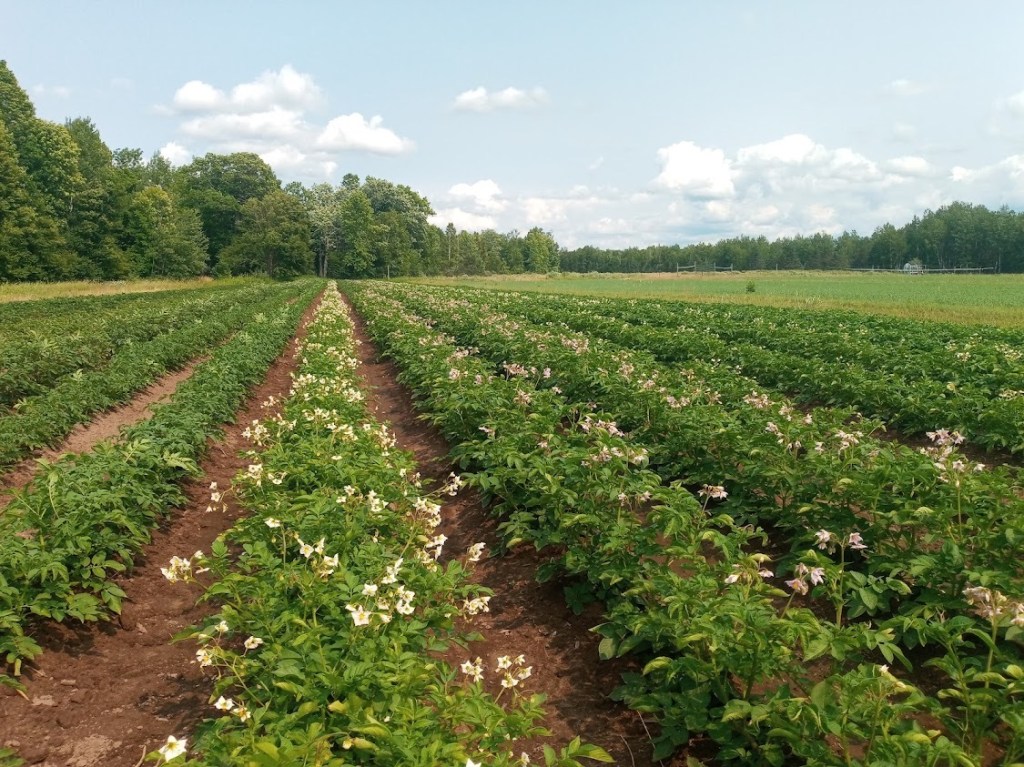
At the end of last week, Janaki took the crew for a walk about the farm to check out everything that’s going on. Things are really starting to pop! The snap peas are crawling all over their trellises and the potatoes are sporting their beautiful white flowers (see above). The biggest melons are palm-sized and starting to ripen. This year we are growing our crowd-favorite, cantaloupe, but we are also trying some watermelons. They’re unlikely to ripen in our climate, but we’re rooting for them! Stay tuned. Also looking to be in good shape are our outdoor carrots (thus far all of the carrots we’ve sent have enjoyed the comfort of greenhouse living).

A highlight for me was learning about Janaki’s growing strategy and how he rotates crops to ensure superb soil quality year after year. He tries to keep a certain level of available resources in each field by incorporating compost, organic matter and planting cover crops after a field has yielded a successful vegetable harvest. For example, he will often interseed clover in mid-to-late summer, which works to replenish important nutrients such as nitrogen levels in the soil. By doing this, we’re able to avoid using fertilizers and other conventional methods to re-establish optimal nutrient levels in our soil for the next round of vegetables. It also aids in weed suppression, meaning we can avoid using herbicides.

We also checked in on a new no-till method we are is testing out. When trying something new at the farm, it’s pragmatic to do a test and a control. In the picture above, you can observe the results at this point in the season. On the left, you can see the control group rows – the soil was turned over before planting and the cabbage is large. On the right, the no-till method shows smaller cabbages, which were planted directly into the clover cover crop. While the control rows appear to be doing much better, what you can’t see is all the work that went into turning over that soil at the beginning of the season before the cabbage could be transplanted. With a no-till method, transplants can go directly into unturned soil. Another benefit of a no-till method is less intensive to no weeding (big win!). The experiment doesn’t look promising now, but we’re waiting until the fall to make a final judgement. With trial and error, we’ve already learned a few things we’d change to make the system better.


In your share this week:

Broccoli – Green-top Carrots – Cucumbers – Garlic Scapes – Greens Mix – Lettuce

Napa Cabbage – Green Onions – Parsley – Snap Peas – Zucchini


This is a recipe forwarded to me from Deb Rausch, A frequent volunteer and friend of the farm. She’s been enjoying a variety of vegetables (mostly kale and chard) with this simple yet tasty dressing. I think it would be great with the broccoli and parsley this week, but use it for whatever feels right to you.

Deb’s Dressing

1/3 c mayo
2 green onions
1 tablespoon champagne vinegar (or rice vinegar)


Miso Glazed Grilled Zucchini

This recipe is a bit intensive but so worth the effort!

2 tablespoons white miso
1 tablespoon honey or maple syrup
1 tablespoon rice vinegar
1 tablespoon soy sauce (or Tamari)
3 medium zucchini (about 1-1/4 lbs)
Cooking oil
Green onions and sesame seeds for garnish

Instructions:

  1. Preheat oven to 400. Slice the zucchini in half length-wise. Cut a cross-hatch pattern into the cut-side of each zucchini half. Each cut should only be about 1/4-1/8 inch deep.
  2. Sprinkle each cut-side with a little bit fo salt. Turn the cut-side down onto a paper towel and let drain for 15-20 minutes.
  3. Once the moisture has been released, quickly rinse the zucchini. Take care not to let the water run over them for too long – you don’t want them to re-absorb water after you’ve drawn out the moisture! Dry off with fresh towels. Make them as dry as possible.
  4. Heat a cast iron skilled or other oven-proof vessel over medium heat. Add 1-2 tablespoons oil, let it heart up, then place the zucchini cut-side down in the pan. Cook until golden brown (about 7 minutes). You can use tongs to carefully peek at the cut-side while cooking.
  5. Once browned, place the cast-iron skill into the oven for 15 minutes. While roasting, make the miso glaze. You can add water to thin it out to the consistency of a BBQ sauce if needed. The zucchini should be extremely fork-tender.
  6. Remove pan from oven and carefully turn over the zucchini so the cut-sides are up. Spoon on the glaze so it covers the zucchini (it doesn’t have to be thick).
  7. Return the pan to the oven, this time with the cut-side up. Turn on the broil function and watch until the miso glaze just starts to bubble. Finish with green onions and sesame seeds.

Smashed Cucumber Salad

Yield: 4 servings

1 large greenhouse cucumber
handful of snap peas (everything you got in your share)
1 teaspoon kosher salt, plus more for cucumber
2 teaspoon granulated sugar, plus more for cucumber
1 1/2 tablespoons rice vinegar
2 teaspoons sesame oil
2 teaspoons soy sauce or tamari
1 tablespoon grapeseed or olive oil
2-3 garlic scapes, minced
Red pepper flakes, to taste

For garnish:
Small handful of cilantro
1 teaspoon toasted sesame seeds (optional)

Instructions:

  1. Rinse cucumber and pat dry. Cut crosswise into pieces about 4 inches long. Cut each piece in half lengthwise.
  2. On a work surface, place a piece of cucumber cut side down. Lay the blade of a large knife flat on top the cucumber and smash down lightly with your hand. The skin will begin to crack, the flesh will break down and the seeds will separate. Repeat until the whole piece is smashed. Break or slice diagonally into bite-sized pieces, leaving the seeds behind.
  3. Place the cucumber in a strainer and toss with a big pinch of salt and a big pinch of sugar. Place a plastic bag filled with ice on top of the cucumbers to serve as a weight and place the strainer over a bowl. Let drain 15 to 30 minutes.
  4. Make the dressing: In a small bowl, combine salt, sugar and rice vinegar. Stir until salt and sugar are dissolved. Stir in sesame oil and soy sauce.
  5. When ready to serve, shake cucumbers well to drain off any remaining liquid and transfer to a serving bowl with snap peas. Drizzle with grapeseed or olive oil and toss. add half the dressing, half the garlic scapes and the red pepper flakes to taste, and toss. Keep adding dressing until cucumbers are well coated but not drowned. Taste and add more pepper flakes and garlic if needed. Serve immediately, garnished with cilantro and sesame seeds.

For the farm crew,

Charlie

Summer CSA Week 5, 2023

Dear Food Farm Community,

As we delve into the heart of the growing season, we find ourselves knee-deep in the world of weeding. Weeding, although often deemed an arduous task, is an essential part of maintaining the health and vitality of our crops. The crew has been diligently working through the fields, carefully tending to each bed, ensuring that our plants have the space, nutrients, and sunlight they need to thrive.

Soon we’ll begin to notice that the daylight hours are gradually decreasing, but the harvest time seamlessly extends, stretching out longer and longer. More variety means more running around for the crew and volunteers. This morning we were doing just that; shuttling harvest totes to and fro to deliver a well rounded box of vegetables.


In your share this week:

Green-top Beets – Broccoli – Green-top Carrots

Cucumber – Garlic Scapes – Kale – Green Onions – Zucchini


Beet Greens & Kale Sautéed with Garlic Scapes

~ 2 servings

  • 1 tablespoon olive oil
  • 1 slice bacon, cut into small pieces (optional, use a little more oil if omitting)
  • 2 garlic scapes, finely chopped
  • 2 green onions, white and pale green portion, finely chopped
  • 6 leaves beet greens, stems cut into 2-inch pieces
  • 2 leaves kale, ribs and stems removed, chopped
  • salt and pepper to taste
  1. Heat olive oil in a large skillet over low heat. Cook bacon until it begins to brown and crisp, about 2 minutes. Add garlic scapes and green onion, cook and stir until golden brown, 3-5 minutes.
  2. Stir beet stems and kale into skillet. Cover and cook until kale wilts, about 3 minutes. Add beet greens. Cover and cook until bright green and wilted, 1 to 2 minutes.
  3. Season with salt and pepper.

Sautéed Zucchini & Carrots

  • 1 medium zucchini, thinly sliced
  • 2 medium carrots, thinly sliced
  • 1 tablespoon olive oil
  • 1 tablespoon ghee (optional)
  • 1 teaspoon dried thyme
  • salt and pepper to taste
  1. Heat a large skillet over medium-high heat. Add the oil and butter.
  2. Once the better is melted, add the zucchini and carrots. Sprinkle with thyme, salt and pepper, toss to coat.
  3. Sauté vegetables until lightly browned and tender, stirring occasionally so they do not burn.

I know I already included a pickled turnip recipe in the week 2 newsletter, but if you are like me, you may have a few extra rolling around in your fridge still. Here is a recipe that includes beets along with our old friend. If you happen to be out of turnips, just use more beets!

Pink Pickles, from Cotter Crunch

8 servings

  • 12–14 ounces purified water
  • Optional: 1 teaspoon sugar
  • 2 ½ Tablespoon Kosher salt
  • 1 bay leaf
  • ½ cup white vinegar (for quick pickling)
  • 1 small red beet, peeled and sliced
  • 2 turnips (about 1 pound), peeled and sliced
  • 1 clove garlic, chopped
  1. Add beet, turnips and garlic to a heatproof jar or container. Set aside.
  2. In a medium saucepan, bring salt, sugar, bay leaf, and 12 ounces of purified water to a boil, stirring occasionally to dissolve salt and sugar. Turn off heat and let mixture cool down for 5 minutes, then stir in vinegar.
  3. Pour pickling liquid over the contents in the jar, and ensure that the turnip and beet slices are submerged completely in the brining liquid. Let it cool, then close the jar and place it in a dark area for 5 to 7 days.
  4. For best flavor, refrigerate before serving.
  5. Store in a covered jar or container in the refrigerator for up to one month.

For the farm crew,

Charlie

Summer CSA Week 7, 2022

Sugar snap peas below solar panels in the front of the farm.

Can you believe we’re already at the end of July?! We can’t! We are approaching harvest time for our preserving shares, one-time bulk produce boxes made specially for canning and freezing. We have shares of canning tomatoes, basil, garlic, green beans, juice carrots, and leafy greens. Get your preserving share order in now at foodfarm.csaware.com! These preserving shares are distributed via our CSA pick-up sites, so you can pick up with your regular summer share. The one exception is our green bean share, which you pick yourself; a fun excuse to come see the farm and get into the field. If you already have a preserving share, we will contact you in the coming weeks via email to schedule pick up.

New in the box this week is zucchini and snap peas. Snap peas are a favorite for fresh snacking.

Peas on the vine

In your share this week:

Napa Cabbage – Zucchini – Lettuce – Cucumber – Green Onions – Carrots with Tops – Snap Peas – Cauliflower – Broccoli


Zoodles – Zucchini Noodles

Here are some tips for making great zoodles or zucchini noodles. Zoodles are a healthy gluten-free alternative to pasta!

Ingredients

Zucchini

Salt

Olive oil (about a tablespoon)

Pasta sauce of your choice

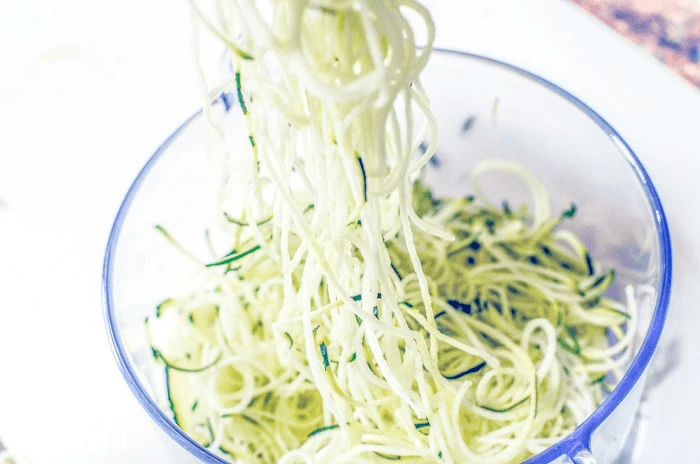
Finished spiralized zoodles

Instructions

  1. Cut the zoodles: Wash your zucchini, but don’t bother peeling. You may have seen or tried long curly zoodles before (image below). These are made with a spiralizer. If you have this tool, follow the manufactures instructions to slice up your zuc. If you don’t have a spiralizer, have no fear! A basic kitchen peeler will work just as well. Just keep peeling past the skin and peel the whole zucchini into long strips. Watch out for your fingers at the end.
  2. Remove excess moisture: Pat your zoodles between paper towels. Sprinkle with salt and allow to rest for 10-20 minutes. This will draw out excess moisture. Press into the paper towels one more time then you’re ready to cook your zoodles.
  3. Cook the zoodles: Saute your zoodles in a pan with a little olive oil over medium heat. Cook for 4-6 minutes or until the zoodles become tender. For the best non-watery results. Do not cover with a lid. Do not overcook. Season with salt and pepper if desired.
  4. Serve with your favorite pasta sauce.

Try zoodles with Carrot Top Pesto, from the week 4 newsletter!


Two members of our farm crew harvesting green onions in the greenhouse.

For the farm crew,

Starr

Summer CSA Week 13

Every day was super eventful on the farm this past week. The crew adjusted the solar panels along the driveway to match the sun’s fall position in the sky. We are also gearing up for the fall harvesting that will be happening soon, especially for the storage crops. On Wednesday we harvested about 13 tons of carrots – all before lunch. It’s days like those that really make us realize the impact we have on the local food system. Also, not to scare anybody but there are at least 30 more tons (hopefully) that still need to be harvested before late October. And those are just the carrots. Our list of things to do seems like it should be getting smaller but let’s be honest – it’s definitely going to get bigger.

Early this week we said a heartfelt goodbye to Karin who has been the backbone of the farm crew for 7 seasons. She will be deeply missed, but we all wish her the best of luck with this transition in her life. In her honor we built a huge shrine with some parts we found laying around in the barn and it’s just outside the pack shed so she is never forgotten. It doubles as a second bucket-drying rack. Just kidding – that’d be weird. But truthfully, she deserves the recognition for being so cool.

As many of you probably experienced this week, the air quality was very poor from the wildfires burning north of us. As a farmer, I never realized how much I had been taking good air quality for granted. Luckily, wearing a mask helps a lot. There was some rain at the end of the week (yay!) that helped improve the air quality. As a bonus we got to finally experience some autumn-ish weather that the storms brought with them – cool breezes and chilly mornings. Rain also gives us all some excitement knowing that our veggies will be that much happier.

Our newer hens have been adjusting nicely to their new home in the last month. They live on the far side of the farm in a mobile coop that gets moved every few days. This ensures the field they are in is getting an equal distribution of fertilization from the chickens. Earlier this season Farmer Janaki taught us that the fields that have had chickens rotated around in them are significantly more fertile than their non-chicken bearing neighbors. This is just another way the Food Farm builds soil and improves soil quality. What that means for our share members is more nutrient dense veggies.

Thanks for reading my first newsletter, I am excited to carry on this task.

Emily

In your shares this week:

Cucumber – Zucchini – Potatoes – Carrots – Hot Peppers – Red and Green Peppers – Onion – Dill – Tomatoes – Greens Mix – Beans – Beets

Zucchini Lasagna from PBS

  • For the Tomato Sauce:
  • 1 – 28 oz can of crushed tomatoes (or about 4 pounds of fresh tomatoes)
  • 1 large garlic clove, minced
  • 1 Tbsp. fennel seed, crushed slightly to release the flavor
  • 1 tsp. ground oregano
  • 1/4 cup finely chopped basil
  • 1 tsp. cane sugar
  • 2 Tbsp. olive oil
  • For the Cheese Filling:
  • 1 pound of ricotta cheese (or cottage cheese)
  • 1 cup grated parmesan cheese
  • 1 egg
  • Salt and Pepper to taste
  • For the Vegetables:
  • 2 to 3 medium-sized zucchinis, no bigger than 4 inches diameter (or 4 to 5 small zucchinis)
  • 2 tsp. salt
  • 3 Tbsp olive oil
  • 1 pound of mushrooms, sliced
  • 1 bunch of swiss chard or spinach (about 4 cups, chopped)
  • 1 large onion, minced
  • 2 Tbsp. flour (can be gluten-free flour)
  • A dozen or so fresh basil leaves (optional)
  • 4 cups shredded mozzarella (about 1 pound)
  1. Slice the zucchinis lengthwise to between 1/8 to 1/4 inch thick. Use a mandolin if you have one, it will help you slice the zucchini faster and in perfect consistent slices. Otherwise, slicing with a knife is fine too. Place the slices on a clean towel and pat the zucchini very dry. Rub 1 Tbsp of olive oil onto an extra-large baking sheet (or 2 smaller ones) and place the zucchini slices in a single layer. Roast in a 375F oven for about 10 minutes. Allow to cool.
  2. If using fresh tomatoes, deseed the tomatoes (if you wish remove the skins). Bring the tomatoes to a boil and add the minced garlic, chopped basil, crushed fennel seeds, ground oregano, olive oil, sugar, and salt to taste. Simmer until thick and reduced. It’s important to use a thick lasagna sauce in this recipe because the lasagna can otherwise be on the soupy side without the pasta to soak up the extra liquid as it bakes.
  3. In a large skillet or wok, heat 2 Tbsp olive oil and sauté the onions for 3 to 4 minutes. Add the mushrooms and continue cooking. Once the mushrooms are soft, add the chopped swiss chard. When the chard is cooked, remove from heat and drain any juices (save these for great soup stock). Add 2 Tbsp flour to the mixture and mix well to incorporate.
  4. Oil a 9 x 13 inch lasagna dish and spread about one third of your sauce on the bottom. Add a layer of roasted zucchini to cover the tomato sauce. Add the ricotta and parmesan cheese mixture and spread evenly. Add another layer of zucchini slices. Add a second round of tomato sauce and spread evenly, followed by the vegetable mixture and half of the shredded mozzarella cheese. Add a last layer of zucchini slices followed by the third and last round of tomato sauce. Place the twelve basil leaves on top of the sauce and sprinkle the rest of the shredded mozzarella on top. Pro tip: place a baking tray on the rack beneath the lasagna pan to catch any bubbling juices from falling to the bottom of your oven. Bake for about 40 minutes at 350F until the cheese is melted.

Cucumber Tomato Salad from Spend With Pennies

  • 2 cucumbers (sliced)
  • 2 large tomatoes (diced)
  • 1/2 onion (sliced)
  • 1 tablespoon of dill
  • 2 tablespoons of olive oil
  • 1 tablespoon of red wine vinegar
  • salt and pepper to taste

Combine all ingredients in a boil and toss well.

Summer CSA Week 11

I am sure I have said in newsletters of yore that recipes aren’t really my thing. Finding them for the newsletter – I just do the laziest thing which, depending on what I’m looking for, is either just googling “spinach recipes” or whatever, or going to a couple of my go-to sites for ideas and seeing what they say. Recipes aren’t really my thing, but I do like pretty pictures of food, and being forced to look up new ideas for the newsletter does help me snap out of a rut (re: last week’s zucchini fritters comment).

A lot of the way I cook (when I’m not “cooking” eggs and toast) feels like just throwing what I have lying around together, often in one or two pots and then eating all of whatever it is in a bowl. Sometimes I don’t feel like it counts as a “meal”- the Midwest concept of what a meal is has imbedded itself in my brain. Sometimes I don’t feel like it counts unless there’s meat (duh) and two sides (one being potatoes) and dessert. I’ll skip the glass of skim milk at dinner… but thanks for offering.

With shares like this week’s especially, I feel like all the food is just waiting to be chopped up and eaten together. I do recommend cooking the potatoes first. All these veggies would be great in a grain bowl for example. Is that so 2017? 2017 BCE? I just made a salad that is not unlike the quinoa chickpea salad below, but instead of a mustardy dressing, I used a huge scoop of fresh basil-pesto in the dressing. So good.

You also don’t have to chop all the veggies and mix them all together this very night. So much chopping! So much time! No matter what I do, I don’t feel like I get any faster at processing whole veggies and working with any whole food takes time. You’re allowed to cut a zucchini in half, cover it in cheese and store bought sauce and roast the living daylights out of it. You can even call that dinner. No milk and no meat, no problem!

All of this is partially a pep talk to myself to get me to do something with the cauliflower in my fridge before another one ends up there!

For the farm crew,

Karin


In your share this week:
Basil – Beans – Cabbage (Monday), or Cauliflower (Thursday) – Carrots – Cilantro – Lettuce Mix – Melon – Onions – Sweet and Hot Peppers – Red Potatoes – Tomatoes – Zucchini


Zucchini Turkey Meatballs with Zoodles

  • 1 pound ground turkey
  • 2 teaspoons garlic powder
  • 1 cup shredded zucchini
  • ¾ cup unseasoned breadcrumbs, or you could use seasoned
  • 1 large egg
  • 1 teaspoon kosher salt
  • ¼ teaspoon ground black pepper

FOR THE NOODLES
2 medium zucchinis, zoodled with a spiralizer (or…https://topwithcinnamon.com/lazy-girls-zucchini-spaghetti-no-fancy-tools-required-with-peas-creme-fraiche-and-pesto/)

Your favorite pasta sauce


Line a large baking sheet with wax paper.
Place all the ingredients for the meatballs in a large bowl. Using your hands, gently work all the ingredients together, careful to not overwork the meat.


Using a two tablespoons, scoop meat into individual balls and place on the prepared baking sheet. Once all is scooped, form the meat into balls. Freeze 20 of them in a freezer-safe plastic bag or container and place 10 of them onto a plate to set aside to cook.
In a large skillet over medium-high heat, add olive oil.


Once the oil is hot, carefully place the meatballs into the skillet and let brown on one side then turn with tongs. Continue cooking until meatballs are all cooked through, about 7-10 minutes.
For the zoodles, you can either just blanch them in hot water and add sauce on top along with the meatballs or you can throw them into the same skillet and cook them until softened and pour sauce on top along with the meatballs.
Serve warm!

The meatball mixture makes roughly 30 meatballs. They freeze really well and I love having the ability to pull them out of the freezer during busy work weeks! 🙂

Quinoa Chickpea Salad with Summer Veggies!

From the Crowded Kitchen

  • 1 cup dry quinoa, cooked according to package directions
  • 1 tablespoon olive oil
  • 1 cup yellow onion, diced (1 small onion)
  • 2 teaspoon fresh garlic, minced (2 cloves)
  • 1 cup finely chopped spinach (or any leafy green)
  • 1 cup cherry tomatoes, halved
  • 1 cup cucumber, finely diced
  • ¾ cup grated carrot
  • ¾ cup finely diced yellow bell pepper (1 small pepper)
  • 3 tablespoon finely chopped fresh parsley
  • 1 14.5 oz can chickpeas (garbanzo beans), drained and rinsed well
  • ¼ cup grated vegan parmesan (or regular)

VINAIGRETTE:

  • ¼ cup extra virgin olive oil
  • 2 tablespoon balsamic vinegar
  • 1 tablespoon whole grain dijon mustard
  • 1 ½ teaspoon maple syrup (or agave)
  • 1 teaspoon fine grain kosher salt
  • ½ teaspoon ground black pepper

INSTRUCTIONS

  1. Cook quinoa according to package directions and add ½ teaspoon of salt to the water.
  2. While quinoa is cooking, add olive oil to a small skillet over medium heat. Add onions and sauté for 4-5 minutes. Add garlic and continue cooking for 2-3 minutes, until softened and slightly browned. Remove from heat and set aside to cool. 
  3. Once the quinoa is done cooking, transfer to a bowl to cool slightly (you can place in the fridge or freezer to speed this up). 
  4. Add all vinaigrette ingredients to a small mixing bowl and whisk until well combined.
  5. Prep the spinach, tomatoes, cucumber, carrots, pepper and parsley.
  6. Add all ingredients (cooked quinoa, onions/garlic, vegetables, parmesan) to a large mixing bowl and toss well with the vinaigrette.
  7. Optional: refrigerate for 30 minutes-1 hour before serving (or enjoy right away!).