
Summer CSA Week 5, 2022

We love fresh produce any time of the year, but early summer is particularly special. There’s something magical about the first time in a season we’re able to share a vegetable. We have several firsts this week: cauliflower, kale, cucumber, AND garlic scapes. We’re watching our harvests diversify and we love it!

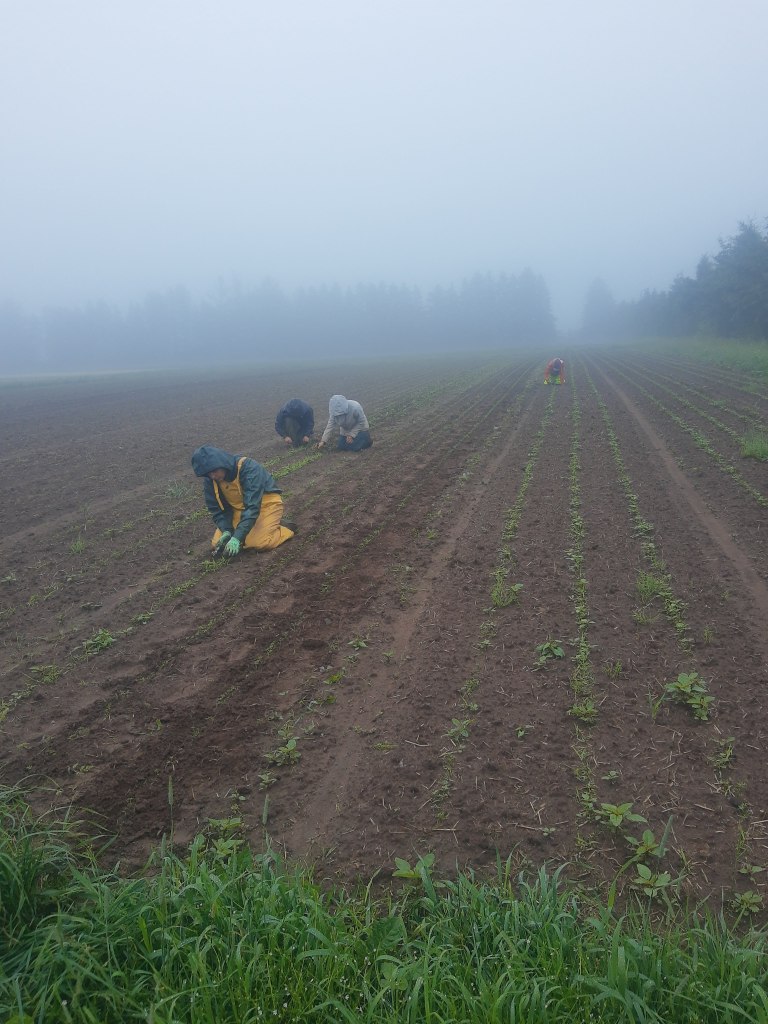
Pictured to the right: the crew weeding carrots in a wet fog on the 4th of July.

We’ve had some more storms and wet weather this past week, but fortunately nothing severe, and the moisture levels aren’t excessive. A word of advice to home gardeners: stay out of your gardens as much as possible in wet weather. Stepping in wet mud will cause compaction and be detrimental to your soil’s health. Plant diseases spread more readily in wet weather and your hands and tools could make that worse. On the Farm, have to keep working, even when it’s rainy, but we’re very selective about the tasks we do and how we harvest. Keep dry!


In your share this week:

Broccoli – Cauliflower – Lettuce – Green Onions – Carrots with Tops – Kale – Garlic Scapes – Cucumber


Forager’s Soup

Serves 6-8

Ingredients

4 tablespoons butter (use olive oil for a vegan alternative)

1 cup diced onion

1 medium potato, peeled and diced

salt and freshly ground black pepper

2 cups chicken or vegetable stock or hot water

1 1/2 cups whole milk (optional)

1/4 cup heavy cream (optional)

~4 cups (8 oz) mixed chopped spring greens, include scapes, kale, green onions, carrot tops, and/or broccoli (use whatever is on hand!)

3 tablespoons olive oil (to cook meat)

3 oz chorizo or bacon, finely diced (optional)

Preparation

  1. Melt butter in a large pot over medium-high heat. Once the butter foams add onion and potato and stir to coat butter. Add salt and pepper. Turn down heat and sweat the onions and potato on with a tight fitting lid for 10 minutes. Vegetables should not brown.
  2. Heat the stock (or water) in a saucepan until simmering. Add hot liquid to potatoes and onions and simmer 5-10 minutes more until vegetables are completely cooked. Add greens and simmer uncovered for 2-3 minutes more. (Don’t over cook the greens!)
  3. Blend with a blender or hand blender. Puree until smooth. Salt and pepper to taste. Stir or blend in milk and cream.
  4. If adding meat, heat olive oil in a small skillet. Add chorizo or bacon and cook until fat is rendered and meat is crisp, 5-10 minutes. Remove and drain on paper towels. Reserve the oil for a garnish or other cooking projects.
  5. Serve soup hot with the above meat and a few drops of the cooking oil to garnish.

This soup can be made a day in advance and kept in the refrigerator! Just gently reheat on the stove top, uncovered. To make this recipe vegetarian, use vegetable broth and skip step 4. To make vegan, also exclude the milk and cream, or substitute with vegan milk option.

*The above recipe is adapted from “Forgotten Skills of Cooking” by Darina Allen and has revisions from volunteer Deb Rausch to better suit our boxes this week. *(Source of recipe previously listed incorrectly.)
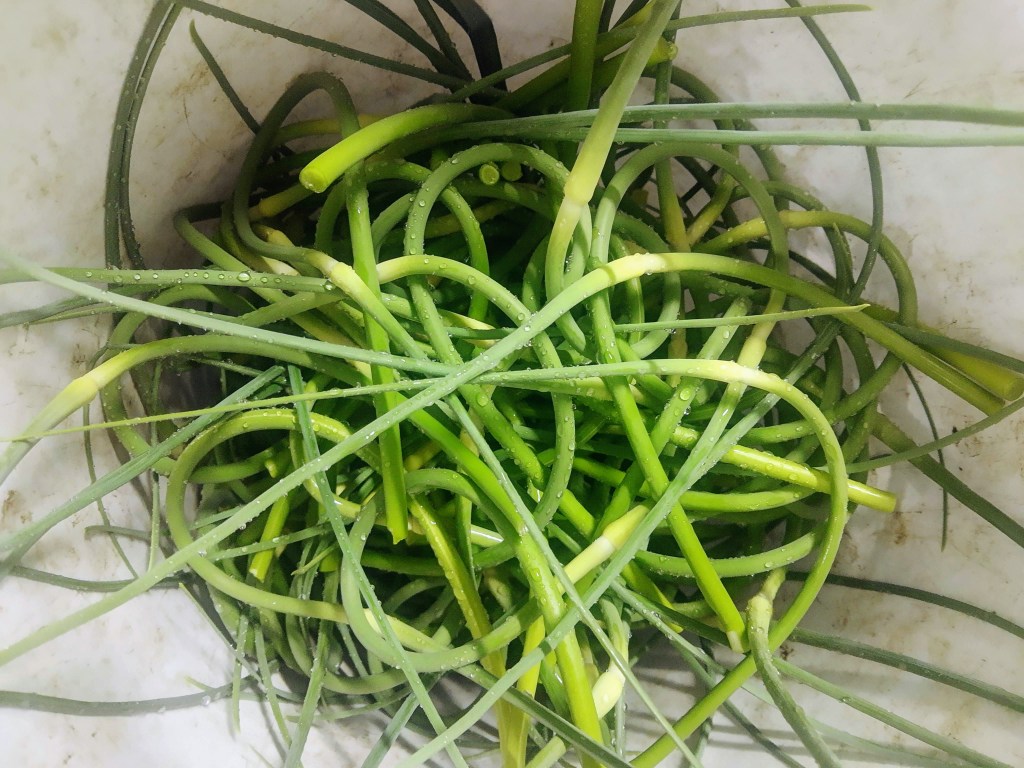
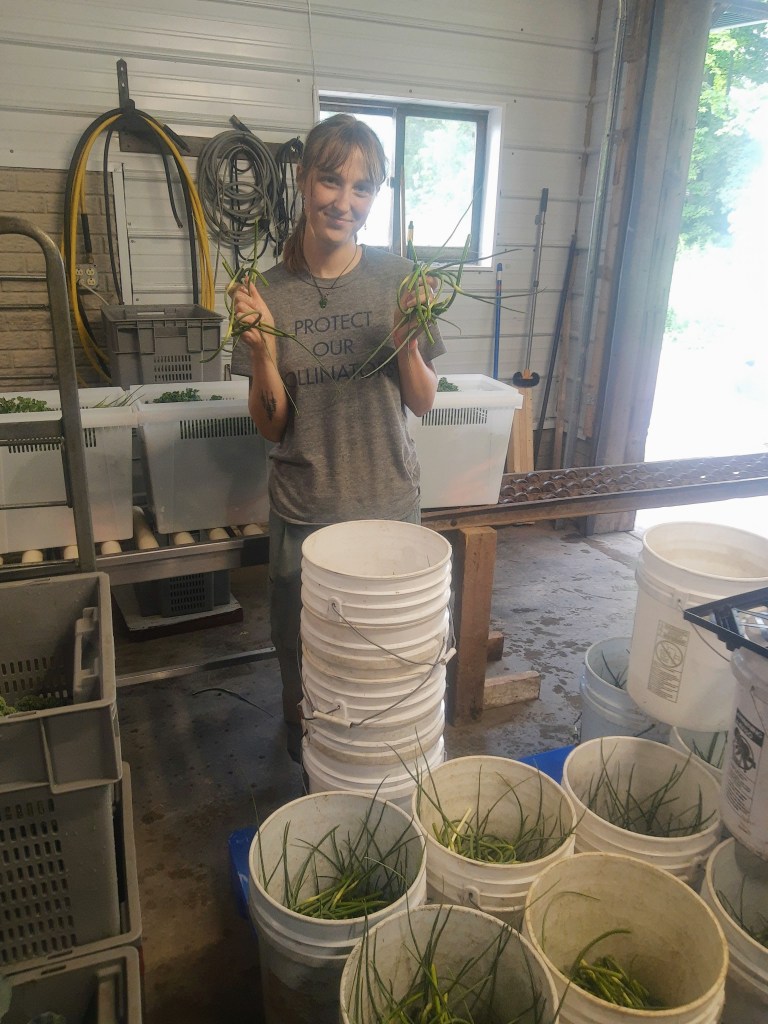
garlic scapes ready to go into share boxes

What are garlic scapes?

Scapes are the curly stems produced by hardneck varieties of garlic. We prune off these scapes so the garlic plant puts more energy into producing the garlic heads we all enjoy. If left on the plant these scapes would produce bulbils, which are like seeds that produce a clone of the parent plant.

Lucky for us, scapes are super tasty and get us through the early summer before the garlic crop is ready! Scapes are have a hot garlic flavor when eaten fresh and are a great garlic replacement in pesto. When cooked, the flavor mellows out. Try grilling garlic scapes or adding them to soups.


Still looking for recipes?

Use the Tag Cloud below to find archived recipes from past years. Just click an ingredient below and you’ll be taken to a list of all posted newsletters with a recipe that includes that vegetable. The larger the text below, the more posts there are including that vegetable.

Arugula Basil Beet Bell Pepper Broccoli Brussels Sprout Brussels Sprouts Cabbage Carrot Cauliflower Celery Cilantro Cucumber Delicata Squash Dill Dressing/Sauce Egg Garlic Garlic Scape Green Bean Green Onion Jalapeno Kale Leek Lettuce Mint Napa Cabbage Onion Parsley Parsnip Pepper Potato Radish Red Onion Rutabaga Scallion Shallot Spinach Squash Thyme Tomato Turnip Winter Squash Yellow Onion Zucchini

The farm crew admiring dramatic cloud formations on 7/11 just before being pelted with rain.

For the farm crew,

Starr

Summer CSA Week 2

I don’t think of myself as a superstitious person typically, but in the past couple weeks I have: left car windows open, left laundry on the line over night, left an open bag of potting soil on my deck (for days), not washed the car, left the garbage lid open, and left the deck chairs out instead of tipped up. This list isn’t just to show how lazy I am, it’s to show that I am TRYING to send a message (to whom it may concern) that we need rain! If I leave these things this way maybe they can be a sacrifice of sorts for rain. None of the passing showers that went through the area have hit the farm and we’ve had less than 1/4″ of rain in the last three scorching weeks, so I invite you all to participate in my efforts such as they are. Maybe the message will get through (and we’ll all have to take in that sopping laundry with joy).

These hot windy days are not only very drying, but also prevent us from irrigating during the day, so Janaki has been moving the irrigation around a lot at night (you know, in his spare time) to make sure all the plants get what they need, especially when so many are tiny seedlings without deep roots yet.

What can we say but say the so-annoying phrase “new normal”? Late spring used to bring rain fairly consistently, and in a soaking, spread out kind of way. And they sometimes still do. Sometimes there are still 45 and foggy days in the end of May- we had a few of those this year. Predictability and farming have never danced well together, but this new climate has scratched up the record we were trying to dance to. In the back of my head now I have a fear about dry-dry-dry and then a deluge of 5 inches of rain over night. It seems to be what happens.

On a sort of lame flip side – I think we’re staying on top of the weeds pretty well so far. Turns out they need water too (though somehow less…. how is that fair?) This past week saw the second and largest planting of potatoes in the ground, as well as the 5th and BY FAR largest planting of cabbage and some broccoli. Good luck out there little babies. We’re on your side!

We are happy to send a box that’s a little fluffier and fuller this week. It would have been a hot week to try to save the rhubarb and early spinach through -hopefully you found that harvest to be worth it! Each week -bit by bit there will be more variety in the boxes headed your way. As you get home with your share, especially on these warm days, a quick soak in a sink full of cold water can help prolong the life of many greens like pac choi and lettuce. They get cooled after we harvest them, but may warm up again at your pick up site. Cut-greens like this week’s greens mix could be put in the fridge with the bag open, but make sure to close the bag up again before night so they don’t dry out. If you use radish and turnip greens, good for you! They could also benefit from a cold soak, though I would really try to dry them well and then use them sooner than later.

Like greens, humans keep better with a good dunking now and then. If not that, maybe you can at least make time to dump some water on your head, or run your wrists under some cool water (trust me, it helps). And, if you do those things, maybe stand by a plant to share some of that water!

Enjoy the veggies!

For the farm crew,

Karin

Flying row cover!

Floating row cover!


In your share this week:
Greens Mix – Romaine Lettuce – Pac Choi – Radishes – Spinach – Turnips


Turnip and Kale Gratin
-From Bon Appetit

In the body of text about this recipe, it says that turnip greens can be used in place of the kale! Voila!

5 garlic cloves, thinly sliced
2 cups heavy cream
½ teaspoon dried thyme
2 tablespoons unsalted butter, divided
3 medium onions, thinly sliced
Kosher salt
3 bunches Tuscan kale, ribs and stems removed, leaves torn
4 medium turnips (about 1¾ pounds total), trimmed, peeled, cut into ½-inch pieces
3 large eggs, beaten to blend
4 ounces Fontina cheese, grated (about 1 cup)
1 ounce Parmesan, finely grated (about 1 cup)
8 ounces day-old white country-style bread, cut into ½-inch pieces
Freshly ground black pepper

Preparation

Step 1

Bring garlic, cream, and thyme to a bare simmer over medium heat. Reduce heat to low and let cream simmer 30 minutes. Let cool.

Step 2

Meanwhile, heat 1 Tbsp. butter in a large skillet over medium-low. Add onions, season with salt, and cook, stirring occasionally and adding a splash or two of water if onions begin to stick to pan, until caramelized and amber colored, 45–60 minutes. Transfer to a large bowl and let cool. Wipe out skillet.

Step 3

Heat remaining 1 Tbsp. butter in same skillet. Working in batches, add kale, tossing and letting it wilt slightly before adding more; season with salt. Cook until kale is wilted and tender, 5–8 minutes; transfer to bowl with onions.

Step 4

While kale is cooking, cook turnips in a large pot of boiling well-salted water until crisp-tender, about 2 minutes; drain. Transfer to a bowl of ice water and let cool. Drain; pat dry. Transfer to bowl with onions.

Step 5

Preheat oven to 375°. Whisk eggs, Fontina cheese, Parmesan, and cooled cream mixture in a large bowl to combine. Add onion mixture and bread; season with salt and pepper. Transfer to a 13×9″ baking dish and press down on mixture with your hands to form a tight, even layer. Bake gratin, uncovered, until well browned, 40–50 minutes. Let rest 10 minutes before serving.

Gratin can be assembled 12 hours ahead. Cover and chill.


Pac Choi and Shiitake Stir-fry
From The Spruce Eats

3 to 4 cloves garlic (minced)
1 cup shiitake mushrooms (sliced OR 1/2 cup sliced shiitake mushrooms and 1/2 cup sliced button mushrooms)
2 teaspoons canola oil or other high-heat oil
1 tablespoon soy sauce (or, use tamari)
1 pac choi
5 to 6 green onions (sliced)
1/4 cup vegetable broth
2 teaspoons fresh ginger (minced or grated)
2 teaspoons sesame oil
2 tablespoons sesame seeds (optional)

Saute the garlic and mushrooms in oil for 3 to 5 minutes then add in the soy sauce, the bok choy and scallions, and cook for a few more minutes. Reduce heat to medium-low and add vegetable broth and ginger. Simmer for another 3 to 5 minutes. Finally, stir in the sesame oil and the optional sesame seeds and remove from heat.

Eat as is or enjoy over rice or another grain!

November Winter Share

farm to table (1)


Welcome to the first Winter Share of the season! The warm and colorful part of the autumn is very much past, the evenings are dark and it is time to start getting in the wintery culinary mood!

I love this time of year, and I know I’ve said so every winter newsletter for a couple of years now. It’s still true. I love the subdued colors of everything, and cold wind on my face and snow falling in the sunshine. I love planning exactly what I should wear outside, and thinking about how I’m so great at planning outfits for winter activities… until I start shedding extra layers along a trail to retrieve on my way back.

I love eating as many potatoes as I want (job perk!). I love getting into a different “breakfast rut” each winter. Two years ago it was hash browns. Last year it was carrots, parsnips (stay tuned for them in later shares!) and potatoes all cooked in a pan with yogurt or ketchup on top.

This year my favorite part of the season will be coming up in just a couple of months: my infant son’s first bites of food. I am so excited for him to eat with me out of the root cellar at the farm. I haven’t decided which of the veggies will be his first. Probably carrots or squash. Or parsnips. Or potatoes. Or rutabaga. I feel so lucky to start him off with such wholesome, good quality food. What a blessing.

Thinking about my boy, and what and how I want him to eat as he grows has been fun, and also challenging for me. It has required me to look at how I eat and my imperfect relationship to food. I want him to have good food, the best food. Healthy and as much organic as possible. But that’s not really all of it. Not at all. I also want food to be something that he sees is worth spending time planning, preparing, and sitting down for.  I want to show him that there is value in investing time and money in food. I don’t want to treat the preparation of food like an inconvenience that just needs to be got over as quickly as possible. And by the time he’s taking his first bites I want to do less eating above the kitchen sink, and more sitting down. Even if it’s just for a fried egg sandwich in the morning.

I say that now. But I recognize that our meals won’t always be balanced, or include a complete protein, or be organic or mostly local. Maybe sometimes they’ll be mostly take-out pizza. And, I want him to see that too, and not see it as a thing of shame. There should be so much LESS shame and embarrassment around familial and personal food choices. Because it isn’t easy to always make the ideal choices we’d like to imagine ourselves making.

At the end of it all, I want him to learn joy- the joy of food in our lives. Food is work, fun, tasty, beautiful, communal, and sustaining.

So thank you for taking on a counter-cultural approach to food with us this winter season. Thanks for being willing to slow things down a bit and put your money down on something of quality.

Whether this is your first or tenth Winter Share with us, welcome or welcome back! I hope this season of local produce finds you well, and keeps you trying new ways of cooking with old staples.

With joy,

Karin


Potatoes with Shaved Celery Salad

(I think in newsletters of yore, I have mentioned that I don’t tend to be much of a recipe follower. Perhaps some of you are though, and perhaps you also got celeriac instead of celery. Ah! If I were you, I’d still give this recipe a whirl, but I would roast scrubbed and halved celeriac until tender (an hour or so) and chop it after that to toss with the salad. But I am not you, so perhaps you’d like to simply roast it with oil and salt and enjoy as is!)

  • 2 1/2 pounds red potatoes, cubed
  • 2 cups cider vinegar
  • 1 cup low-fat buttermilk
  • 1/2 cup finely chopped green onions
  • 1/2 cup light sour cream
  • 1/4 cup finely chopped fresh dill
  • 1/4 cup canola mayonnaise
  • 1 1/2 tablespoons grated red onion
  • 1 tablespoon grated lemon rind
  • 1 tablespoon Dijon mustard
  • 1/2 teaspoon kosher salt
  • 2 cups thinly diagonally sliced celery
  • 3/4 teaspoon freshly ground black pepper

Bring 12 cups water and potatoes to a boil in a large saucepan. Reduce heat; simmer 20 minutes. Add vinegar; simmer 10 to 15 minutes. Drain. Spread in a single layer on a baking sheet; cool.

Combine buttermilk and next 8 ingredients (through salt) in a large bowl. Stir in potatoes. Stir in celery and pepper. Chill at least 1 hour.


Curried Carrot and Coconut Soup

  • 3 tablespoons butter
  • 1 medium onion, roughly chopped
  • ¾ pound carrots, peeled and cut into 1/2-inch coins
  • 1 teaspoon peeled, grated fresh ginger
  • ½ teaspoon ground cumin, to taste
  • ½ teaspoon ground turmeric, to taste
  • ½ teaspoon ground coriander, to taste
  •  Pinch of cayenne pepper
  • 2 cups chicken or vegetable stock
  • 1 cup unsweetened coconut milk
  •  Juice from ½ lime
  •  Salt and freshly ground pepper
  •  Cilantro, if you have it
  1. Heat the butter until the foam subsides. Add the diced chopped onions, sprinkle with salt, stir to coat with butter. Add the chopped carrots along with the spices. Stir and cook until softened, about 10 minutes.
  2. Add the stock; there should be enough to cover the vegetables. Bring the pot to a boil over high heat. Reduce the heat to medium and continue cooking until the carrots are cooked through, about 10 to 15 minutes.
  3. If you have an immersion blender, purée the soup in the pot. If not, wait until the soup cools slightly, and purée in a food processor. Add enough coconut milk (and a little more stock or water if necessary) to bring the soup to the consistency you want. Adjust the seasoning (depending on the stock you use, you may need more or less salt), and lime juice to taste. Garnish and serve.